Most family tree projects fail because they begin in the past instead of in the present. The easiest way to learn how to build a family tree is to begin with the people you can still ask: your parents, your grandparents, and the older relatives who surround them. This guide uses a conversation-first method. It turns a family tree from a giant research chore into a living story you co-author with the people who matter.
The quiet power of a three-generation core
A family tree can feel complicated when it is drawn as a cascade of ancestors. In practice, strong genealogy starts with a three-generation core: you, your parents, and your four grandparents. These nine people form a durable skeleton. Their names, dates, and relationships can be confirmed by living memory and, when needed, by legal documents. They also create anchor points for every extended branch that follows.
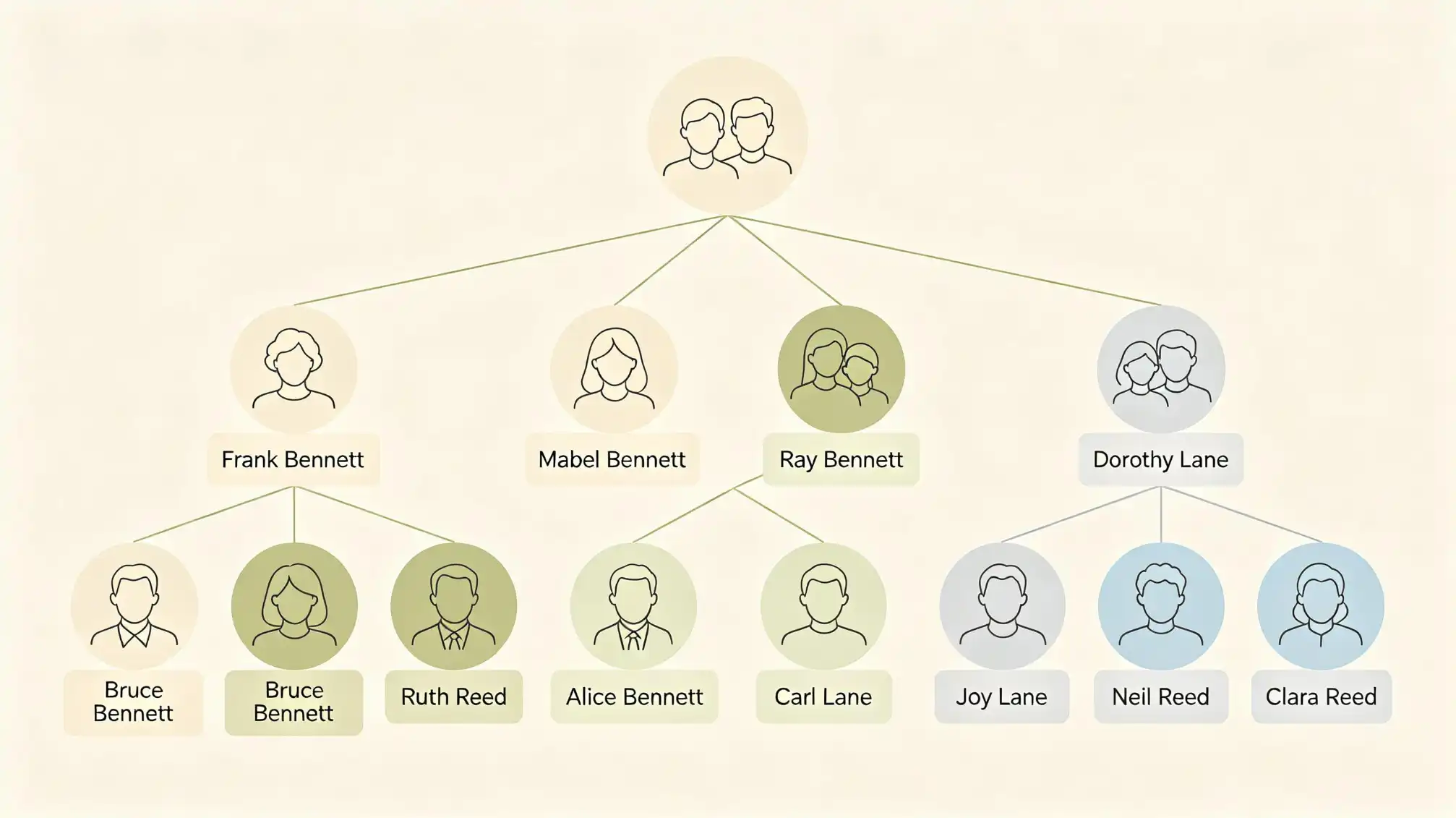
As you collect this core, your picture will naturally expand. You will notice that your parents remember their parents, but you may not know where one grandparent worked or when another grandparent's family moved to the city. Those gaps are not failures. They are clues. List them as interview questions instead of guessing at answers.
Begin with an interview, not a blank chart
The purest family research is still a conversation across the table. Prepare a short list of questions and let one answer trigger another. If you interview your grandparents, ask about school, daily chores, and the names of neighbors. These personal details will make later record searching easier because you will already know which regions and surnames are important.
- Ask for each person's full name at birth, including nicknames.
- Ask for each grandparent's birthplace, approximate birth year, and childhood street or town.
- Ask about siblings, including those who died young, because they often disappear from oral records.
- Ask about courtships, weddings, and moves rather than only birthdays. These events are what local records index.
Record the interview if the relative agrees. Even a short voice memo lets you listen more carefully later. When details differ from one family member's memory to another, do not argue. Note both versions and treat them as branches to verify. That healthy questioning is the difference between folklore and a reliable tree.
Turn memory into a visual map of relatives
Once you have a few family stories, draw a rough tree. Put yourself at the bottom or in the center, your parents above you, and your grandparents above them. Use one color for your father's side and one for your mother's side. This simple drawing exposes repeated names, missing dates, and relationship gaps instantly.
If you prefer digital tools, create a private online space for your relatives. The Family Love family page is a good home for this stage because it lets you add photos and invite relatives to help correct names. Keeping everyone in the same place also prevents conflicting versions of the same story.
Choose one format before you go far up the tree
People who enjoy building a family tree usually have a format they love: a large wall chart, a binder of family group sheets, or a genealogy app. Each has advantages, but you do not need to own all three. Choose a simple structure and stay consistent. For most beginners, a binder or folder divided by grandparent line is enough. When you later want to search records, you can transfer the information into a more structured system.
Look at the process as organizing relationships, not accumulating documents. A relative who remembers Aunt Clara's second husband can be more useful than an unsourced online tree. Start your chart with what living relatives know, and treat every new date as a gift to confirm.
Expand one grandparent line at a time
After the first map is complete, avoid the common mistake of chasing four different surnames at once. Expand one family line carefully before moving to the next. Choose your father's mother's line or your mother's father's line; order does not matter as long as you stay steady.
For each ancestor pair, write down the same six facts: full name; date of birth; place of birth; marriage date and place; death date and place; and the names of children in order. If a date is unknown, leave a blank. A blank date is better than an invented one because it guides your next search. This rhythm makes even a large extended family tree feel possible.
Treat extended relatives as living archivists
Some of the best family historians are not professional genealogists; they are older cousins, in-laws, and neighbors who watched families grow. Ask relatives who they remember visiting when they were children. Their memories often reveal people who were never legally related but were treated as family. A modern family tree should include adoptions, remarriages, and chosen family with the same respect it gives blood relationships.
Keep an open ear for the quiet members of the family. The quiet aunt who stayed home to care for her parents may not seem important to the official record, but she can unlock more names and dates than a distant ancestor's portrait. Listen for the words they repeat. Those names often lead to relatives who were not on your original chart.
Verify each branch with a paper trail
Oral history carries shape and emotion; documents carry precision. Once you have drafted a three-generation map, ask relatives for old certificates, passports, letters, and photo backs. Try to locate a parent's birth record, a grandparent's marriage or death record, and any naturalization or census documents your family may have. Use each one to confirm names, dates, and places.
Write the source next to a fact whenever possible. You do not need a formal citation system; a few words such as marriage certificate, county clerk, 1952 make your tree credible and help you avoid repeating mistaken online lineages. When memory conflicts with a document, ask the relative for context before deleting the story.
Keep the finished tree alive
Family history is not a school project that ends. Births, marriages, and losses change the trunk, so schedule a short update twice a year. Use holidays or reunions to compare memories. If you have children, ask them what they remember about grandparents; the simplest observation can become a family treasure. The tree you create should not live only in a drawer. It should help relatives understand where they belong and keep their stories moving forward.