Every family history has a quiet beginning. Maybe you noticed an old surname on a wedding invitation, or your grandmother mentioned a seaside town you can’t find on a map. You don’t need a complete collection of ancestors before you can call yourself a family historian. You need one name, one question, and a simple way to capture what you learn. A family tree is not a final exam; it is an evolving map of the people who made you possible.
Begin with the names you already carry
The most overlooked research material is inside your own head. Sit down with a blank sheet of paper and list your immediate circle: yourself, your parents, grandparents, aunts, uncles, and siblings. Some dates will come easily; others will feel fuzzy. That is normal. The goal is not perfect data; it is a foundation that tells you where to look next.
Write each name and then add every small detail you already know: a birthplace, a nickname, a profession, or the name of a street. These fragments become the questions you will ask later. This is how to build a family tree that feels alive—not as a static column of dates, but as a connected web of relationships waiting to be explored.
Conduct conversations that capture more than dates
Your relatives are walking archives. Before you search a single online database, talk to the people who remember. Schedule a call or a visit, and ask permission to record the conversation. A twenty-minute talk can reveal a birthplace, a migration story, or a family phrase that unlocks a completely new line of research.
Ask about childhood homes, how two people met, and what holiday dinners felt like. Record the details as well as the dates: the color of a kitchen, the nickname a grandfather hated, the song played at a wedding. These small textures turn a chart into family history.
As you collect these stories, you will notice that relatives often hold different pieces of the same puzzle. A cousin in another city may have inherited a box of photographs; an older aunt may remember who appears in each picture. This is a natural moment to create a shared space on a family page at Family Love, where relatives can add memories, correct dates, and identify faces while the research is still fresh.
Sketch a simple diagram before you go digital
Software can be helpful, but it can also distract with automatic hints and fancy charts. Begin with a hand-drawn or very simple diagram. Arrange yourself at the bottom or top, place parents above or beside you, then add grandparents one level higher. Many modern family tree diagrams use clean lines to show marriage and blood relationships, which is all you need at this stage.
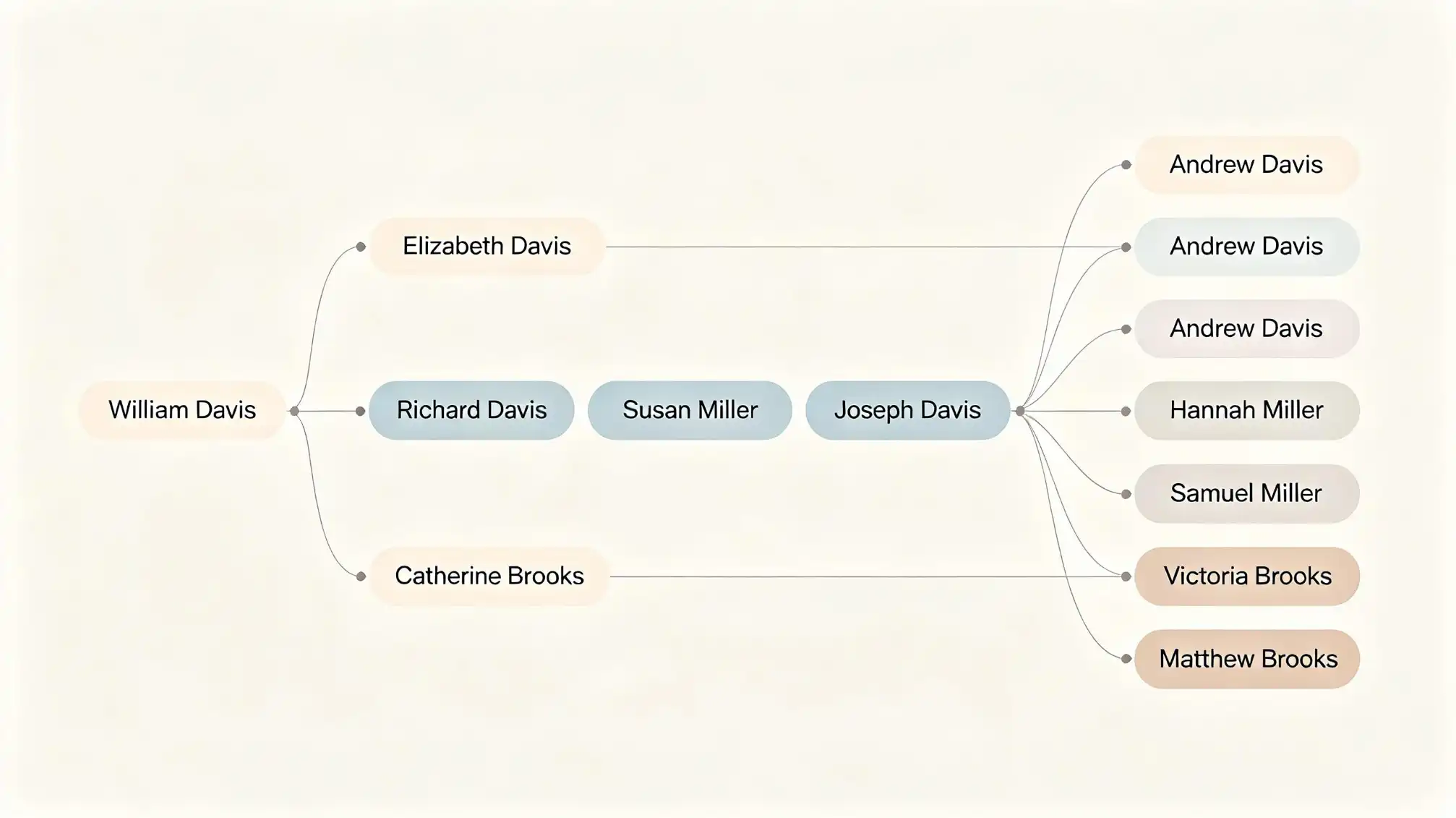
If the diagram becomes cluttered, give each branch a color: one for your mother’s side and another for your father’s. Label each line with a place or a year. This simple structure will immediately show which grandparents you know well and which branch needs your attention next.
Use records to fill the gaps, not to overwhelm yourself
Civil records give your family history bones: birth certificates, marriage licenses, census returns, military papers, immigration records, and property deeds. The task feels huge if you view it as one massive project. Instead, choose one person. Start with a grandparent who appears in the most documents, and try to find three records about that person.
When you locate a useful record, save a copy, note where you found it, and attach a date or place. Ask your local library about free access to genealogy databases, and visit a historical society for records that are not online. You don’t need a paid subscription on the first day. Focus on one document at a time and the family tree will grow branch by branch.
Turn every discovery into a conversation with living relatives
Research produces surprises: a changed surname, a double wedding, a family that crossed an ocean. These discoveries need to be checked against memory. Share a census image with an older relative and ask whether the address sounds familiar. What looks like a mistake may actually be a family pattern—two cousins named Mary, for example—that changes how you interpret later records.
At this stage, family history often disappears inside private notebooks. If you keep it locked away, you miss the contributions only living relatives can provide. Post a scan of a photograph, ask a question about handwriting on the back, and invite family members to contribute. The best way to build a family tree is as a shared project, not a solo mission.
Set a pace that keeps curiosity alive
Most beginners lose momentum after two weekends of blank pages and frustrating searches. They assume genealogy requires endless energy. In truth, small habits outperform intense bursts. Plan each research session around a single question, such as “When did my grandparents meet?” or “What towns did my great-grandparents live in?” Limit your session to about an hour, and end by writing the next question you want to answer.
Keep one master file, physical or digital, for every result and note. Label each file with surname, place, and year—for example, Keller, Zurich, 1905. If you use a notebook, reserve the first page as an index. If you use a digital folder, give it a clear name such as family-history-2025. The secret of a successful family history is not speed. It is showing up again and again with curiosity and letting the tree reveal its shape over time.