How to Trace Your Ancestors Even When Family Records Run Thin
Most family history projects begin the same way: a grandmother recalls a name, an old envelope hints at a town, and a faded photograph sets you wondering about the faces behind your own. Tracing your ancestors is less like solving a mystery and more like building a bridge from remembered fragments to documented facts. With the right order of work, you can extend your family tree even when you have only a few solid clues.
Start Under Your Own Roof
The best place to start is not a distant archive but the pile of papers, albums, and keepsakes already in your home. Look for birth and marriage certificates, passports, naturalization papers, funeral cards, and family Bibles with dates written inside. Open drawers and envelopes you have ignored for years. These physical objects carry exact dates, original spellings, and places that memories often blur.
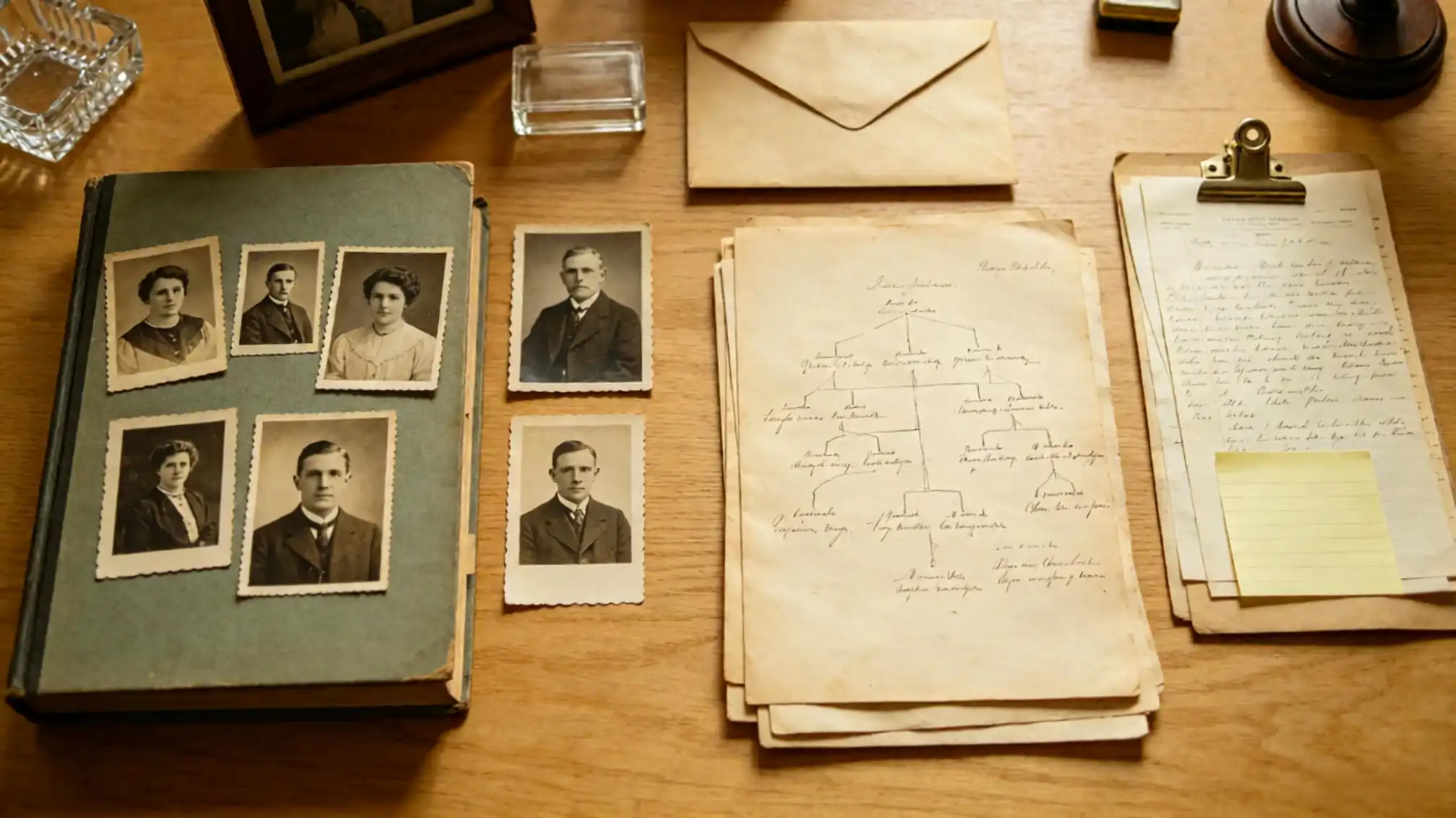
Do not skip the obvious boxes. A stack of old photos may be undated, but the studio address stamped on the back can narrow a city and a decade. Even an unmailed letter inside a book can give you a full name and a street address. Make a list of every document you find, noting who gave it to you, because the chain of custody matters later.
Interview the Eldest Generation Before the Details Vanish
Your older relatives are walking archives, and their memory is the most time-sensitive resource you have. Schedule interviews with the oldest members of your family first. Ask open questions about their own parents and grandparents: what did your mother call her father? Did anyone emigrate? Was there a sibling who died young? Push for stories about daily life, religion, and work, but also collect precise facts like wedding dates and hometowns.
Record the sessions with permission, then immediately transcribe them into a notes file. Keep names verbatim, including nicknames. If the same relative mentions a surname you have never heard, write it down exactly. Often the key to the next generation is a woman’s maiden name, which can appear unexpectedly in a story about a wedding or a quarrel.
Once you have a collection of family accounts, consider storing them in a shared medium so distant cousins can fill their own gaps. Reading how other families preserve spoken memories may give you practical ideas for your own project; a visit to family stories can show how ordinary people turn interviews into written records worth sharing.
Build a Basic Family Tree Skeleton
Before you search any record database, assemble the names you already have into a three-generation tree. Start with yourself, your parents, and your grandparents. Add dates and places in a consistent format, and mark every fact with a question mark until you have seen a source. Use a large sheet of paper, a spreadsheet, or free genealogy software. The purpose of this skeleton is to reveal the missing pieces you will search for.
Work one person at a time. Choose a family member you know well, usually a grandparent, and list all known facts about that person: birth date, birthplace, marriage date, spouse, children, and residence. Then look at what is missing. That lack becomes your first research question. Do not try to trace every surname at once or you will drown in results.
Move Into Public Records With Clear Targets
Once your skeleton is set, you can search official records with precision. Civil registration, census returns, church registers, tax lists, and probate records are the backbone of genealogy. For every record type, you need to know where your ancestor lived and roughly when, which is why your skeleton and interview notes matter so much.
Begin with vital records. Search for a birth, marriage, or death certificate for your grandparent through the appropriate state, county, or national archive. In many places, indexes are online, but the image of the original certificate is far more trustworthy than a typed index, because the index may contain transcription errors. When you find a record, photograph it and note the full citation, including the archive name and certificate number.
Next, place your ancestor in census or household registers. A census can give you everyone living under one roof, plus ages, birthplaces, and sometimes immigration years. Even if you already know the names, census records can reveal a widowed mother-in-law living in the household or a neighbor who later marries into the family. Each new census decade becomes a stepping stone backward through time.
Use Archives, Not Just Search Engines
Genealogy databases are tools, not the final answer. A comprehensive collection of indexed records is powerful, but many documents are not indexed line by line. For that reason, you must learn the archives that serve the places where your ancestors lived. State libraries, county courthouses, diocese offices, and national archives each hold materials no private website has ever digitized.
Know the top of your research. If a census shows your great-grandfather as a farmer in a certain township, the county agricultural census, tax rolls, and deeds can trace his property moves. Land records often list where a person lived before the purchase date, which breaks through brick walls when no birth record exists.
When you write to an archive, be specific. Request one exact record by reference number, give the full name and dates, and ask what the cost would be for a photocopy or scan. Keep a log of every archive you contact and the answer you receive. That log will save you from repeating requests months later.
Cross Boundaries and Misspellings
Surnames shift with every generation, and sometimes with every alphabet. An immigrant family from Eastern Europe may have changed their surname at the port, or your great-aunt may have altered the spelling to sound more local. Search phonetic variants and use wildcards in online indexes. Try first name variations, nickname forms, and even reversed given names for older generations.
Do not ignore religious records if you know the family's faith. Baptisms, confirmations, marriages, and burial or cemetery lot books fill gaps where civil records never existed or were destroyed. A parish register can give you both parents' names in the baptismal entry, which immediately adds another generation to your tree.
Handle DNA With Caution and Common Sense
DNA testing is a brilliant supporting method, but it will not hand you a finished pedigree. Autosomal DNA matches can point you toward distant cousins who share a known ancestor, but every shared segment must be tied to a paper trail. Use DNA to confirm or challenge a relationship you have already built with records, not as a replacement for them.
Upload your raw DNA data to more than one service if you can, and check match triangulation features. When you message a match, introduce yourself by naming your most recent communal ancestor. Always compare both sides of your family tree to avoid mistaking a relative match through an unexpected line.
Stay Honest About Evidence
A family tree is only as strong as its weakest source. Mark every conclusion with one of three statuses: proven, probable, or unverified. If you cannot find a birth certificate but a census states the person was born in Maryland in 1885 and that matches all other facts, you may call it probable, but not proven. Do not let the excitement of a discovery force you into deciding the case before the evidence closes.
Write down where you found each fact, even if you think you will remember. A year later you will not. Use a simple source template: who created the record, what it is, where it is stored, and when you looked at it. This habit will also help a future relative who receives your family tree and wants to verify it before building onward.
Preserve What You Find
The finished work is not a printed tree; it is the entire collection of stories, citations, images, and notes that you have gathered. Make at least two digital backups and one physical copy. Label every scanned photograph with names, places, dates, and the name of the person who handed it to you. Unlabeled photos are worthless to the next generation.
Consider publishing the narrative pieces of your research so your family can appreciate the lives behind the chart. Short biographies of an ancestor, paired with images, turn raw names and dates into something your own children will want to read. The example of other families who share their stories online can be a powerful nudge in that direction.