Every family has more layers than any single photograph can show. Behind a wedding picture, there is the street they walked home on; behind a nickname, there is a childhood joke. Genealogy is a way of collecting those layers and arranging them with love. If you have never tried to build a family tree, you might think it is too late or too difficult. It is not. The only starting point is the person in front of you: yourself.
Genealogy Needs a Compass, Not a Map
Every genealogy journey seems to promise a trip through generations. Yet if you try to find all of your ancestors at once, you will quickly feel stuck. Choose one specific question to answer first. This is your compass.
- Where did my mother’s father’s family live around 1910?
- Why did that great-aunt never speak about her hometown?
- What does our surname mean, and how might that name have first appeared in this country?
Once you have a single question, make it measurable and gentle: I want to find one document that places my great-grandfather in a specific town on a specific date. This simple intention protects you from what researchers call rabbit-hole genealogy, where a beautiful old map or a distant cousin pulls you away from the story you really care about.
Turn Your Own Living Room Into a Research Center
Family history is not a treasure hunt backward into ancient time; it is a construction job beginning in the present. Write down your full name, date of birth, and place of birth. Then add your parents’ names and, if you know them, their birth dates and places. You have just completed your first generation.
Repeat the process for your grandparents. Do not worry about the empty spaces. Keep a separate column called to verify, because a blank space is not a failure. It is an invitation to search later with fresh eyes.
Make a Home Source Checklist
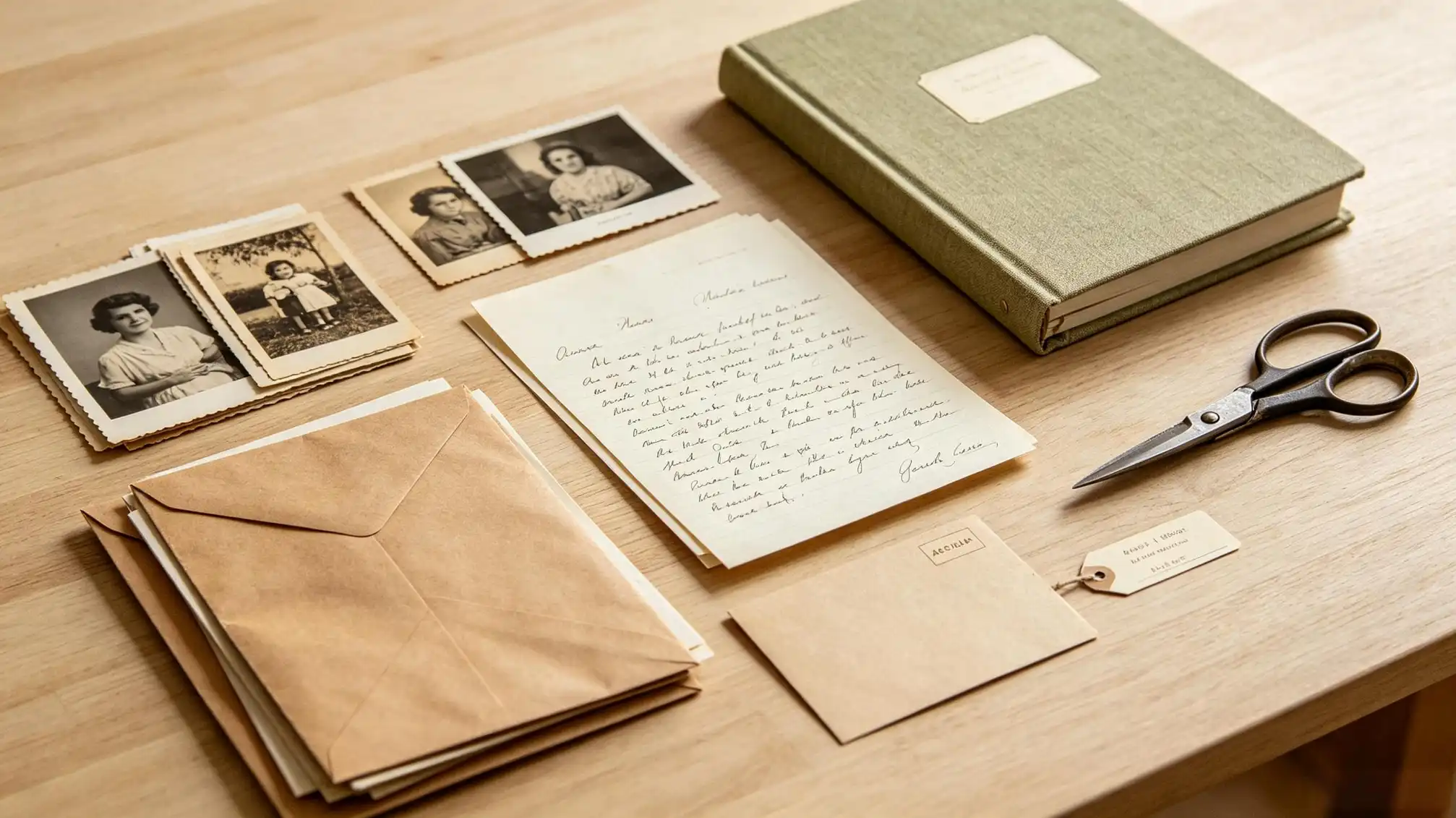
Before opening any subscription database, look inside your own home. Families often carry their archives in shoeboxes, drawers, and old photo albums. Tick off anything available to you:
- Birth and marriage certificates held by relatives
- Old notebooks, family Bibles, diaries, or address books
- Immigration, naturalization, or military service papers
- Photographs with names, dates, or studio stamps written on the back
- Letters and cards that include a sender address or a postmark
Now put everything in one folder, box, or camera roll. For each item, write one small note about who owned it and where it came from. This is your first real archive. Keeping this simple habit early will protect your work when your curiosity grows and the number of sources begins to expand.
Use Official Records as Anchors, Not Decoration
Home sources are a warm basement; official records are the sturdy library above it. Birth certificates, census records, marriage registers, passenger lists, and death records can confirm what family memory only hints at. As a beginner, you do not need to become an expert in every record type. You only need to know one important difference.
A primary source was created near the event by someone who was there. A secondary source was created later or by someone who heard the story second hand. Both can be useful, but you should trust primary evidence first. If your aunt remembers that the family came from Poland, look for a ship manifest or naturalization paper. That anchor record becomes the place where your family history stands on solid ground.
When you find a record that matches a name, never stop at the name alone. Look at the neighbours listed on the same census page, the handwriting of a clerk, the addresses that repeat across documents. These small context clues often reveal relationships that no search engine can explain.
Interview Early and Interview Gently
No database contains your grandmother’s laughter or the way her father cleared his throat before a story. The most valuable source in your genealogy is probably still alive and sitting across from you at the kitchen table. Sit with them, bring a phone or audio recorder, and prepare a handful of open questions.
Instead of asking What years were you in school?, ask What was your favourite meal as a child, and who cooked it? Ask for one memory of each of their parents, one smell from their childhood home, and one lesson they have carried their whole life. Write down the exact words they use, because dialect and rhythm are part of family history.
As you collect these details, keep in mind that genealogy produces not only a family tree but a family story. If you want to see how other people shape those memories into something you can share, spend a few moments with the stories captured by other families. Seeing how one photo or one phrase has opened a doorway for someone else can inspire your own questions.
Watch Out for Three Beginner Assumptions
You do not have to make every mistake in order to learn. These three quiet assumptions slow more new researchers than any difficult handwriting:
- Copying names without evidence. One copied surname can send you on a nine-month detour. A family tree needs footnotes, not just branches. Write where every piece of information came from.
- Researching too wide too quickly. The desire to populate every branch is understandable, but it creates shallow work. Choose onefamily line for your first season of research and allow yourself to go deep.
- Keeping everything only in your head. You may feel that you are not ready to organize yet. That is exactly when you should. Even if you have only ten records, capture them somewhere safe. A documented family history is a gift that wants to be shared.
Let Your Family History Grow Like a Real Relationship
New learners often believe they must reach the sixteenth century in order to take genealogy seriously. The truth is far more freeing: one well-documented great-grandparent is worth more than a hundred unverified names. You belong in this community whether you have traced back one generation or twelve.
Talk about your findings with relatives, ask local historical societies for guidance, and allow your tree to change when evidence arrives. Every ancestor you research was a real person who once stood on a real street, looked at the sky, and wondered about the future. Your careful attention is the only way they become visible in your family history.