"title": "Family History Questions That Catch the Stories Hidden Between the Facts",
"metaTitle": "Family History Questions to Ask Grandparents and Relatives | FamilyLove.love",
"metaDescription": "Prepare for your next family interview with these family history questions that uncover real memories, from childhood to careers to love.",
"summary": "A fresh set of family history questions that help you interview grandparents and relatives without turning your chat into a lifeless quiz.",
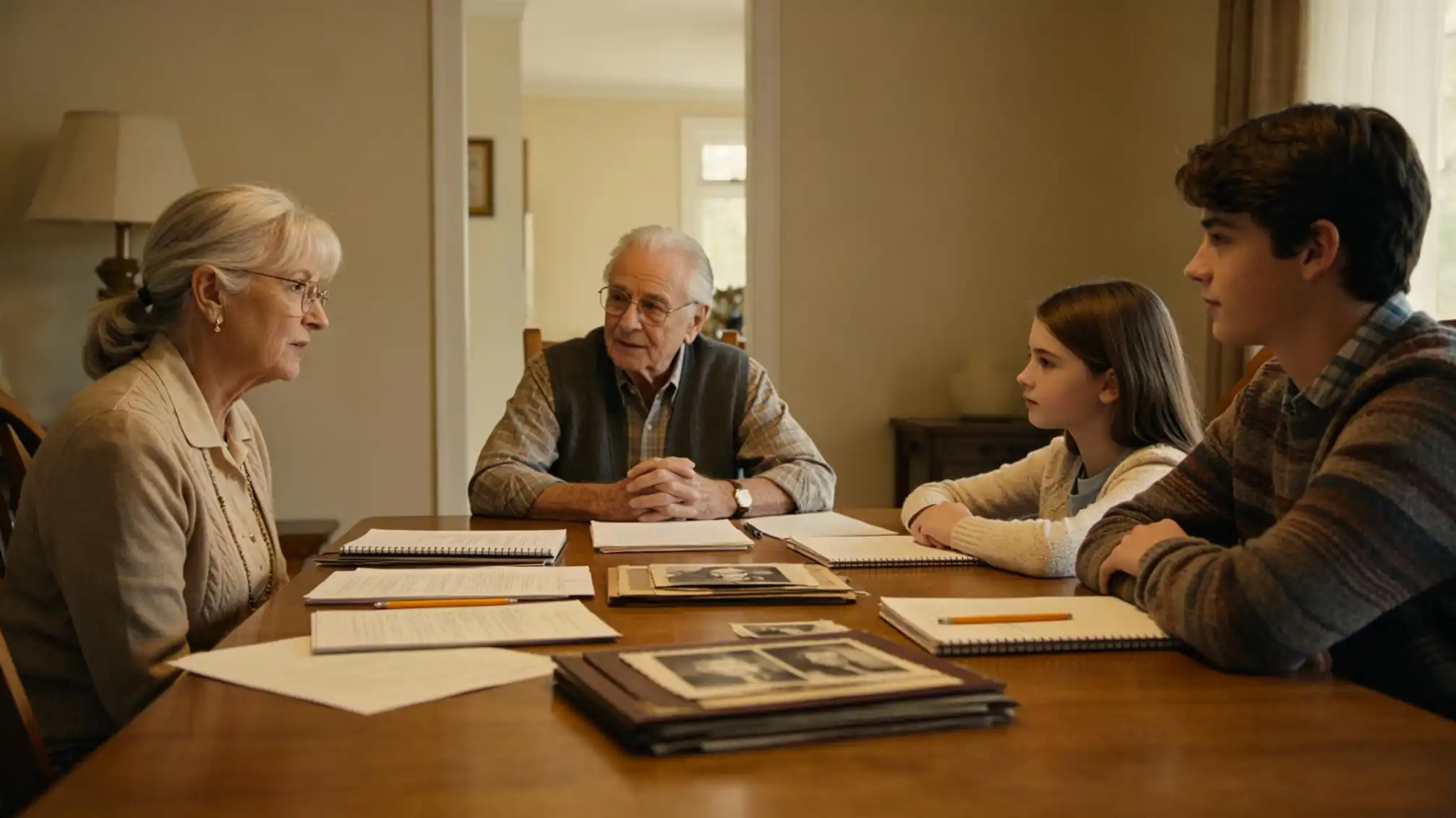
"contentHtml": "<p>Most of us can recite the dates: born in 1943, married in 1965, moved in 1972. But a date is not a story. The best family history questions do not look for answers in a birth record. They look for the moments that explain why a relative laughs at a certain joke or refuses to throw away a cracked plate.</p><p>When you interview a parent, grandparent, or older relative, you have a narrow window. There will be interruptions. There will be pauses. And if you use the wrong questions, there will be one-word answers. This is why preparation matters so much: a few well-chosen family history questions can turn a quiet afternoon into a recording that your children will treasure.</p><h2>Start With What They Can See, Smell, and Touch</h2><p>Forget the timeline for a few minutes. Before you ask any relative about the year they were born, ask them about the world they were born into. Sensory details are easier to recall and harder to summarize, so they naturally lead to longer answers.</p><figure><img src='https://r2.familylove.love/static/seo/interviewscene3.webp' alt='A son asking relatives thoughtful questions during a family history interview' /><figcaption>Sit where the conversation feels natural, and let the recording become an afterthought.</figcaption></figure><p>Try these opening questions with a parent or grandparent:</p><ul><li>What smell always pulls you back into your childhood kitchen?</li><li>What did your house sound like early on a school morning?</li><li>Which room did nobody want to enter, and why?</li><li>If the walls of your childhood home could talk, what secret would they tell?</li></ul><h2>Questions for Grandparents That Bring Childhood Back</h2><p>Grandparents are often the easiest relatives to interview, because they have had time to make peace with the past. But that does not mean every question will land. Stay away from vague prompts like 'Tell me about your childhood.' Too wide. Instead, give their memory a place to stand.</p><p>These family history questions work well because they bring the past into focus:</p><ul><li>Who decided how money was spent in your family, and how did that make you feel?</li><li>What did your parents agree on, even when they fought about everything else?</li><li>Which piece of clothing did you hate wearing, and who chose it?</li><li>When you were upset as a child, who were you most likely to run to?</li><li>What was the best time you ever had without spending any money?</li></ul><h2>Questions for Parents, Aunts, and Uncles About the In-Between Years</h2><p>The early years are polished with nostalgia. The middle years are less polished, so they are often closer to the truth. If you are interviewing a parent or an aunt, ask about the transitions that made them who they are.</p><ul><li>What was your first job, and what did it teach you about people?</li><li>How did you know your partner was the right person?</li><li>What was the hardest year of your life, and who helped you through it?</li><li>Which decision changed the path of the whole family without anyone realizing it at the time?</li></ul><h2>Use Follow-Up Questions to Go a Little Deeper</h2><p>When the answer stops at a sentence, do not jump to the next item. Repeat the last two or three words of the answer as a question. For example, if your grandmother says, 'We never talked about it,' pause and say, 'Never talked about it?' Silence will do the rest. Most relatives are generous with their memories; they just need permission to stay in a difficult place for a moment.</p><p>You can also ask, 'What happened immediately after?' This simple phrase is one of the strongest family history questions you can keep in your pocket. It takes a closed memory and opens another door.</p><h2>Slow Stories Become the Best Family History</h2><p>A meaningful interview rarely follows the order you planned. Let your relative lead the way, even if that means leaving your list behind. The questions you carry are only maps. The real treasure is told in a passing comment, a repeated phrase, or a story that starts with, 'You will not believe what your grandfather did one time...'</p><p>Once you have these conversations, keep them somewhere safe. If you are looking for examples of how other families shaped their memories into written stories, look through the family stories shared at <a href='https://www.familylove.love/stories'>FamilyLove Stories</a>. They will remind you that an ordinary memory can become an extraordinary record.</p><h1>Practical Steps</h1><ul><li>Take a look at examples of real relatives telling their own stories at <a href='https://www.familylove.love/stories'>FamilyLove Stories</a> so you can see what is possible.</li><li>Need a simple system for recording, saving, and sharing the moment? Use this practical guide: <a href='https://www.familylove.love/docs'>FamilyLove Help and Guidance</a>.</li></ul>",
"images": [
"https://r2.familylove.love/static/seo/interviewscene3.webp"
]
}