Most family historians begin with a shoebox of photographs, a few census printouts, and an ancestor chart covered in notes. That approach works until you find the same relative in three different places or realize you have lost the source for an important marriage date. An online family tree changes the experience by turning scattered research into a structured, searchable, and shareable digital record. For anyone comparing digital family tree tools, the real value is not simply going paperless; it is making family history more reliable, collaborative, and sustainable.
A single source of truth for family data
Paper pedigree charts are often accurate only for the person who last touched them. When you work in an online family tree, every individual enters a shared database. Dates, places, and relationships are stored once and then appear in any chart, timeline, or report you generate. If you discover that your grandfather’s birth year was 1912 rather than 1911, you change it in one place, and every branch diagram reflects the correction. That single source of truth prevents the small inconsistencies that end up being passed down as folklore.
Visualize relationships without the wall of paper
Draw a handful of generations on paper and you soon run out of space. Draw a blended family with second marriages, adopted children, and step-siblings and you run out of patience. An online family tree uses flexible relationship models that handle those situations cleanly. The software decides how to arrange boxes, so you no longer need to angle branches around the edge of a table. The result is a family structure that is easy to explore and even easier to explain to younger relatives.
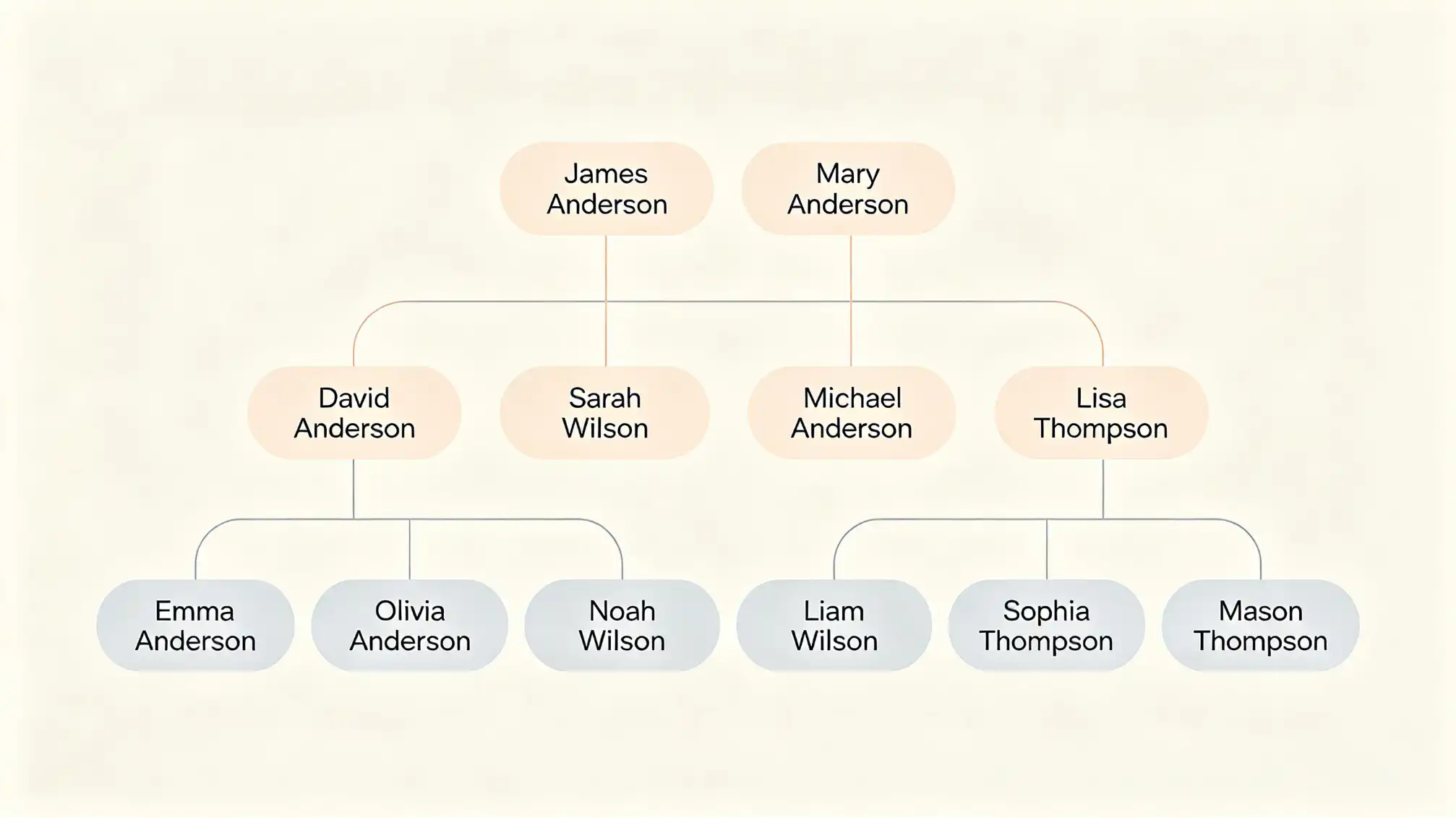
Using a visual tree also creates better conversations. When a child asks how they are related to a great-aunt or a cousin twice removed, you can share a screen or a mobile link. You can zoom out for the big picture or zoom in for a single couple. Once you begin comparing digital family tree products, test how smoothly each one renders a segmented, multi-branch chart, because that is where clarity becomes make-or-break.
Invite relatives into the research process
Family history is rarely a solo project. Most people need a mother to confirm maiden names, an uncle to scan photographs, or a cousin in another country to read a church register. An online family tree makes collaboration natural because you define exactly what each person can do. Some relatives may only need to view their branch, while others can add stories or correct relationships.
FamilyLove’s family hub is a practical example of where you can gather relatives around a shared project. You can post questions, share an ancestor profile, and keep everyone moving in the same direction without formal online meetings. When relatives see the tree taking shape, they tend to contribute details that would never have made it into a passive document. The tree becomes a living space as well as an archive.
Attach the evidence that makes family history credible
Genealogy is stronger when every conclusion points back to a source. A quality online family tree gives you storage for certificates, census transcripts, letters, photographs, and DNA matching details. You can attach one marriage record to several people at once. You can also distinguish between a fact you have documented and a memory that still needs confirmation. That distinction is valuable when you share your research, because other family members can see what is verified and what is still an open question.
Let smart hints guide your research
Online tree platforms have changed the rhythm of genealogy research. Rather than scrolling through every civil register manually, you can use automated hints drawn from historical record collections. A record suggestion might point to an immigration manifest in one year or a census listing from another. These hints are not final answers, but they dramatically reduce the time you lose searching without direction. Over time, the pattern of your online family tree expands and reveals gaps you would not have noticed in a paper folder.
Choosing the right online tree for your needs
When you compare platforms, you are comparing ecosystems. Data controls matter as much as charts. Look for an online family tree service with these traits:
- Privacy controls for living people, historical records, and branches your family wants to keep private.
- Collaboration settings that allow certain relatives to edit without giving them full control.
- Export options like GEDCOM and PDF so your family history remains portable.
- Storage capacity for high-resolution scans and long audio recordings.
- Archive integrations that connect your tree to useful record collections.
There is no universal best platform, but there is probably a right one for your family’s confidence level and research style. The features above matter most if you plan to share the tree with relatives who are not genealogists. A streamlined interface often wins over a dense set of research tools if it keeps family members engaged.
Start building before your research feels complete
Do not wait until every source is polished before you create an online family tree. Start with the names, places, and memories you already know, then add evidence as you find it. The discipline of entering data into a shared system actually makes your genealogy better because it forces you to see gaps. What seems like a simple family line often becomes clearer when you can map it beside all the other branches you have collected.