{
"title": "How to Build a Family Tree with Parents and Grandparents: A Fresh, Practical Guide",
"metaTitle": "How to Build a Family Tree with Parents and Grandparents | FamilyLove",
"metaDescription": "Learn how to build a family tree with parents and grandparents step by step. Simple methods, record-keeping tips, and trusted templates from FamilyLove.",
"summary": "A practical guide to creating a family tree starting with parents and grandparents, with tips for organizing relatives, verifying records, and preserving family stories.",
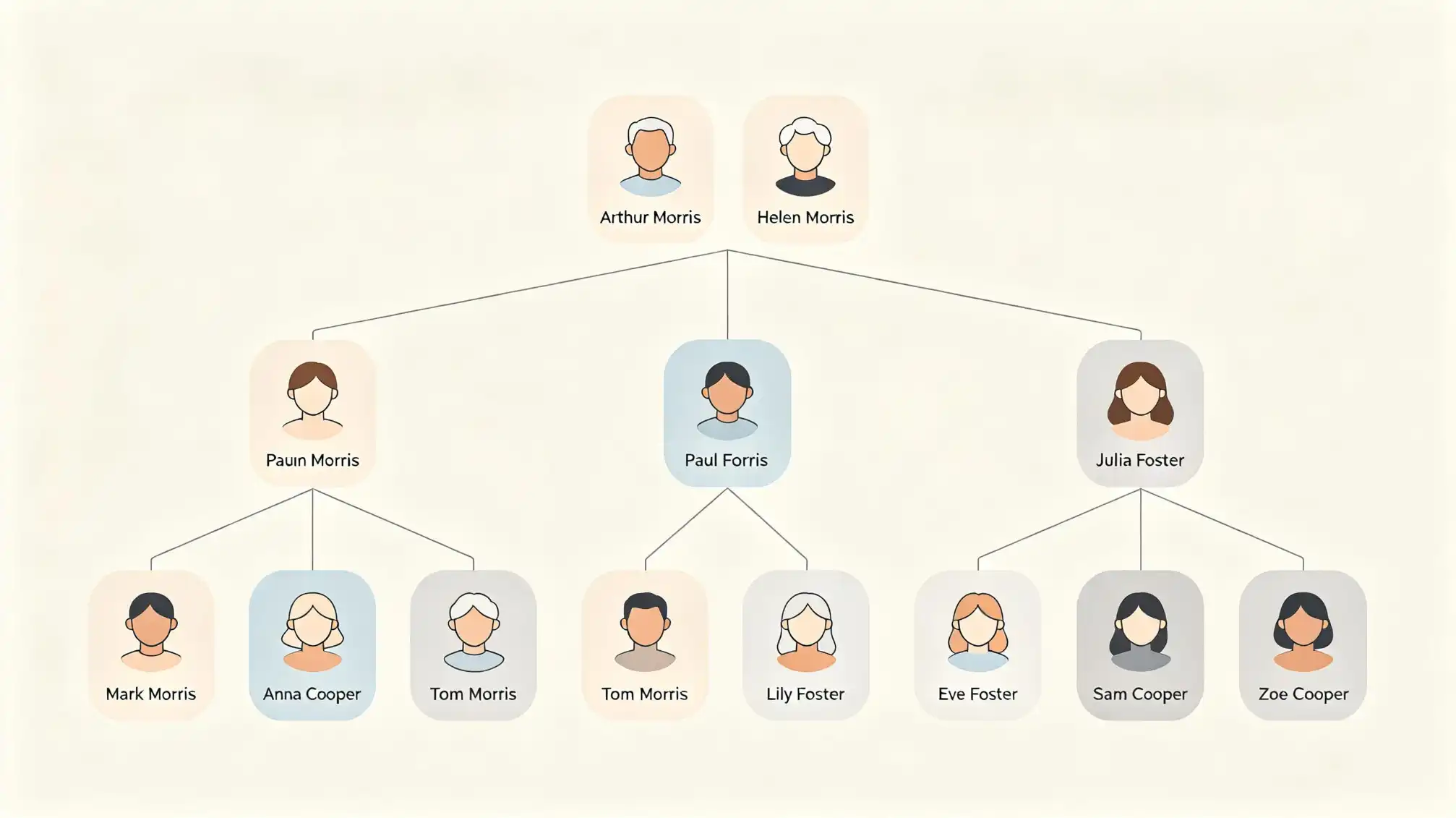
"contentHtml": "<p>Every family tree begins with a simple truth: you are the link between the generations you know and the ancestors you have yet to discover. If you have ever wondered how to build a family tree, the best place to start is not a dusty archive or a complicated website. It is right in front of you — with your parents and grandparents. Building from those closest anchors makes the process less overwhelming, more accurate, and deeply personal.</p><h2>Why Start with Parents and Grandparents?</h2><p>Many people believe that a real family tree must begin centuries ago. In practice, the strongest trees are built from the base upward. Your parents and grandparents are the roots of your personal family story. They hold names, dates, places, and anecdotes that no online database can replicate. By starting with them, you create a verified foundation that makes later research into distant relatives and ancestors far easier.</p><p>Working with three generations gives you a clear reference frame. You can confirm birth dates, marriage locations, siblings, and migration patterns. You also get the chance to capture living voices before stories fade. This is why a practical family tree project should always begin with a conversation, not a search engine.</p><h2>How to Build a Family Tree with Parents and Grandparents</h2><p>The phrase “how to build a family tree” often sounds like a large research project. But when you narrow the angle to parents and grandparents, it becomes a manageable, even joyful task. Follow these steps to get started.</p><h3>Step 1: Gather What You Already Know</h3><p>Before asking anyone else, write down everything you already know. Include your own details, then add your parents’ full names, birthdates, birthplaces, and marriage date. Do the same for each grandparent. Do not worry about missing pieces yet. This initial list will show you where the gaps are and what questions to ask.</p><h3>Step 2: Interview Your Parents and Grandparents with a Fresh Angle</h3><p>Instead of asking a dry list of dates, invite them to tell stories. Ask about the house they grew up in, the school they attended, or the journey they made to meet your other parent. Those details often reveal the facts you need in a natural way. Record the conversation on your phone, and take notes about surnames, nicknames, and places. You will be surprised how much of a family tree is hidden inside a simple memory.</p><h3>Step 3: Choose a Simple Chart or Tool</h3><p>You can draw a family tree on paper or use a digital template. The point is to keep it clear. A three-generation chart is ideal: you, your siblings, your parents, and your four grandparents. Place yourself at the bottom or center, with lines connecting upward. This visual structure makes it easier to see relationships and decide where to add relatives next.</p><h3>Step 4: Verify and Expand with Documents</h3><p>Once you have the oral record, look for documents that confirm the details. Birth certificates, marriage licenses, old passports, and family Bibles are excellent sources. Even a handwritten note on the back of a photo can solve a mystery. Keep copies of everything, and note where each fact came from. This habit protects your family tree from rumors and guesswork.</p><h2>Use Photos to Identify and Connect Relatives</h2><p>Photographs are one of the most powerful tools for building a family tree with parents and grandparents. Old pictures give you faces to match with names, and they help you spot physical similarities across generations. When you gather photos, ask relatives to identify everyone in the frame. Keep the original order of the people in the photo, and add labels such as “front row left” or “standing second from the right.”</p><figure><img src="https://r2.familylove.love/static/seo/members1.webp" alt="A family tree with parents and grandparents organized around a happy family gathering" /><figcaption>Use photos of parents and grandparents to confirm identities and build a more personal family tree.</figcaption></figure><p>As you collect images, scan them at a high resolution and store them digitally. A family tree becomes much richer when it includes faces, not just names. For every photo, record the estimated year and location, even if you are not certain. Future research may confirm the details later.</p><h2>Keep Track of Relatives, Not Just Names</h2><p>One of the most common mistakes in family tree work is turning people into labels. Your grandmother is not just a name and date; she is a person with siblings, cousins, and a life story. When building your tree, take time to map the relationships around each grandparent. Who were their brothers and sisters? Where did they fit in the family line? These relatives are not ancestors in a direct line, but they provide essential context and often lead to surprising discoveries.</p><p>Create a simple coding system to note the type of relationship: direct ancestor, sibling, cousin, or in-law. This helps you understand the structure of your family tree and makes it easier to expand later. Remember, a family tree is not a diagram of names — it is a map of belonging.</p><h2>Expand Carefully Beyond Grandparents</h2><p>Once your parents and grandparents are firmly placed, you may feel ready to reach back to great-grandparents and other ancestors. That is a natural next step, but it requires caution. Older records can be inconsistent, and family stories sometimes confuse two people with the same name. Before adding a new ancestor, look for at least two independent sources. Census records, church registers, and civil registries are reliable guides.</p><p>Keep the same calm, methodical approach that worked with your grandparents. Verify each fact, record the source, and never guess. A smaller tree that is accurate is far more valuable than large tree built on assumptions.</p><h2>Build a Living Family Tree with Your Relatives</h2><p>Your family tree does not have to live only on a sheet of paper or in a software file. It can become a living project that brings relatives closer together. As you discover stories and photos, share them with your parents, grandparents, aunts, and uncles. Ask them to fill in the blanks. If you want to keep the tree interactive and easy for everyone to contribute to, the <a href="https://www.familylove.love/family">FamilyLove family hub</a> is a practical place to organize and share your growing research with the people who matter most.</p><p>Collaboration also protects your work. When several family members contribute, mistakes are caught quickly, and memories are validated by multiple voices. The process of building the tree becomes a way to strengthen family bonds.</p><h1>Practical Steps</h1><ul><li>Start by mapping your immediate and extended family relationships at <a href="https://www.familylove.love/family">FamilyLove Family</a> to see what your current tree looks like and where the gaps are.</li><li>For more help and guidance, visit <a href="https://www.familylove.love/docs">FamilyLove Documentation and Resources</a> to continue building your tree with confidence.</li></ul>",
"images": [
"https://r2.familylove.love/static/seo/members1.webp"
]
}