When people hear the phrase family tree, many picture a formal chart hanging in a relative’s hallway, with names pencilled into branches. That image is not wrong, but it is incomplete. A family tree is a way of seeing your place in a much longer story. It connects you to the people who came before you, and it gives the traditions, traits, and choices that echo through your life.
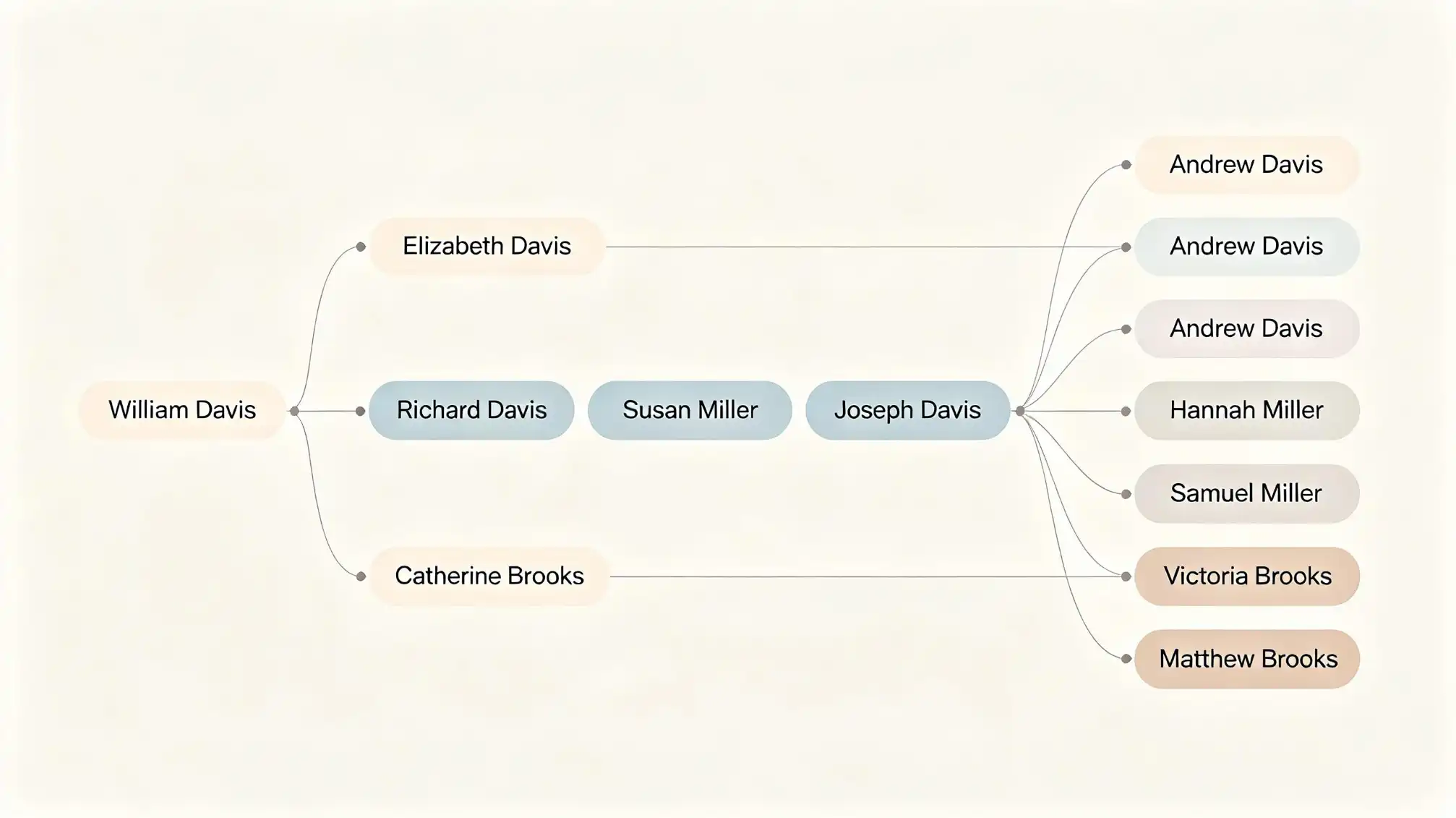
A fresh way to understand your family tree
At its simplest, a family tree is a visual record of relationships across generations. It starts with you and works outward to parents, grandparents, great-grandparents, and beyond. But the real value is not in the lines and boxes. It is in the family history those lines represent. Each name stands for a person with a birthplace, an occupation, a set of hopes, and a reason for moving or staying. When you collect those details, you turn a simple diagram into a rich biography of your ancestors.
Think of it this way: a family tree is a map of belonging. It can show you why your family speaks certain words, celebrates certain holidays, or values certain kinds of work. It can also reveal surprises—an ancestor who changed their name, a branch that emigrated in search of safety, or a relative whose story had been quietly forgotten.
Why family history starts with you
Many beginners worry that they do not know enough to begin. This is understandable, but it is also a misunderstanding of how genealogy works. Family history is not built from grand discoveries first; it is built from ordinary details that you gather one by one.
Begin with yourself. Write down your full name, date of birth, and place of birth. Add your parents, then your grandparents. For each person, record what you know and what you are unsure about. Gaps are not failures; they are clues. A missing grandmother’s maiden name or a grandfather’s unknown occupation gives you a clear next question to ask.
The basic shape of a genealogy chart
Once you begin, you will notice that most family tree charts follow a simple pattern. You are the root. Your parents branch out from you. Their parents branch out from them. Each generation adds another level. You do not need to complete every branch at once. Even a small tree with three generations is a meaningful achievement.
- Full names: Include nicknames and maiden names if you can.
- Dates: Use approximate dates when exact ones are unknown.
- Places: Birthplaces, marriage locations, and death places help you avoid mix-ups.
- Relationships: Note whether someone is an adopted parent, step-parent, or biological parent when relevant.
Once you have these details, you will begin to see patterns. Many people discover that they have ancestors from a particular region, or that a first name repeats in every generation. Those patterns are the starting points for deeper family history research.
Where to find relatives and records
Your first resource is always the people around you. Ask parents, aunts, uncles, and grandparents about their memories. Old photograph albums, letters, and certificates are useful, but so are casual stories. A single remark about “Grandpa’s shop” or “the house near the river” can point you toward records you would never have found otherwise.
As you collect these stories, you will need to organize them. Write down who told you what and when. This may seem fussy, but it is the only way to test whether a memory is consistent with official documents. If a census record says your great-grandfather was born in 1872 but your great-aunt always said 1875, you need both pieces of information to decide what is likely true.
If you are looking for a supportive place to start thinking about these relationships, take a look at the family page on this site for ideas on how to approach conversations with relatives and capture what they share.
Choosing the right tools for your research
You can use a simple a spreadsheet, or an online genealogy platform. Each has strengths. A notebook is personal and portable. A spreadsheet lets you sort and search. An online service can automatically search historical records and suggest connections.
Whatever tool you choose, keep your entries consistent. Use full names where possible, and note whether a name is a birth name, married name, or nickname. Include dates with as much precision as you have: for example, “about 1842” is more honest than a guessed exact year. Always record where the information came from. This is a habit that separates serious genealogy from casual guesswork.
Common pitfalls in beginner genealogy
The most common mistake is assuming that information found online is always correct. Census records, birth certificates, and newspaper articles can contain errors. Compare multiple sources before you accept a fact.
Another mistake is skipping generations. If you try to jump directly from yourself to a famous historical figure, you may miss the ordinary ancestors who actually shaped your family history. Slow down and let each generation lead you to the next.
It is also easy to become discouraged when a branch seems to disappear. Names get misspelled, borders change, and records burn. Do not let that stop you. A family tree is not a race. It is a practice of attention and patience.
Bringing your ancestors to life
When you have a few generations recorded, pause and think about what the tree means. What does it feel like to see your ancestors listed in sequence? What patterns do you notice? Some people discover that they are the first in their family line to live in a certain region. Others find that a beloved occupation or hobby has been passed down for a century.
Bringing these observations into your family history makes the project personal. You are no longer just collecting facts; you are preserving a story. That is what turns a family tree into a meaningful heirloom.