Every family has a library that has never been catalogued. It lives in the way your grandparents say certain words, in their old photograph albums, in a recipe card stained with cinnamon, in the story of how they met during a blackout in August. Collecting grandparents family history is not about filling a family tree with names and dates. It is about catching the atmosphere before it quietly vanishes. The good news? You need no special equipment and no journalism degree. You need a relaxed afternoon, a objects that belong to their world, and the patience to let one memory open another.
Many of us make a common mistake: we search for a long list of family history questions and then work through it like a checklist. We ask about birthdays, school names, and war years, and our grandparents give shorter and shorter answers. It begins to feel like a courtroom, not a conversation. Instead, try the opposite. Give them something to react to. Show them a photograph from 1962. Let them smell the soap in the bathroom cabinet. Play a song that was popular when they were courting. Memory does not follow your list. It follows their senses.
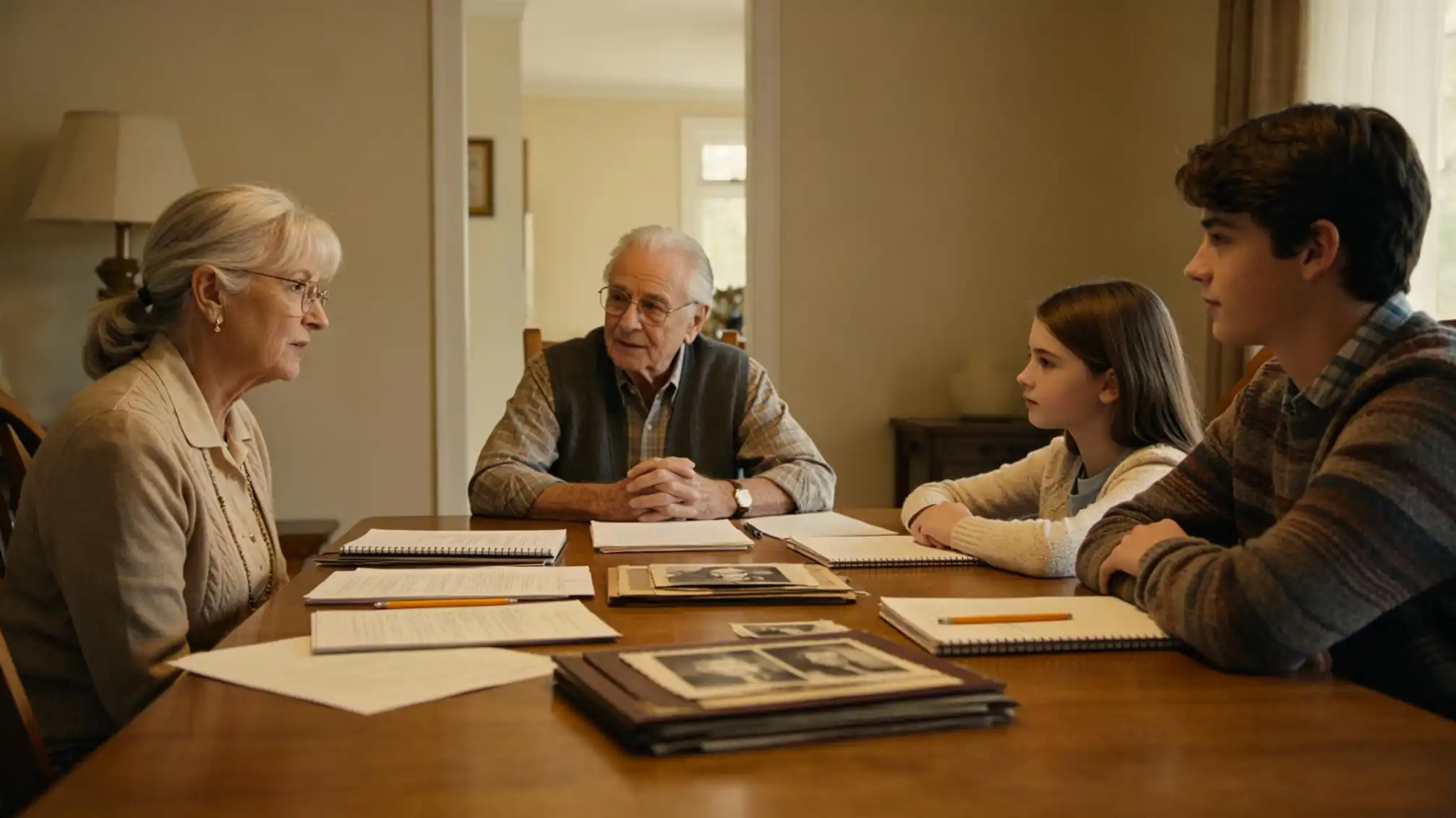
Start with a place, not a questionnaire
Grandparents family history is often hidden in geography. Before asking “who,” ask “where.” Pick a street they lived on, a train station, a childhood kitchen, or the corner where the ice cream cart parked. Ask: “What did you see from your bedroom window?” “What did the neighborhood smell like at noon?” “What was the quickest way to get to your best friend’s house?” These are not fact questions; they are keyholes.
One of the most effective family history questions is also one of the softest: “What did you hear when you woke up in the morning?” A rooster? A trolley? Your great-grandmother singing? That question reveals sounds that have disappeared from everyday life, and it instantly brings your grandparents into the story.
Let objects carry the conversation
Objects do the asking when we forget what to say. Take a stack of photographs and scatter them across the table. Let your grandparent choose the first one. Do not ask for names right away; ask, “What do you remember about this day?” There will be false starts, laughter, and long pauses. Do not rush in to fill the silence. A few extra seconds of quiet usually brings up the memory that has been waiting for an opening.
Keep the pot that made the Sunday soup. Keep the chipped saucer. These are stepping stones. When you touch them, your grandparents are not being interviewed; they are being trusted with what they know best.
Listen for the moment behind the fact
You will hear facts: “We moved away when I was twelve.” That is a door. The story behind it is “I packed my comic book and a jar of tadpoles.” Ask, “What did you take with you?” and “What did you miss the most?” Those are the details that make family stories feel alive.
Whenever relatives mention a name, resist the urge to put it on a family chart. Instead ask, “What did she always say?” “What was the first thing he cooked for you?” “Did anyone call her by a nickname?” The most ordinary details—a voice, a habit, a phrase—carry more emotional truth than a date of birth.
Record lightly, without turning it into a production
Your phone is enough. Set it on audio memo, face down on the armchair, and forget it. Do not point it at them like a microphone. Do not stop the recording when you get up to make tea; the sounds of cups and refrigerators become part of the memory. People relax when the recorder is invisible.
After the visit, send them voice clips back. They will laugh and add details. That is how you keep grandparents family history growing.
Bring in other relatives at the right time
Once you have a few short recorded moments, invite cousins, siblings, aunts, and uncles to listen. Relatives remember the same event in completely different ways. One remembers the snowstorm, another remembers the orange candy Aunt June sneaked under the table. When those voices meet, a shared family story becomes richer.
If you are not sure how to assemble family stories from many voices, look at how other families have organized theirs on our family stories page. Their examples show that imperfect, conversational memories are more moving than neat, polished essays.
Keep the ending open
Do not wait for the perfect moment or a complete archive. A grandparents family history is built one visit at a time. At the end of each conversation, ask: “What is one thing you have never told me?” If no one answers, leave your phone recording anyway. The best stories often arrive just as you are walking to the door.