Your First Family Tree: A Beginner’s Guide to Family History
“Family tree” often brings to mind an elegant diagram with names written in loops and branches reaching toward the sky. But in reality, a family tree is a working map of your family history. It is one of the most practical tools for anyone who wants to understand who their ancestors were, where they came from, and how those lives shaped the family of today.
If you are just starting to explore your genealogy, the family tree is your natural place to begin. You don’t need a degree in history or a subscription to an expensive database. All you need is a willingness to ask questions, a notebook or digital document, and a little patience for the unexpected.
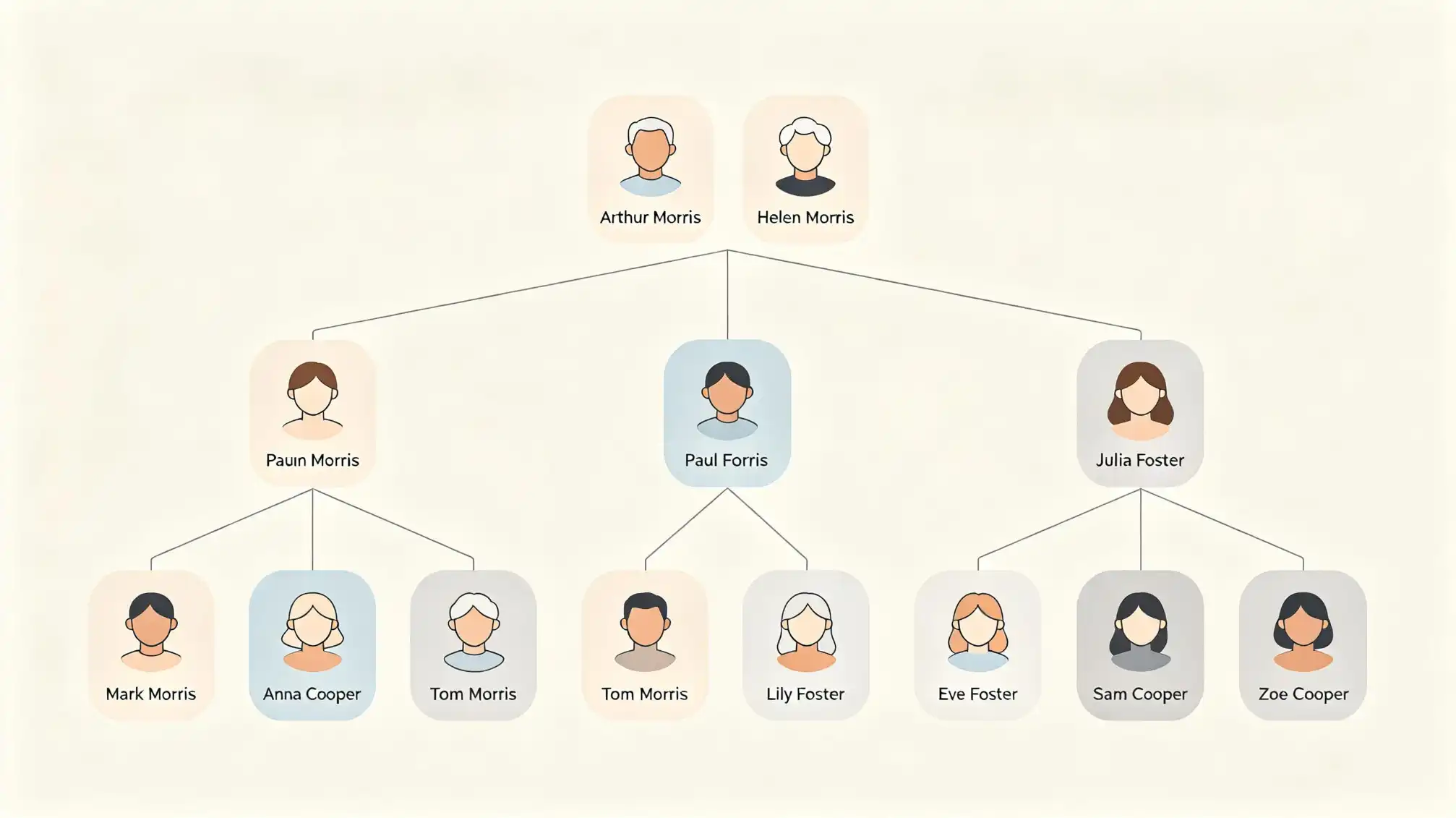
What a Family Tree Really Shows
A family tree is a visual representation of your family history. At its center, or at its root, stands a person—usually you. From there, branches extend to your parents, grandparents, great-grandparents, and beyond. Each branch represents a relationship: a parent-child tie, a marriage, or a sibling connection. But a family tree is not just a diagram of names. It can also include birth places, dates, stories, and photographs that make your ancestors feel like more than entries on a chart.
There are many ways to draw a family tree. Some people use an ancestor chart, which focuses on your direct line back through parents and grandparents. Others prefer a descendant chart, which starts with an earlier ancestor and shows their children, grandchildren, and great-grandchildren. You might also see a fan chart, which arranges generations in concentric circles. The format matters less than the clarity it provides. A good family tree helps you see relationships at a glance and spot the places where you have questions to answer.
For beginners, the idea of a family tree can feel oversized, but it is actually a simple concept. If you know your parents, you already have the first branch. Add your grandparents, and another generation appears. Every time you add a name, you create a new path for future research.
Why Family History Starts with a Family Tree
Genealogy is the study of your family history, and a family tree is the foundation of that study. Without a tree, names and dates float in isolation. With a tree, they become part of a connected story. You can trace how a great-grandmother’s move from one town to another shaped your own branch of the family. You can understand why certain names repeat through generations or why a holiday tradition began a century ago.
A family tree also preserves the stories that otherwise might disappear. Older relatives may have memories of people you never met. When you build your tree, you give those memories a permanent home. You can attach a letter, a photograph, or a note about an ancestor’s occupation. In this way, the tree becomes a family history archive that grows richer with time.
Another reason to start with a family tree is that it helps you ask better questions. Once you see that your great-grandfather was born in a different country, you might wonder what brought him to his new home. That small open branch can turn into a fascinating research project. The tree is not only a record of what you know; it is also a map of what you want to discover.
How to Build Your First Family Tree
The best way to begin is to work from what you know. Start with yourself. Write down your full name, birth date, and birth place. Then add your parents, including their full names and important life events. Follow with your grandparents. At this stage, you don’t need to worry about making everything perfect. Leave question marks where you are unsure; they will guide your next steps.
Next, talk to your family members. Your parents, aunts, uncles, and grandparents are valuable sources. Ask them to tell you stories about past relatives. Record the names they mention, the places where families lived, and any dates they remember. Sometimes a nickname or a family joke can be the clue that unlocks a long-lost ancestor.
After the conversations, gather documents. Birth certificates, marriage licenses, census records, and old passports can confirm what you have heard. A family Bible with birth dates handwritten inside can be a treasure. Look through photo albums too. The back of a photograph may include a name and a date, giving you another piece of the puzzle.
As you collect information, choose a format that works for you. Many beginners enjoy drawing a simple chart on paper, while others prefer using online tools or spreadsheets. The right choice is the one you will actually use and update. If you want a structured way to begin, the family page at familylove.l offers ideas and examples that can help you get started without becoming overwhelmed.
Using Your Family Tree for Genealogy
Once your first few generations are in place, your family tree becomes a launching point for deeper genealogical research. Look at the gaps. Which grandparents do you know the least about? Which family branches seem to disappear after a certain town or year? Those are the places where your research time will have the most impact.
You can use your tree to test new information. When you find a record with a name that matches an ancestor on your tree, compare the dates and places carefully. Does this person’s spouse match? Do the children line up? This kind of checking is what separates a reliable family history from a house of cards.
You will also discover that family trees are meant to be shared. A cousin you never met may have an old photograph of your great-grandfather. A distant relative may have already traced a branch you are struggling with. When you share your tree, you invite collaboration and open the door to new connections. Family history is rarely a solo journey for long.
Common Mistakes to Avoid
Every beginner makes a few missteps, and that is okay. The key is to be aware of them. Names are often spelled differently in old records, so keep a list of spelling variations. A person called “Margaret” in one census might appear as “Maggie” in another. Both could be the same ancestor.
Dates can also be misleading. In the past, a birth date might be recorded on a church baptism record rather than a birth certificate. Some people used old calendar systems, especially in earlier centuries. Always try to find primary records, and when you must rely on memory, label it clearly.
Another common mistake is copying information from other public trees without verification. Public family trees can be helpful, but they often contain errors that have been repeated many times. Treat them as clues, not conclusions. Confirm every important fact with a document or a trusted family source before adding it to your own tree.
Keeping Your Tree Alive
A family tree is not a one-time project. It is a living document. As you grow older, you may learn new details about your youth or uncover letters from relatives who passed away. Family members may welcome a new baby, and those names should be added too. The more you work with your tree, the more natural it becomes.
Revisit your tree regularly. Spend a few minutes on a quiet Sunday looking through old records. Follow a single ancestor and try to learn one new fact about their life. The goal is not to become perfect at genealogy overnight; it is to enjoy the process of discovering your ancestors and preserving their stories for the people who come after you.
If you feel stuck, remember that family history is about connection. Call a relative. Visit a cemetery. Look through that box of photographs your mother kept in the closet. The next piece of the puzzle is often closer than you think.