Start Close, Then Reach Higher
Many people believe that building a family tree begins with a famous ancestor or a distant relative. In practice, the strongest family trees grow from the people you know best: your parents and grandparents. By starting with this familiar foundation, you can create a reliable structure that makes later ancestor research much easier.
When you think about how to build a family tree, remember that every branch needs a trunk. Your immediate family is that trunk. Once you document your parents and grandparents correctly, the names and dates you add later will have a solid context. This approach also reduces the frustration of hitting a dead end with an unfamiliar ancestor before you have practiced working with records and conversations.
Begin With What Is Already in Your Home
Before you ask anyone a question, take a quiet hour to search for family clues inside your own home. Look for:
- Birth certificates, marriage licenses, and other official documents
- Old family Bibles with handwritten names and dates
- Photo albums with captions or names written on the back
- Letters, cards, and postcards that mention family members
- Funeral programs, obituaries, or memorial cards
These items may not give you a complete picture of your parents and grandparents, but they will help you prepare meaningful questions. Organize everything into folders, one for each person. This simple step is often the difference between a casual interest in ancestors and a real family tree project that lasts.
Talk to Your Parents First
Your parents are the most direct bridge between your own life and the generations before you. Ask them about their parents, grandparents, and siblings in a relaxed, conversational way. You are not conducting an interview; you are helping them remember stories.
Good questions to open the conversation include:
- Where were you born, and where did you grow up?
- What did your parents do for work?
- Did your grandparents live near you when you were young?
- What family traditions do you remember from your childhood?
- Who is the oldest relative you remember meeting?
Listen for names, dates, and places, but do not interrupt too quickly. The goal is to capture the shape of the family before you worry about every exact date. After the conversation, write down everything you remember. Transcribe or record the conversation if your parent is comfortable with it.
Identify Your Grandparents as the Next Link
Once you have a basic outline from your parents, you can focus on your grandparents. For each grandparent, record their full name, birth date, birthplace, marriage date, and death date if applicable. Also note the names of their children in order. This gives you a three-generation block that is easy to verify and expand.
A common mistake is jumping directly to great-grandparents before the first three generations are complete. That often leads to duplicate records and confused identities. Instead, use your grandparents as checkpoints. When you research ancestors later, every new relative can be connected to one of your grandparents. This keeps the tree neat and biologically accurate from the start.
Choose a Simple Family Tree Format
There are many ways to display a family tree, but when you are just starting with parents and grandparents, two formats work best:
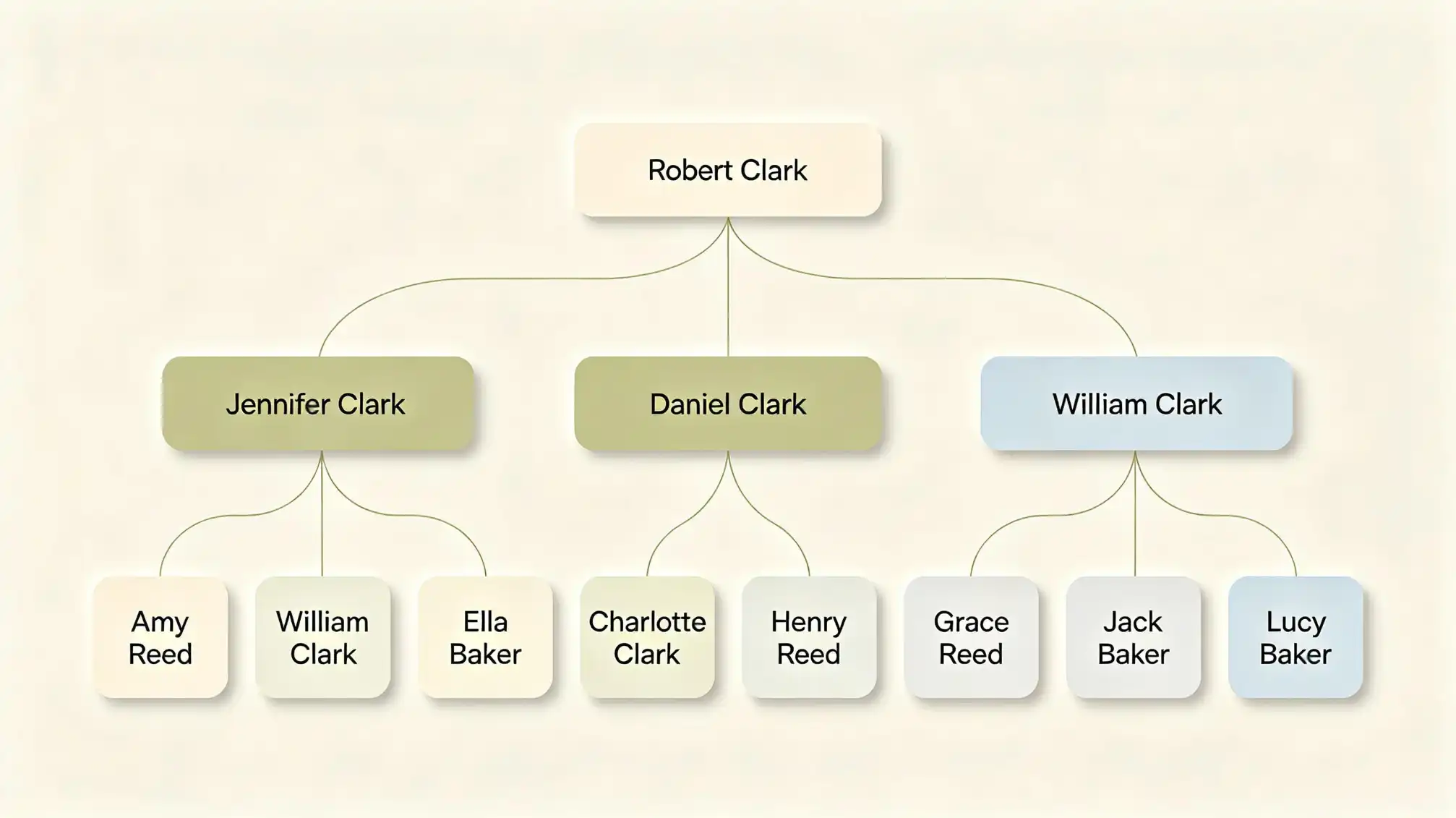
Pedigree chart. This classic format traces your direct line only: you, your parents, your grandparents, and your great-grandparents. It is perfect for seeing ancestors at a glance and for sharing with relatives who want a quick overview.
Family group sheet. This format focuses on one set of parents and their children. It is more detailed because it includes all siblings and their birth order. Use a family group sheet for each of your parents and for each set of grandparents.
If you want to keep everything connected while you organize relationships between people, visit the family relationship hub where you can store your notes and link individuals as you build your tree. That page is designed to make the process feel less overwhelming.
Verify the Details With a Second Source
Family stories are valuable, but they are not always precise. Birth dates shift, spellings change, and places get misremembered. As you collect information about your parents and grandparents, compare each fact with at least one additional source. For example, if your mother tells you that her mother was born in 1932, try to find a census record, a birth index, or a family Bible that confirms that year.
This habit is especially important before you add distant relatives and ancestors. A single wrong date on a grandparent can send your research down the wrong branch for years. Staying careful at the beginning does not slow you down; it protects your future work.
Refresh Your Tree as You Learn More
Building a family tree is not a one-time activity. As you talk with aunts, uncles, cousins, and older relatives, you will learn new names, nicknames, and family connections. Keep your document flexible. You can use a simple spreadsheet, a digital template, or a notebook.
Make a habit of updating your tree every few weeks, even just for five minutes. Add any new date you discovered or correct a name you wrote down incorrectly. A small, regular review will keep your records clean and help you notice gaps in your knowledge. This steady rhythm is the practical secret behind every polished family tree.
Expand Gently Into the Ancestor Generation
After your parents and grandparents are well documented, you can extend upward to great-grandparents and beyond. At this stage, you are no longer relying on memory alone. You will need public records, genealogy databases, and patient detective work. Keep the same principle: collect every clue, verify it with a second source, and connect it to the correct branch.
Remember that relatives and ancestors are not just names on a page. Each person had relationships, challenges, and celebrations. Include the small stories you hear from your parents and grandparents. Those stories will make the tree feel alive for your children and grandchildren.