Researching your ancestors can feel like trying to assemble a puzzle with half the pieces missing. You may have a few names, a handful of stories, and a deep urge to know where your family came from. The good news is that tracing your family history is not a mysterious talent. It is a methodical process that anyone can follow. This guide gives you a clear, step-by-step roadmap so that every discovery you make becomes a solid foundation for the next.
Start With What You Already Know
The most useful archive in your search is the one inside your own home. Before you type a single name into a genealogy website, sit down with a blank sheet of paper or a notebook and record everything you know.
List your parents, their siblings, and their parents. Write down birth dates, marriage dates, and places whenever you have them. Do not worry about being complete. The goal here is to expose the gaps. Every missing date or uncertain place becomes a research question you can answer later.
Look for physical evidence as you go. Birth certificates, marriage licenses, obituaries, funeral cards, old letters, and passports all count as documents. Even an old address written in a birthday card can point you toward a census record or a city directory.
Build a Simple Family Tree as Your Foundation
Once your notes are in place, create a basic family tree. A simple ancestor chart is enough at this stage. Start with yourself or your oldest known generation, then move backward one line at a time.
Do not rush to add every distant cousin you suspect. Instead, keep the tree narrow and direct. Focus on your parents, grandparents, and great-grandparents first. Each person you add should have at least one piece of evidence attached to them. If you cannot prove a relationship yet, leave it blank. The tree is not a contest, it is a working map.
Use a free genealogy software program or a simple spreadsheet if you prefer. Digital tools make it easier to correct mistakes and organize sources as your research expands.
Interview Relatives While You Still Can
Your older relatives are living archives of your family history. They carry details that no government record will ever show: why a grandfather left his hometown, what a grandmother actually did during the war, or how the family ended up in the same city for generations. Schedule interviews while these voices are still available to you.
Prepare your questions before you call or visit. Ask open-ended questions such as “What do you remember about your grandparents?” and “Where did your mother grow up?” Record the conversation, but always ask for permission first. Back up the audio or video file immediately.
These interviews often produce the most meaningful content in your whole family history project. If you want to preserve and share those stories with the rest of your family, consider placing them on the family stories page at familylove.love/stories. That page gives you a natural home for the memories you collect.
Move Into Official Records
Now you are ready to move from memory to evidence. The most reliable sources for tracing ancestors are official records created by governments, churches, and courts. Each record type has a different purpose, and you will need several of them to build a complete picture.
Begin with civil vital records: birth, marriage, and death certificates. In most countries these were kept by local or national governments, and they usually include names, dates, places, and sometimes parents’ names. Marriage records are especially useful because they often list the bride and groom’s parents, plus witnesses who may be relatives.
Census records are another cornerstone of genealogy. They are taken every ten years in many countries and can place your ancestors in a specific home with specific family members, ages, occupations, and birthplaces. Use each census to narrow down your ancestor’s birth year and track how the family moved over time.
Next, look at church records. Baptism, marriage, and burial registers often begin decades before civil registers. They may include annotations such as “daughter of…” or “married in the presence of…” that reveal additional family membersp>
Immigration and naturalization documents are essential if your ancestors crossed national borders. Ship passenger lists, naturalization petitions, border crossing records, and passports can confirm arrival dates and original hometowns.
Use DNA Testing as a Clue, Not a Conclusion
DNA testing has changed the way people research their ancestors. A saliva sample can connect you to distant biological relatives and give you estimates of your ethnic origins. However, DNA results are only clues, not proof. They need to be combined with documentary evidence.
Take the time to understand the different types of tests. Autosomal DNA, which covers most of your genome, is the best tool for finding cousins within five or six generations. Y-DNA and mitochondrial DNA are more specialized and trace paternal and maternal lines directly. Choose a test based on the specific question you are trying to answer.
When you receive your matches, do not simply copy anyone’s family tree. Treat each match as a starting point. Communicate with the person, compare documents, and confirm the connection step by step.
Organize, Document, and Back Up Every Finding
Genealogy is a research discipline, and a good researcher keeps clean notes. For every record you find, write down three things: the source name, the original date of the record, and where you saw it. This is called a citation. It may feel tedious, but it will save you from repeating your own research later.
Create a folder system on your computer for each surname or family unit. Scan paper documents and save images with descriptive filenames, such as Smith_John_birth_1883_Pennsylvania.jpg. Back up your files regularly, using an external drive and a cloud service. Losing your research to a crashed computer is a heartbreaking mistake that is entirely avoidable.
Expand Beyond Paper Trails: Photographs and Heirlooms
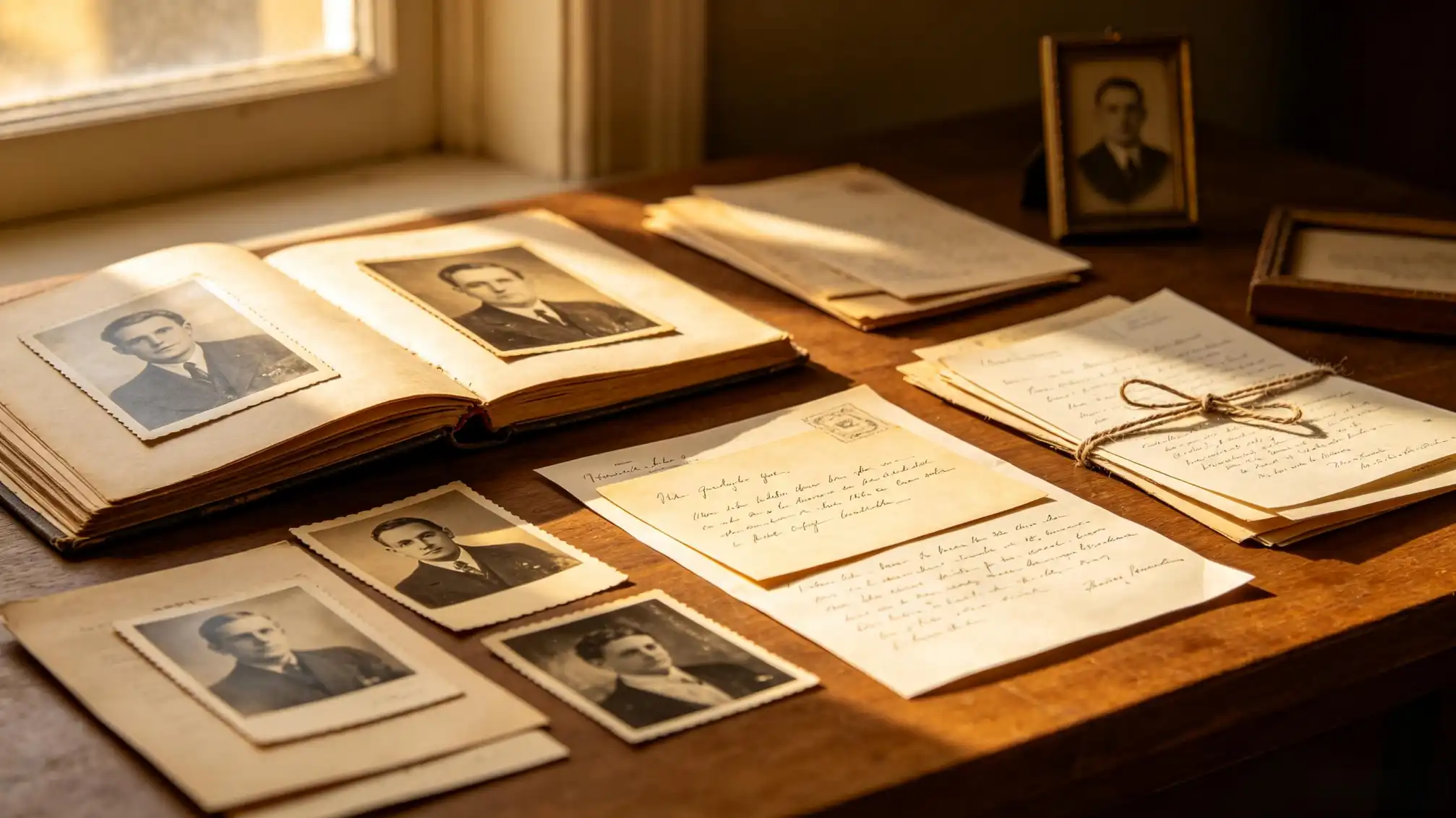
Photographs offer a different kind of genealogical evidence. They can help you identify physical traits, estimate ages, and understand the social context of your ancestors’ lives. Look at the back of every photograph you own. Names and dates are often written there, and occasionally they conflict with official records, which gives you a new clue to investigate.
Heirlooms do the same. A quilt passed through three generations, a military uniform, or a piece of jewelry can carry material evidence of your ancestor’s life. Note who owned it, when it was passed down, and what stories accompany it. These details become a richer layer of your family tree.
When You Hit a Brick Wall
Every genealogy researcher eventually reaches a point where the records seem to run out. Do not treat this as a dead end. Instead, change your approach.
Search for alternative spellings of your ancestor’s surname. Try using first names only or using a nickname. Look at the records of close neighbors, known friends, and business partners. Probate records, land deeds, and local histories often mention people who are absent from official registers. Sometimes the answer to your question is waiting in the next town, not the next record.