Every family tree starts with a single name. But tracing your ancestors step by step can feel overwhelming when you stare at an empty chart. The way forward is not mysterious—it is a repeatable process. This guide gives you a clear sequence of actions to build a reliable family history without wasting hours on dead ends. You will learn where to look, what to ask, and how to prove each branch of your family tree.
Raid Your Own House First
Look for the paper trail already inside your home. Search drawers, shoeboxes, and closets for old photographs, family Bibles, military discharge papers, naturalization certificates, letters, and diplomas. The backs of photographs often hide the best clue—handwriting like 'Aunt May, summer 1943' or 'John and Clara, Chicago.' Family Bibles frequently contain birth, marriage, and death dates written by hand on the inside cover. Even a half-finished family tree drawn by an older relative can save you months of work.
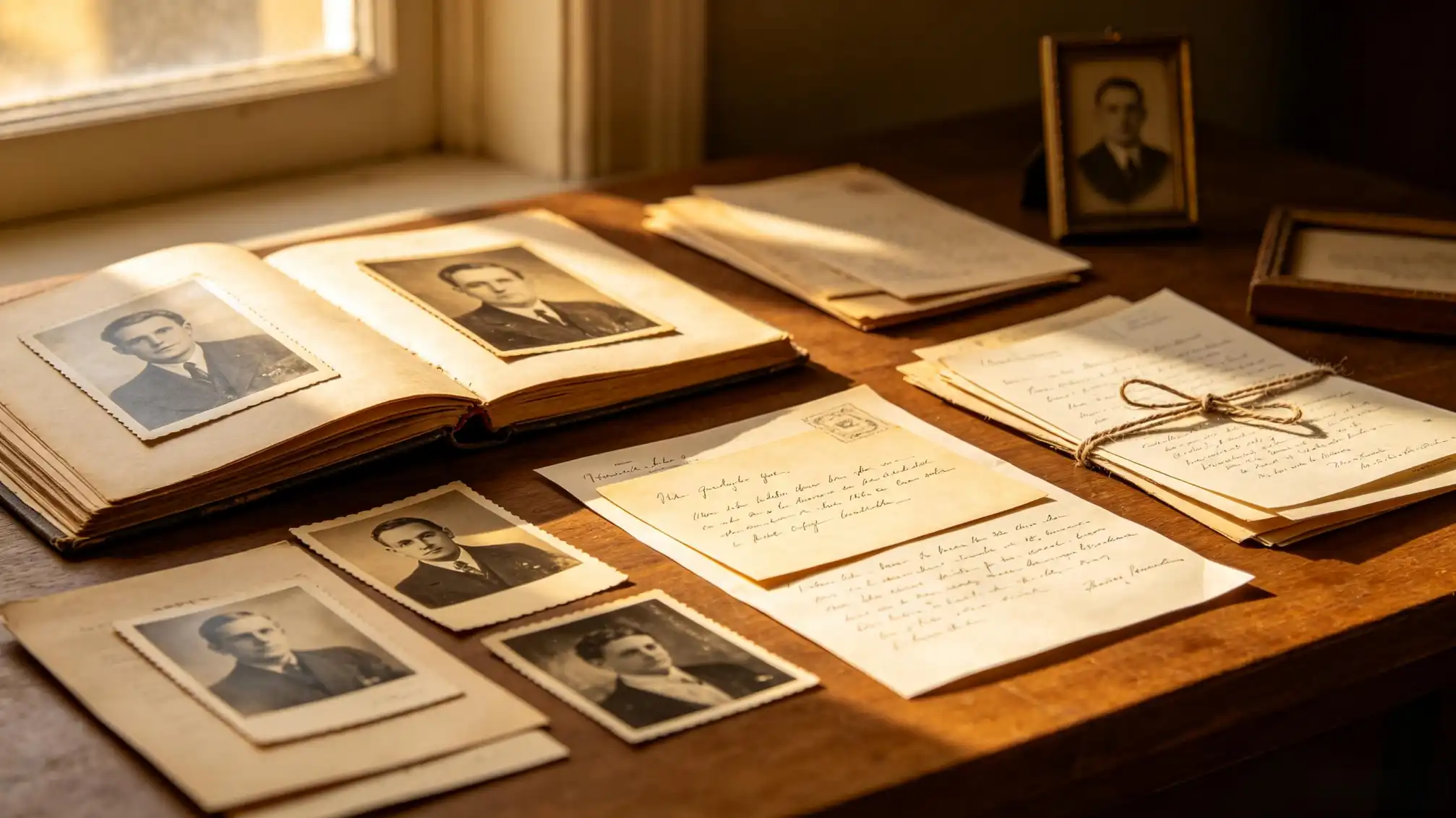
As you gather these items, scan them or make photocopies. Keep the originals safe and never write on them. Label every scan with the name of the person who gave it to you and the date you found it. That small step turns a memory into a citable source.
Interview Relatives With Specific Questions
Do not ask 'Do you remember anything about your grandparents?' Start instead with 'What is your full name, and where were you born?' Then move to parents and grandparents. Ask for exact dates and places: 'Do you know the town where your mother was born?' 'Did anyone in the family use a different spelling of the last name?' 'Which siblings lived longest?' These details give you the exact identifiers needed for record searches.
Record the conversation with your phone and take notes. After the interview, send a thank-you note summarizing the key facts. That reinforces the relationship and gives the relative a chance to correct any errors. If you collect stories that deserve a permanent home, you can upload them to the family story archive at https://www.familylove.love/stories.
Sketch a Working Family Tree
Use paper, a spreadsheet, or dedicated genealogy software. Start with yourself and work backward one generation at a time. Write the last name in capital letters to make sorting easier. For each person, include the full name, date of birth, place, and—if known—date and place of death. Leave blanks for what you do not know.
This simple chart is your research map. It shows you which branch needs work, where you might have two relatives with the same name, and when a family moved from one county to another. The tree also prevents you from randomly jumping between ancestors. Always finish one generation before moving to the next.
Search Official Records One Generation at a Time
Start with the most recent ancestor you can document and work backward. Civil birth, marriage, and death certificates are the backbone of modern genealogy. Census records appear every ten years and reveal household members, addresses, ages, and occupations. Immigration and naturalization papers can list the exact village of origin for immigrant ancestors. Military records, especially those from the two world wars, often include physical descriptions and next of kin.
When you locate a document, record the source citation immediately. Do not rely on memory. A good citation shows which record you found, which archive or website holds the original, and the page or volume number. This makes it possible for other researchers—or your future self—to find the exact same document.
Use DNA as a Directional Tool
A DNA test can connect you with cousins who share a segment of your genome and who may have already researched your common ancestor. Focus on matches that share a known ancestral couple. If you see a cluster of matches all descending from one location, that is a strong hint. But remember that an online family tree attached to a DNA match is only as reliable as the research behind it. Verify a hypothesized relationship through standard records before adding it to your own tree.
Also consider testing the oldest generation in your family. Their DNA covers more of the ancestor pool and makes your research faster. DNA is a clue, not a conclusion. Use it to generate a hypothesis, then confirm it with documents.
Organize Your Evidence With a Research Log
After you collect records, the biggest risk is losing track of which fact came from where. Create a folder for each ancestor and put a research log in every folder. The log should list the date of the search, the collection searched, the specific record found, and a short note about what it proves. When two sources disagree, list both and move on. Do not delete a conflicting record. In genealogical research, contradictions are often the key to solving a family mystery.
When you reach a brick wall, look at siblings of the direct ancestor. Their records can mention your ancestor as a witness, executor, or guardian. Working through collateral relatives is one of the most effective ways to break through a blank generation. Finally, remember that family history is not just about dates. It is about understanding the places your ancestors lived and the choices they made. Once you have documented the facts, write a short biographical sketch for each person. That effort will show you what you still need to learn and will make the research worth sharing.