A family tree template is the closest thing to a shortcut for family history research. Instead of staring at a blank page and wondering where to begin, you can open a ready-made framework that prompts you with boxes, labels, and lines. That structure may feel simple, but it can transform scattered names and dates into a clear picture that future generations can actually follow.
Why a family tree template makes the work feel lighter
Starting from zero is the fastest way to get stuck. A template gives you a visual starting point that already answers the question, 'What do I need to collect?' The boxes on a typical family tree template ask for names, birth dates, marriage dates, and places. When you see those fields laid out, your mind starts filling them in. What you already know becomes visible, and what is missing becomes a research target.
Using a template also prevents duplication. If you are working with a sibling or a cousin, everyone can add to the same structure instead of creating separate versions. And because the relationships are already mapped, you can spot gaps quickly. That is why a family tree template is one of the most useful tools for both beginners and longtime genealogy buffs.
Choose a free family tree template that fits your research
Not all templates are the same. The best one depends on how you like to work and what you want to understand about your family. A free family tree template is often enough to get you started, but you should look for a format that matches your goal.
- A standard pedigree chart places you at the center and traces parents, grandparents, and great-grandparents in a straight line. It is ideal for seeing direct ancestry at a glance.
- A family group sheet organizes one family unit at a time and includes space for each person's life events. This works well when you want to add details about spouses and children.
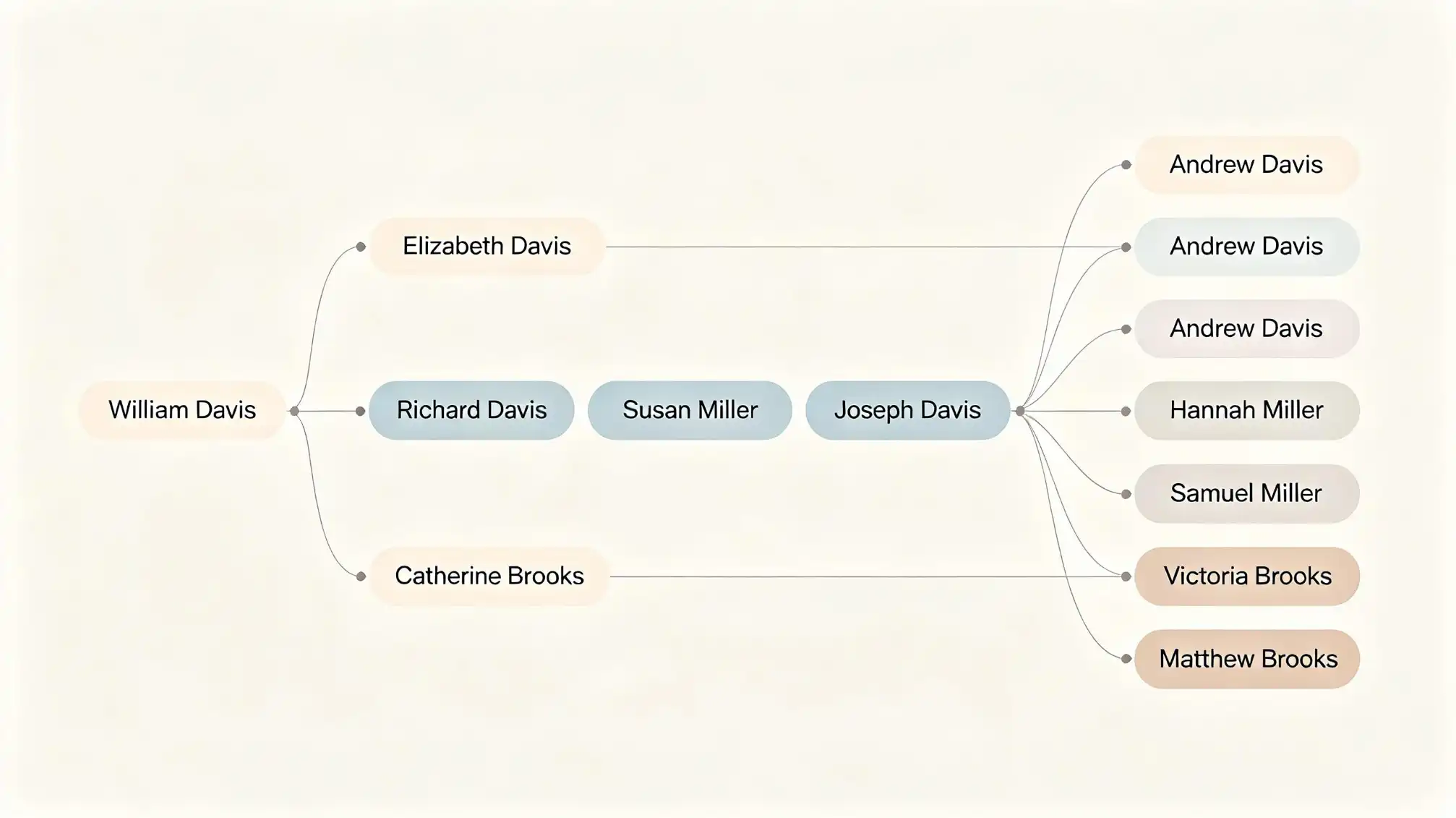
- A visual tree diagram with branches is best for a shared family gallery. It looks beautiful and helps younger family members understand relationships without reading a spreadsheet.
- A family history template with columns for sources, notes, and DNA matches is more advanced. Use it when you need to document where every fact came from.
Gather the basic facts before you write anything in stone
Before you fill in your family tree template, take a quiet hour to jot down everything you already know. Start with yourself, then your parents, then your grandparents. Write names as completely as you can, including maiden names. Add dates and places if you have them. Do not worry about small gaps yet. The purpose is to create a rough draft of your family history template, one that you can verify later.
Once your rough draft is ready, talk to relatives. A quick phone call or text to an older family member can confirm a birthplace or reveal a nickname. These conversations often produce more than facts; they produce the stories that make the template feel alive. Write those stories in the margin or in a separate notes section.
Use the template as a research tracker
A family history template does more than display the final result. It also tells you what to look for next. If a box for a great-grandparent is empty, that is your next research assignment. Keep a list of the missing pieces next to your template. Each time you find a new record, update the template and cross one item off the list.
This method keeps your research focused. Instead of wandering through online databases, you can search for one specific person at a time. If you are using a free family tree template on paper, use a pencil until you have a reliable source. If you are using digital software, link the source directly to the record in the template.
Add photos and stories to your family tree template
A wall of names is useful, but a family tree becomes meaningful when it includes faces and voices. Print the template at a size that leaves room for small photos, or use a digital family history template that supports image attachments. Add a portrait of a grandparent next to their branch, and add a caption with a favorite memory. These small touches make the tree feel like a celebration, not a spreadsheet.
If you are building a visual tree, work in layers. First, place all the verified names and dates. Next, add photos. Finally, add memory prompts such as where someone lived or what they did for a living. The result is a conversation piece for your next family gathering.
Go from a template to a living family space
A single document can be easily lost or forgotten. To make your work last, move your research somewhere your whole family can see and contribute. You can start a dedicated family page on FamilyLove and invite relatives to view the tree, add memories, and correct details. That turns a static free family tree template into a collaborative archive that grows with every generation.
FamilyLove provides a simple space where you can post your family history template, share stories, and keep everyone on the same page. This is especially valuable when relatives live in different cities. Instead of emailing files back and forth, you give everyone one place to go.
Keep improving your family history template
Your first version does not need to be perfect. In fact, treating your family history template as a living document is the healthiest way to approach it. Set aside time once a month to refine it. Add a newly discovered census record, correct a birth year, or scan a photo from an old album. Over time, the small updates turn into a comprehensive family archive.
When you are ready to expand, look for patterns in your family tree template. Did several ancestors live in the same town? Did a surname appear in a different country? These patterns can guide your next research project and give you new questions to ask your relatives.