How to Begin Recording Your Family History Without Getting Lost in the Past
There is a moment when you realize your family's stories are more fragile than you imagined. A grandparent's laugh, the way your mother describes her childhood home, the nickname your great-uncle carried for decades—these are not details you can look up later. They live in memory, and memory, left unrecorded, fades.
If you have been wanting to begin recording your family history but feel unsure where to start, you are not alone. The good news is that you do not need a professional recorder, a complicated app, or a spare month of free time. You need a simple method, a little curiosity, and the willingness to take one small step today.
Family History Is More Than a Family Tree
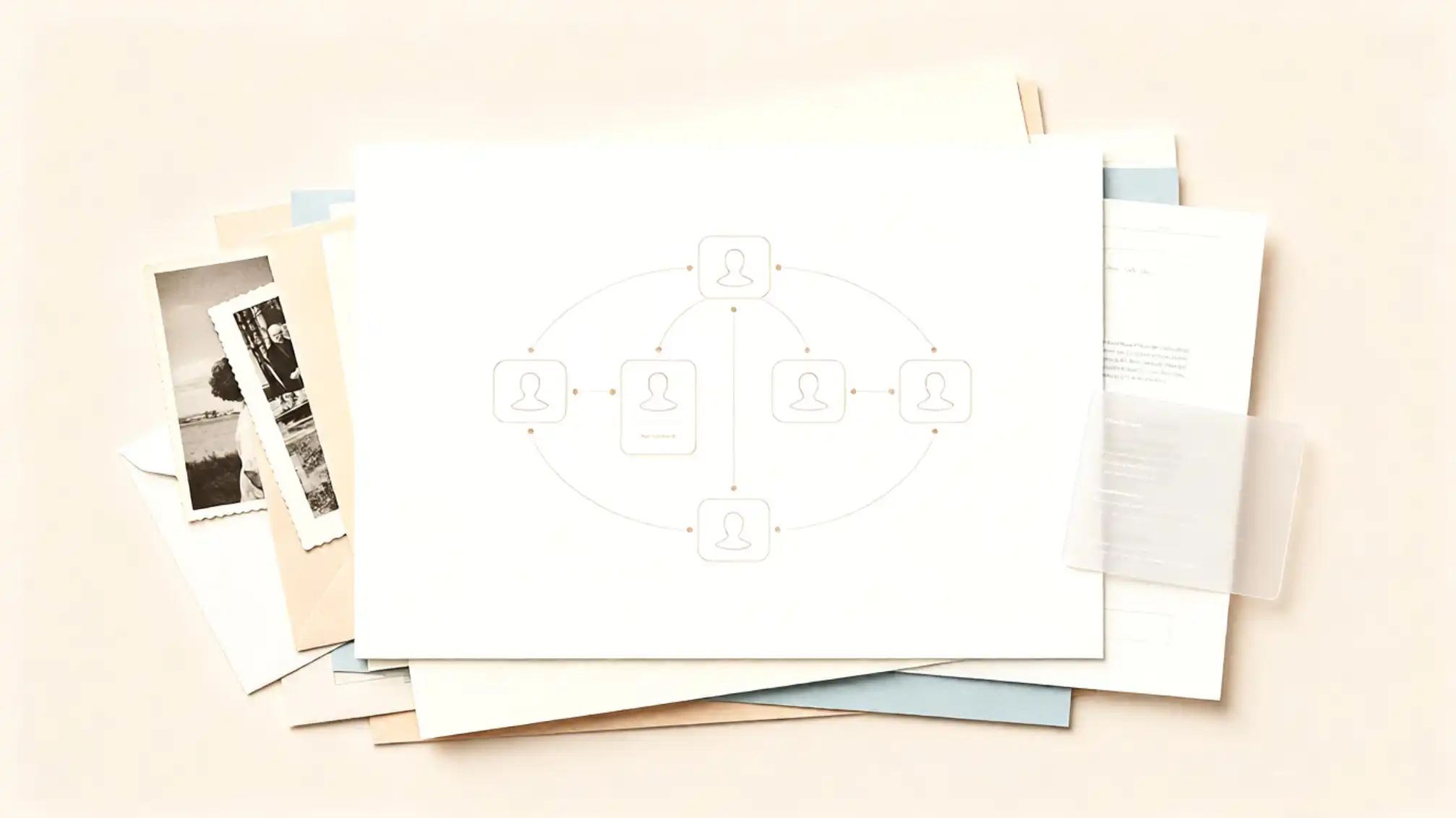
Many people confuse family history with a family tree. A family tree gives you the skeleton: names, dates, places of birth, marriage, and death. It tells you who existed and when they lived. Family history, however, is the breath inside that skeleton. It is the story of why your ancestors left their homeland, how they met, what they feared, and what they hoped for.
This distinction matters because it changes how you approach the work. When you focus only on dates and documents, you can quickly feel overwhelmed by official records and dead ends. When you shift your focus to family stories, everything becomes more human. You are not chasing a birth certificate; you are chasing your father's childhood summers, your grandmother's first job, or the joke your uncle told at every family dinner.
As you begin, hold both tracks together. Use your family tree as a reference to keep the generations straight, but let family stories be your compass. Your goal is not to compile a perfect database. Your goal is to feel that, long after you are gone, the people you loved will still be known.
Start with Your Own Memory
The most accessible place to begin is inside your own head. Before you call relatives, sort through boxes, or search the internet, take a quiet hour to write down what you already know. No fact-checking, no organizing, no judging. Just pour out memories as they come.
Think about the kitchen of your childhood, the sound of a parent's voice, the songs that played during road trips, the smell of a holiday meal. Think about the relatives you met only a few times but still remember clearly. What did they say? How did they make you feel? These fragments are the seeds of your family history.
Write them in a plain notebook, a digital document, or voice memo. Do not worry about grammar or chronology. The act of capturing is more important than the quality of your prose. This “memory inventory” becomes your starting map. When you later talk to relatives, you will have questions to ask and gaps to fill.
Choose a Recording Style That Feels Natural
One of the biggest mistakes new family historians make is turning every conversation into a formal interview with a recorder on the table. That approach can make relatives freeze, especially older ones who may feel pressured to perform. Instead, record family history in the flow of everyday life.
Try keeping a small voice recorder in the kitchen while you cook with your mother. Sit beside your uncle while he looks through an old photo album and let the questions arise naturally. Ask your father about his first motorcycle while you take a walk together. The more casual the setting, the more relaxed the storyteller, and the richer the stories you will capture.
Use open-ended questions that invite memory rather than narrow facts. Instead of asking, “When did you get married?” ask, “Tell me about the day you met your husband.” Instead of asking, “Where did you grow up?” ask, “What did you love most about your childhood neighborhood?” These questions give your relative room to wander, and the detours are often where the most precious details live.
Let Objects Unlock the Past
Family history lives inside tangible things: a yellowed wedding photograph, a handwritten recipe card, a military medal, a pressed flower inside a bible, a letter postmarked seventy years ago. Objects carry memory in a way that conversation sometimes cannot. They invite touch, memory, and emotion.
Gather a few objects from your home or a relative's home and sit with them. Do not rush to photograph or label them immediately. First, allow the stories to surface. Ask your relative what they remember about the object. Who owned it? When was it used? How did it end up in the family?
After you listen, document the object. Write down the story on an archival index card or in your digital notes. If possible, scan or photograph the item so the image and story can live together in your family history collection. Remember to handle original photographs by the edges and keep letters away from direct sunlight. Preservation and storytelling go hand in hand.
Bring Relatives into the Process
You do not have to preserve your family history alone. In fact, you should not. Different relatives hold different pieces of the same puzzle. Your cousin remembers your great-aunt differently than your sibling does. Your grandfather's recollection of an event may differ from your grandmother's. That is not a problem; it is the texture of family history.
One effective way to collaborate is to create shared family story pages where everyone can contribute memories, photos, and comments. If you are looking for a simple way to begin, consider starting a shared page at FamilyLove Stories. You can invite a few trusted relatives to add their own memories, ask questions, and respond to each other's recollections. This turns family history from a solo project into a living conversation.
When you involve relatives, be patient about digital comfort levels. Some will happily type their memories; others will want to send voice notes or have a phone conversation that you transcribe later. Accept every format. The goal is not uniformity; it is shared remembrance.
Embrace the Gaps and the Gray Areas
Family history is not a perfect record. There will be names you cannot pronounce, dates that do not line up, and stories that seem too strange to be true. You may discover that a beloved family legend contradicts a census record. You may find a photograph with no label and no one left to identify the faces.
Resist the urge to tidy these inconsistencies away. Instead, record what you know and mark what you do not. Write, “Handwritten note says 1923, but cemetery stone reads 1925,” or “Aunt Ruth thought this was her great-grandmother, but no one can confirm.” These notes are not failures; they are gifts to future generations, invitations for them to keep exploring.
Ancestors become vivid when you are honest about uncertainty. You can still tell their stories while saying, “We believe,” or “Records suggest.” The mystery around a family tree can be as compelling as the facts. Let it drive your curiosity rather than discourage it.
Build a Simple Rhythm, Not a Grand Project
Most abandoned family history projects begin with too much ambition: “I will scan every photo, interview every relative, and trace every ancestor by summer.” That pressure turns a meaningful practice into a chore. Instead, build a small routine you can actually enjoy.
Set aside fifteen minutes on the same day each week. One week, write a memory you have been thinking about. The next week, scan three photographs. The next, call an older relative and record a ten-minute conversation. Over time, these small actions accumulate into a remarkable archive.
One helpful pattern is to rotate through three activities: capture, organize, and share. Capture means recording new stories or images. Organize means sorting and labeling what you have. Share means sending a memory to a relative, posting a story page, or simply reading a recorded story aloud in a quiet moment. This cycle keeps the work alive without demanding perfection.
You do not need to finish your family history, because it is never truly finished. Every new generation adds new layers, new questions, and new stories. Your role is simply to begin and to keep going, one gentle step at a time.