There is a moment in every family history project when a jumble of names and dates begins to feel like an actual story. That moment usually happens when you create a family tree. The branches, lines, and labels are not just decoration. They are the scaffolding that holds your ancestors together and gives future generations a route back to the people who came before them.
More Than a Diagram: What a Family Tree Really Means
At first glance, a family tree looks like a neat chart of names. Look closer, and you will see relationships, choices, migrations, and even silences. A family tree can show you who lived through hardship, who moved across the country, who stayed close to home, and whose memory was quietly carried through the years.
For beginners, the most helpful way to think about a family tree is as a living map. You start with what you know, add what you can prove, and leave room for what still needs to be discovered. That small shift in mindset makes the project less intimidating and more rewarding.
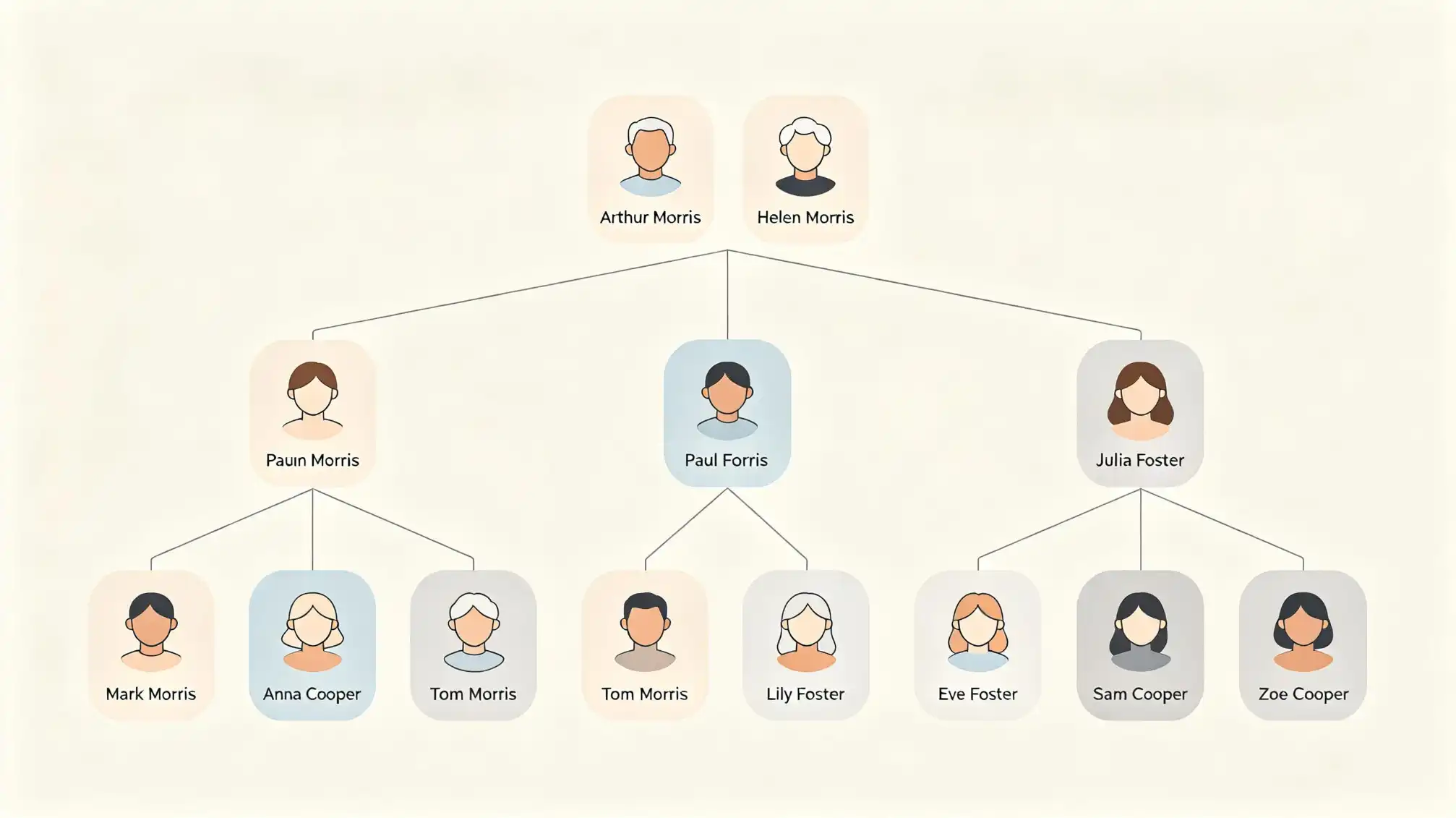
Key Pieces of a Family Tree
Before you start drawing lines between names, it helps to know the basic language of a family tree.
- Ancestors are the people above you in the tree: parents, grandparents, great-grandparents, and every branch that leads further back.
- Descendants are the people below a common ancestor: children, grandchildren, and the expanding family line.
- Siblings and extended relatives fill the side branches of the tree and often provide the richest stories.
- Events are the dates and places that anchor each person in time, including births, marriages, deaths, and moves.
When you can name these pieces, reading someone else’s family tree becomes easier, and building your own becomes clearer.
Why a Family Tree Is Not a Final Product
One of the most common myths in family history is that your tree should be complete or perfect. In practice, a family tree is always a work in progress. Sources can be wrong, names can change, and family stories may be contradicted by official documents. That uncertainty is not a failure. It is an invitation to keep asking questions.
A good family tree records what you know and why you know it. When you add a source or a note next to a name, you turn a family tree from a list into a reliable reference. This is the difference between collecting names and actually practicing genealogy.
How to Start Your Own Family History Tree
The beginning of a family tree does not lie in an old archive. It lies in your own life. Write down your name, your birth information, and the names of your siblings. Then add your parents and grandparents. Work one generation at a time, from known to unknown.
As you fill in each branch, ask relatives for help. Older family members can give you exact spellings, approximate years, and the kind of everyday detail that official records rarely capture. Record their memories, but also make notes about where the information came from. Those notes will save you later.
If you want an accessible starting point, the FamilyLove family hub at https://www.familylove.love/family is designed to help you organize the first branches of your family history without overcomplicating it.
How to Avoid Overwhelm as a Beginner
Family history can feel enormous, especially once you discover how many names lead backward from your own. To stay focused, limit your first tree to four or five generations. It may seem small, but a carefully documented five-generation tree is more useful than a sprawling tree full of guesses.
When you hit a wall, go smaller instead of going further back. Re-read the records you already have, ask a relative to review your names, and look for spelling variations. Sometimes the missing link is hiding in a place you already searched.
The Lasting Value of a Family Tree
When you create a family tree, you are doing something more than organizing information. You are building a bridge between generations. A child who sees a grandparent’s name on a tree begins to understand that they belong to a longer story. An adult who traces a great-grandparent’s migration begins to understand why their family values feel the way they do.
Those benefits are not automatic. They come from the effort you put into the tree, the questions you ask, and the stories you preserve alongside the names. In that sense, every family tree is also a form of gratitude.
When to Update and Revisit Your Tree
Life changes, and so does your family tree. New babies are born, marriages happen, and older relatives pass on. Each of those events is a chance to revisit your tree and keep it current. You may also discover new records online, at courthouses, or through DNA testing. Instead of treating those updates as chores, treat them as opportunities to see your family from a new angle.
A practical habit is to review your tree once or twice a year. Use a moment like the holidays or a family reunion to ask relatives for updates and stories. This keeps the tree alive and creates a reason to gather.