How to Preserve Old Family Photos for Family History
When was the last time you actually looked through the box of family photos in the closet? The one with the bent corners, the faded colors, and the faces you only half-recognize. Old family photos are more than just paper and ink. They are small windows into your family history, and if you don't make a plan for preserving them, those windows may close for good.
The good news is that you don't need a museum budget or professional equipment to protect your family memories. You need a thoughtful system, a little patience, and the intention to keep your ancestors present in everyday life. Here is a fresh way to approach photo preservation that goes beyond "scan it and forget it."
Preservation Is More Than Storage
Preservation starts with a quiet shift in mindset. When you look at a photo, you are seeing a person who once laughed, loved, and made choices that led to you. To preserve old family photos for family history, you want to protect both the physical object and the meaning attached to it. That means asking three questions for every picture: Who is in this photo, where were they, and what do I want my children to know about them?
These questions turn a simple photo box into a family archive. They also help you decide which photos really matter. Not every photo needs to be kept forever, but every photo that you keep deserves to be kept well.
Step 1: Gather and Sort Without Causing Damage
Start by collecting all the photos you can find. Look through drawers, albums, attics, and old purses. Lay them out in a clean, dry room, but don't attempt to repair torn prints or remove photos from sticky albums yet. That's a job for a professional conservator. For now, simply see what you have.
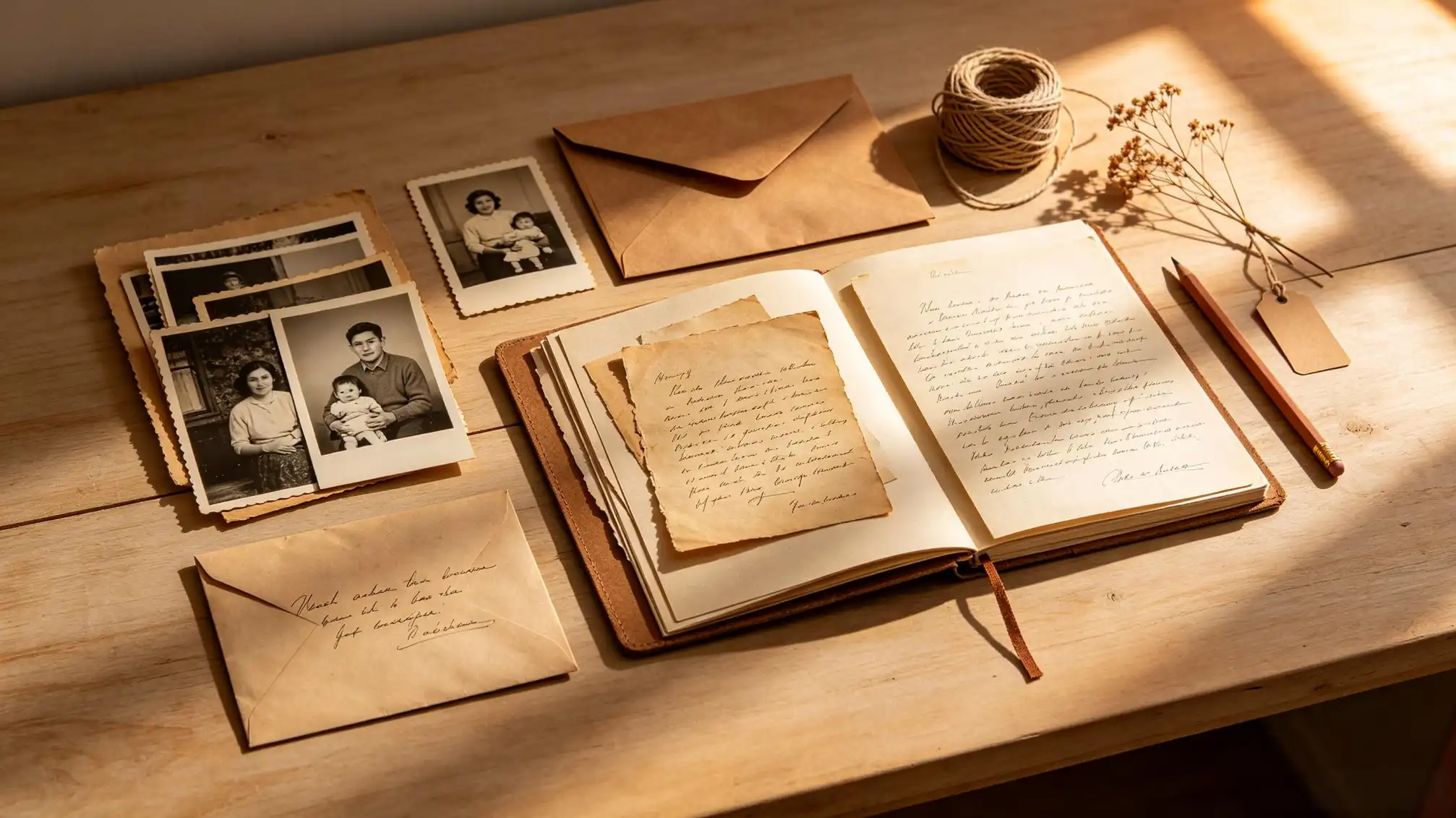
As you sort, make three piles: keep, scan and share, and unknown. For unknown photos, set them aside and ask older relatives later. Sometimes the back of a photo has a name, a date, or a location written in pencil or faded ink. Write down anything you see before you forget it. Don't use pens directly on photos; use a pencil on a separate adhesive label or a photo-safe sleeve.
Step 2: Handle With Care and Store Smart
Old photos are fragile. Grease, moisture, and sunlight are the main enemies. Always handle photos by the edges with clean, dry hands. Cotton gloves help too, but they can feel clumsy; just be gentle. To protect photos against dust and scratches, place each photo in an archival photo sleeve. Use boxes that are acid-free, lignin-free, and labeled for photo storage.
Storage conditions matter more than you might think. Heat, humidity, and direct sunlight speed up fading and yellowing. A cool, dark, dry closet is far better than a sunny shelf. If you can keep the temperature below 70°F and humidity around 40 to 50 percent, your photos will last much longer. Don't store them in the attic or basement where temperatures swing wildly.
Step 3: Scan Once, Store Twice
Scanning is one of the best ways to preserve old family photos for family history because it creates a digital backup that can be shared and recovered. You don't need a fancy scanner; a flatbed scanner with at least 300 dpi works well for most prints. If a photo is small or has detailed faces, scan at 600 dpi to capture the texture. Save the master scan as a TIFF or PNG file, not just a compressed JPEG. You can always make JPEG copies for sharing, but the master file should stay high quality.
Name your files in a consistent way that makes sense for your family. For example, "1945-07-14_Cousin-Margaret_Birthday.jpg" tells you the date, the person, and the event without opening the file. After you finish scanning, store the digital copies in at least two places: one on an external drive and one in a secure cloud service. That way, if a printer fades or a hard drive fails, your family history is safe.
Step 4: Add Names, Places, and Stories
An old photo without context is just a stranger. As you scan, keep a simple notes file for each photo. Include the names of the people, the location, the occasion, and any memory that comes to mind. If you don't know the details, write down what you do know and add a question mark. Future generations will appreciate even a partial clue.
You don't have to write a long essay for every picture. A sentence like "Grandpa Joe on the porch of the farmhouse in Ohio, summer 1952" is enough. Over time, these small details become a rich record of your family's journey. You'll discover that preserving family memories is not just about saving objects; it's about keeping the stories of your ancestors alive.
Step 5: Share With the Family
The final step is sharing. Photos that stay hidden in a box may survive, but they won't live. Make digital albums for different branches of the family, or print a small photo book for a relative who isn't comfortable with computers. Better yet, invite your family to contribute their own memories. You might find that an aunt knows the name of a mysterious woman in a wedding photo, or that a cousin has another copy of a faded group picture.
One thoughtful way to connect photos and stories is to create a family story collection. On our family stories page, you can gather these little pieces of your family history alongside the photos and make them easy for everyone to revisit. This turns preservation into a shared act of love.
Keep the Cycle Going
Preservation isn't a one-time project. It's a habit. Set aside an afternoon every few months to scan and annotate a few more photos. Teach your children to handle old prints with care. Let them hear the stories of the people you love. The more you practice, the more natural it becomes.
Remember, the goal is not to build a perfect archive. The goal is to keep your family memories close and pass them on. Every photo you save is a gift to the future, a handshake between your ancestors and the generations still to come.