How to Turn My Family History into a Family Tree That Tells Your Family’s True Story
Every family has a collection of little moments that define it: a grandmother’s sayings, the recipe your dad always burned, the photograph of great-uncle in his uniform. That is my family history in its rawest, most beautiful form. Too often we think family history means dates, certificates, and archived documents. It doesn’t. It starts with stories. And those stories are exactly what you need to create a family tree that feels alive and meaningful.
A family tree built only from names and dates is like a house without windows. It has structure, but it doesn’t let the light in. When you begin with the stories, every branch you add carries warmth with it. The goal of this guide is to show you how to move naturally from the stories your family tells to a tree you can share, print, and treasure.
Start with Stories, Not Just Names
Sit down with the people you love before you worry about exact birth dates. Ask about their childhood homes, the friendships that shaped them, and the sounds of their grandparents’ voices. These conversations are where family history really lives. Keep a notebook or use your phone to record those chats. You might be surprised how quickly names and places appear once people start remembering out loud.
To make the conversation easier, prepare a few gentle questions ahead of time. “What was your favorite room in the house where you grew up?” or “What did your mother always say when you were about to leave?” are perfect openers. You don’t need an interview script. A few questions are enough to get stories flowing.
For more printable prompts and family conversation ideas, the family page on Family Love offers a warm and practical starting point. It can help you turn an afternoon with relatives into a goldmine of family memories.
Create a Simple Timeline from Memories
After a few conversations, take those memories and write them down as a rough sequence. For each person, list the moments that came to mind: a birth, a move, a marriage, a first job, a favorite summer. You don’t need exact years at first. Write “around 1940” or “before my sister was born.” This is the honest scaffolding of your tree.
As the timeline grows, you will start to see patterns: a generation that moved west, a generation that stayed close to home, a grandfather who followed the same profession as his uncle. These patterns are the hidden texture of your family history. They also give you new questions to ask in the next conversation.
Timelines also help you separate what you know from what you are guessing. When a date is missing, leave a small question mark and move on. You can always fill it in later, and the question mark will remind you to ask that one last question before it slips away.
Sketch the Branches by Hand
Don’t jump straight into a family tree app. There is something powerful about drawing your first family tree on a large sheet of paper. Put yourself at the bottom, your parents above you, your grandparents above them. Add siblings as smaller branches. Then fill in the aunts, uncles, and cousins you know about.
A hand-drawn sketch helps you stay focused on people rather than software. It also makes the gaps obvious: a name you can’t remember, a cousin you always mixed up with another. Those empty spaces are not failures. They are your next round of stories waiting to be collected.
Use different colors for each side of the family, and leave a little room around each name. That extra space gives you a place to add dates, a tiny note, or a small thumbnail photo later. The more breathing room you give each person, the more natural the tree feels.
Layer in Photos, Documents, and Voice
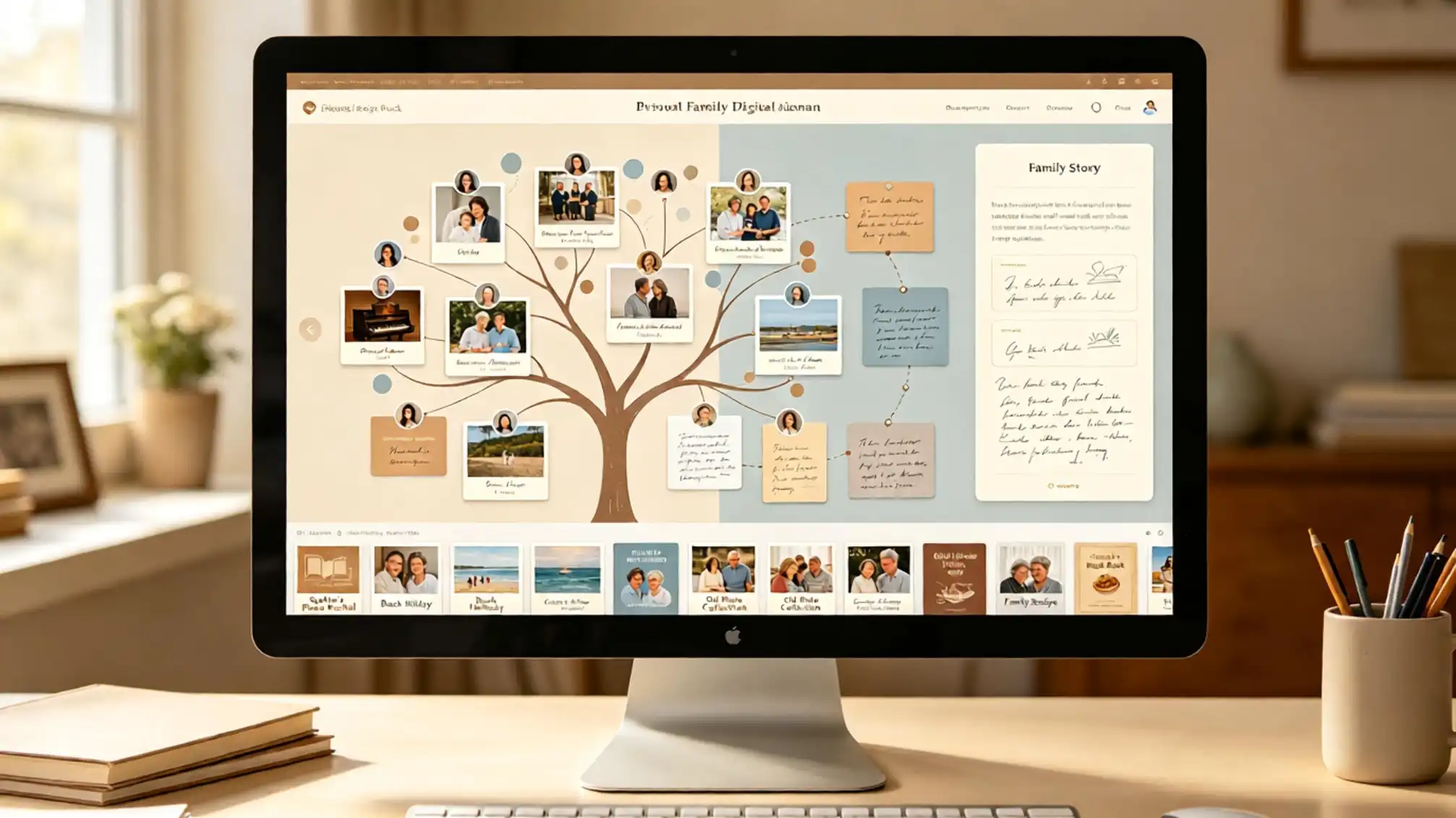
This is where the tree begins to breathe. Attach a photograph to each person when you can. If you have a birthday card, a handwritten recipe, or a letter, add that too. A voice recording of a relative telling a story can be attached to their name just like a date. These small pieces turn a dry chart into a living family album.
As you work, you will probably discover that the same photo appears in several branches. That is a good sign: it means your relatives have already been sharing stories across the generations. Use those shared images as anchors to keep the tree connected.
Don’t worry if you don’t have a photograph for every person. A handwritten note, a postcard stamp, or even a favorite saying can stand in until a photo surfaces. The point is to leave evidence that this person was loved and remembered.
Keep the Stories Attached to the People
Names and dates are only the skeleton. The heart of a family tree is the story behind each name. Write a small line under each person: “always sang while cooking,” “never missed a school play,” “sent postcards from every city he visited.” Those little details are what the younger generation will remember longest.
When you add a story, try to keep the original voice. If you can,use your family member’s exact words. That preserved voice is the most authentic piece of my family history anyone could ask for. It carries personality in a way no statistic ever could.
You can also group stories by theme. Gather all the food-related memories on one page, all the travel stories on another. The themes will reveal who your family really was at the dinner table, on the road, and in the quiet moments in between.
Share the Tree While It’s Still Growing
Perfection is not the goal. Send a rough draft to a cousin and ask if you missed someone. Call an aunt and read her part aloud. Share the photos you have found and see who can add context. Every set of eyes will make the tree more accurate and more meaningful.
Sharing also creates a beautiful side effect: relatives feel invited into the process. Aunts start sending old pictures. Cousins suddenly remember that great-grandmother’s nickname. The tree keeps growing because the family is helping you grow it.
Use the sharing moment as a reason to gather again. You don’t need a holiday. A simple video call works just as well. Pull up the tree, let people see their branches, and ask them to tell you what is missing. The conversation you start today might uncover a story that was almost forgotten.