Why Most Family History Searches Stall
Every family history project starts with curiosity. You want to know who your ancestors were, where they lived, and how their choices shaped the people you come from. But within a few weeks, many researchers stall. They chase the wrong names, trust unverified trees, or jump straight to advanced DNA tests without doing the groundwork first.
The fix is not more hours online. The fix is a better order of operations. If you approach the work the way professional genealogists do, you can trace your ancestors step by step, without redoing your research or feeling lost in the noise.
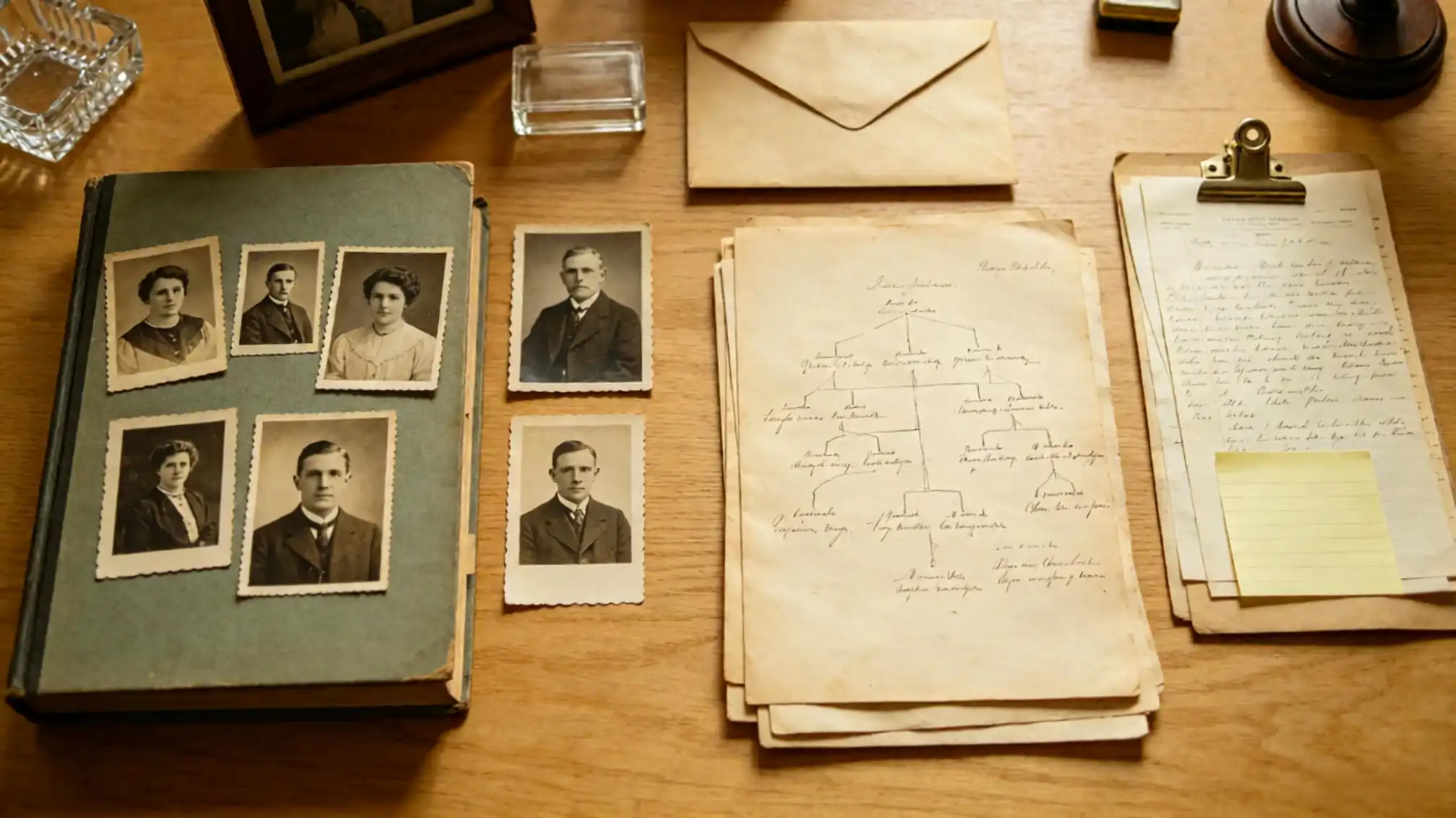
Begin With What You Already Own
Start at home, not in a database. Go through drawers, closets, albums, and boxes. Look for birth certificates, marriage licenses, funeral cards, passports, military records, and letters. Even a scribbled address on the back of a photo can point you to a place where your ancestor lived and worked.
As you collect items, sort them by family line. Use a simple folder system, one for your father's side and one for your mother's side, then break each side into surnames. This small step will keep you sane later when names start multiplying.
Interview the Oldest Relatives First
The people who can answer your earliest questions are often the easiest to overlook. Call or visit the oldest members of your family. Ask open-ended questions about their childhood, their parents, and the stories they heard growing up. Do not worry if you already know some of the answers. The point is to hear it in their own words and to ask one follow-up question you have never thought of before.
Record the conversation, even if it is just voice memo on your phone. Later, you will be grateful for the details you missed the first time. If you do not know where a relative fits into the family tree, sketch a rough diagram as you talk and fill in names later.
Build a Simple Family Tree to Spot Gaps
Once you have a pile of records and a recording or two, write down what you actually know. Do not trust your memory alone. Create a basic family tree chart starting with yourself, then your parents, grandparents, and great-grandparents. Leave blanks for the things you do not know. Those blanks become your research goals.
For each blank, write a specific question. Instead of “find more great-grandparents,” write “find the maiden name of Mary Smith, born around 1900 in Ohio.” Turning a vague interest into a precise question is what separates productive research from endless clicking.
Search Official Records, Not Just Other Trees
When you are ready to move beyond home sources, look for records that were created close to the event. Birth and death certificates, census entries, marriage records, and probate files are the bread and butter of genealogy. They often contain exact dates, addresses, and names of other family members who lived in the same household.
Use the big genealogy websites, but treat every hint as a lead, not as a fact. The best way to trace your ancestors step by step is to verify every new piece of information against at least two independent sources. If a generated family tree on a website says your ancestor was born in 1845, look for the actual census line or a clergy record that confirms that date.
Cluster Research: Look at Neighbors and Relatives
When one ancestor goes quiet, stop staring at their name and look at the people around them. In many older records, families lived in clusters. A future spouse often lived on the next farm. A brother-in-law appears as a witness on a wedding record. A grandmother is listed three houses away in the census.
Create a cluster chart of the ancestor's neighbors, extended family, and associates. This technique frequently breaks down brick walls because it reveals relationships that the main records never state directly. It is a professional approach, but it works just as well for a beginner who is patient.
Preserve Your Stories as You Go
Research can become an endless loop of collecting facts. But the reason you are doing this is not simply to fill a chart. It is to hold a story. When you find a good detail, a date, a place, or a photograph, pause and write one paragraph about what it suggests. What did it take for that ancestor to live through that year? What did their daily life look like? If you want a place to share these fragments as you go, you can post them in the family story collection on Family Love Stories, where relatives can comment and add their own memories.
Do not wait until your research is perfect. The imperfect story shared now is more useful than a polished one locked in a drawer.
Verify, Cite, and Organize Your Findings
Every time you add a name, date, or place to your family tree, record where that detail came from. Write the source on the back of the paper, in a spreadsheet, or in the notes field of your family tree software. A genealogy without sources is just an opinion about the past.
Revisit your earlier research as you learn more. You may discover that a record you trusted was a digitized index with a typo, or that two cousins shared the same name and got mixed into one person. Correcting mistakes is part of the process. Do not treat your family tree as a finished monument; treat it as a living document.