Choosing the right online family tree can feel overwhelming because every platform promises to preserve your family history. The truth is, the best tool is the one that fits how you and your relatives actually work. This guide gives you a clear comparison framework, so you can evaluate features, privacy, and long-term access without getting lost in marketing talk.
What an Online Family Tree Really Does
At its simplest, an online family tree is a searchable database of your ancestors and living relatives. Each person can have a profile with photos, vital records, and links to parents, siblings, children, and partners. The real advantage over a paper chart is that the tree is dynamic. When you add a source, it can be attached to the right person. When a cousin finds a new document, they can update the family tree in seconds rather than redrawing everything by hand.
For people researching genealogy, an online platform also makes it easier to spot missing links. Many tools offer hints from historical records, but a careful family historian still needs to review each match. A good online family tree should feel like a workspace, not just a view-only chart.
Key Features to Compare Before You Choose
As you look at different options, keep these practical features in mind:
- Collaboration controls: Can you invite relatives to view or edit? Are there different permission levels for family, close friends, or the public?
- Source management: Does the tool let you upload images, PDFs, transcripts, and citations? Is the original file visible when someone clicks on a fact?
- Chart options and exports: Can you generate a simple family tree, an ancestor fan chart, or a detailed descendant report? Can you export a GEDCOM file if you ever switch platforms?
- Privacy and geolocation: For living people, are profiles hidden by default? Can you control what appears on public search engines?
- Mobile access: Will you be able to add a photo from your phone at a family reunion or update a profile from a tablet?
These points matter because the best online family tree is the one that you and your relatives will keep using.
Digital vs. Paper: A New Way to Preserve Family History
A paper family tree often stops with one person's memory. Digital tools encourage ongoing contributions from multiple generations. An aunt in another city can scan a wartime letter, a cousin can correct a birth date, and a grandchild can attach a recording of a grandparent telling a favorite story. Over time, the tree becomes the family's shared memory, not a single person's project.
If you want to see how a shared process like this works in practice, take a look at the family hub to see how profiles, photos, and relationship connections come together in one simple view.
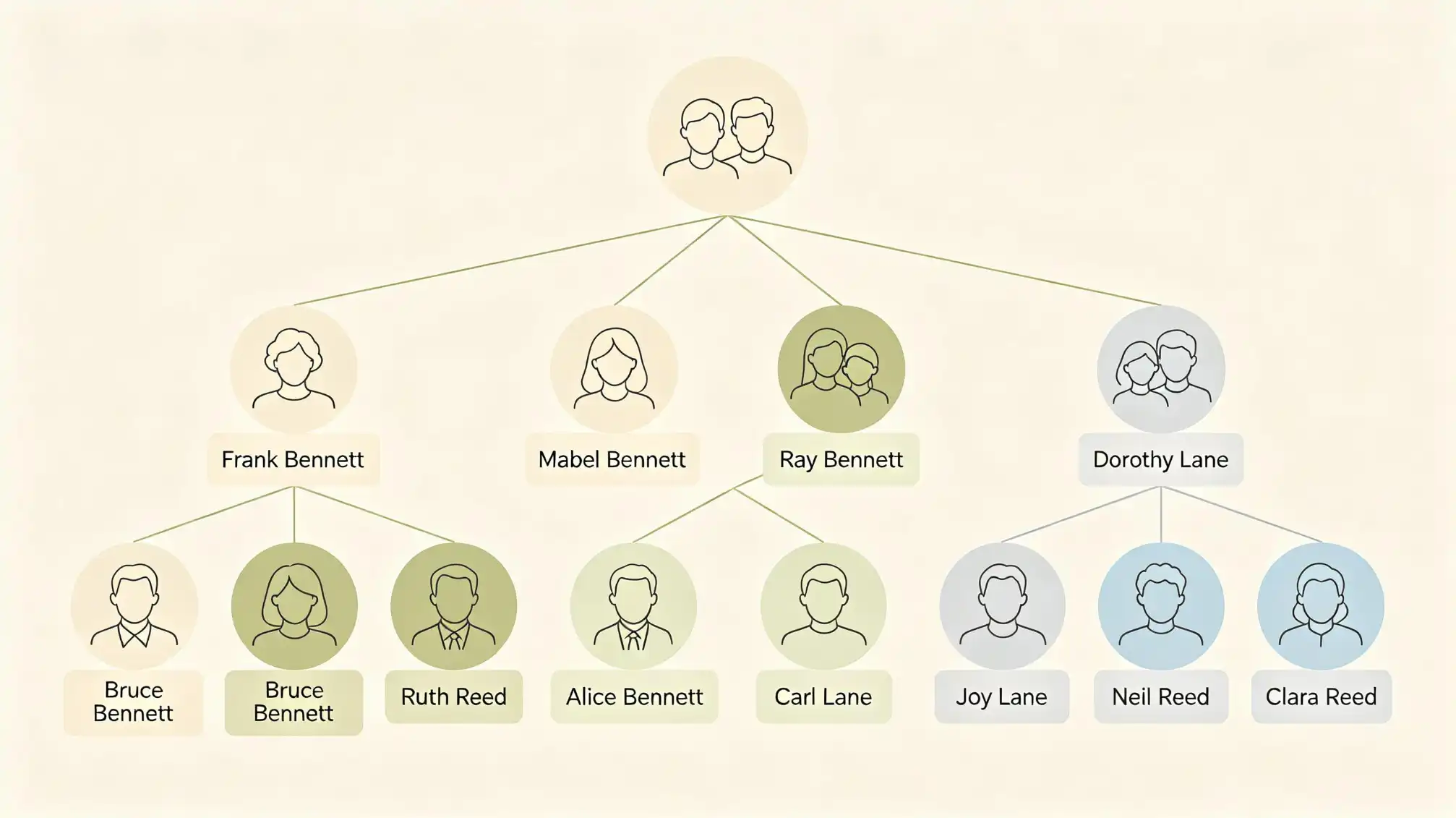
Chart Styles and Visualizations Matter More Than You Think
One feature that separates online family tree tools is the variety of charts they offer. Some families prefer a classic pedigree chart with ancestors branching left to right. Others need a descendant chart to illustrate uncles, aunts, and cousins. Still others use a fan chart to see several generations at a glance. Before you commit, check whether the tool allows you to switch between chart styles without changing the underlying data. If a platform only offers one view, you may outgrow it quickly.
Also consider how the chart handles uncertain or conflicting facts. A good tool allows you to add notes or mark a date as approximate. This is especially useful when oral family history and official records do not quite agree.
Data Ownership and Long-Term Access
One of the biggest concerns when comparing online family tree platforms is what happens to your data if you close your account or if the service changes. Before you commit, read the terms around data ownership. Many platforms allow you to export your family tree and files, but the format and the level of detail can vary. A platform that lets you download photos, notes, and citations gives you more security than one that locks everything inside a proprietary chart.
Similarly, think about long-term access. A family tree is not something you build in one weekend. You want a platform that has a clear backup policy and a stable team. If you are not sure where to start, look for a help center or documentation that explains export options in plain language.
Privacy: Balancing Sharing and Protection
One of the real strengths of an online family tree is the ability to share with the right people. But with that comes a responsibility to protect living relatives. Look for platforms that let you mark a person as living and keep their details private. Also check whether the platform's default search visibility is set to public or private. Some genealogy services make member trees public by default; others require an explicit invitation. Decide what feels right for your family and choose a tool that matches that comfort level.
Cost and Subscription Models
Price is an important factor, but it should not be the only one. Some online family tree tools are free with limited uploads, while others charge a subscription for advanced charts, record hints, or unlimited collaboration. Make a list of the features your family will actually use. If you only need a simple tree and photo storage, a free plan may be enough. If you are actively researching genealogy, look for a paid plan that includes source citations and cloud backup without surprising overage fees.
Getting Started Without Overcomplicating It
If you are new to family history, start with a small branch. Add your grandparents, their parents, and one or two siblings. Add photos and dates you already know. Then invite a close relative to verify the details. Once you see how the tree behaves, you can expand. The goal is not to build a perfect tree overnight; it is to create a place where family stories can grow.