Family Memories That Stay: Turning One Shared Corner Into Your Family's Living Story
Most families aren't short on memories. We're short on containers for them. The photos live in three phones and a laptop that won't turn on. The stories live in Grandma's head. The good intentions live in a group chat that went quiet in 2021.
The fix isn't a bigger archive. It's a smaller, shared, visible place — one corner of the house where your family's story is allowed to sit out in the open, get touched, get added to, and get talked about. Here's how to build it, together, without turning it into a project that nobody finishes.
Why a Shared Space Does Something a Shoebox Can't
A memory that stays hidden stays static. A memory that sits in the middle of daily life keeps recruiting new ones. When a photo hangs where everybody walks past it, it stops being an artifact and starts being a conversation starter — the aunt who says, "That was the summer the car broke down in Ohio," and the eight-year-old who suddenly wants to know what Ohio is.
That's the real goal: not preservation as storage, but preservation as participation. A shared space makes your family memories something the whole household maintains, not something one tired person is supposed to do someday.
Start With One Wall, Not the Whole House
The most common failure is trying to organize every photo you own before you display a single one. Don't. Pick one physical spot — the end of a hallway, the side of a fridge, a shelf beside the stairs — and one digital spot, and let everything else stay messy for now.
Your corner needs three layers, and each one has a different job:
- The anchors. Four to six pieces that never move: a wedding portrait, a great-grandparent's immigration photo, the first day of school picture that makes everyone laugh. These give the space its identity.
- The rotating layer. A few frames, a clip line, or a small album that changes seasonally. This keeps the corner alive so people stop seeing it as wallpaper.
- The growing edge. A basket, envelope, or shared folder where new things get dropped without ceremony. This is where the future enters.
That's it. One wall, three layers, and permission to leave the rest alone.
Give Every Picture a Story, Not Just a Face
A photo with no caption becomes anonymous within two generations. A photo with a caption becomes family history. This is the single highest-value habit you can build, and it costs about ninety seconds per picture.
Write captions by hand on the back of prints, and in the description field for digital files. Aim for the answer to three questions: who, when, and why does this matter? "Mom, 1987, the day she got the job she almost didn't apply for" is worth ten unnamed portraits.
Capture the voice, not just the facts
If you can, record a short audio clip and attach it. Sixty seconds of your grandfather describing how he met your grandmother will outlast any formal record you could ever type up. Voice is the part of memory that paper can't hold.
Make Adding Memories a Five-Minute Job
Memory projects die when they require a dedicated afternoon. Design for the tired Tuesday version of your family. Keep a small box or tray next to the memory corner where anyone can drop a print, a ticket stub, a school drawing, or a note. Keep a shared digital folder that everyone can upload to without asking permission.
The rule: capture first, organize later, forgive yourself for the gap between the two. An unsorted photo that exists beats a perfectly catalogued one that never got scanned.
Build the Digital Shelf Beside the Physical One
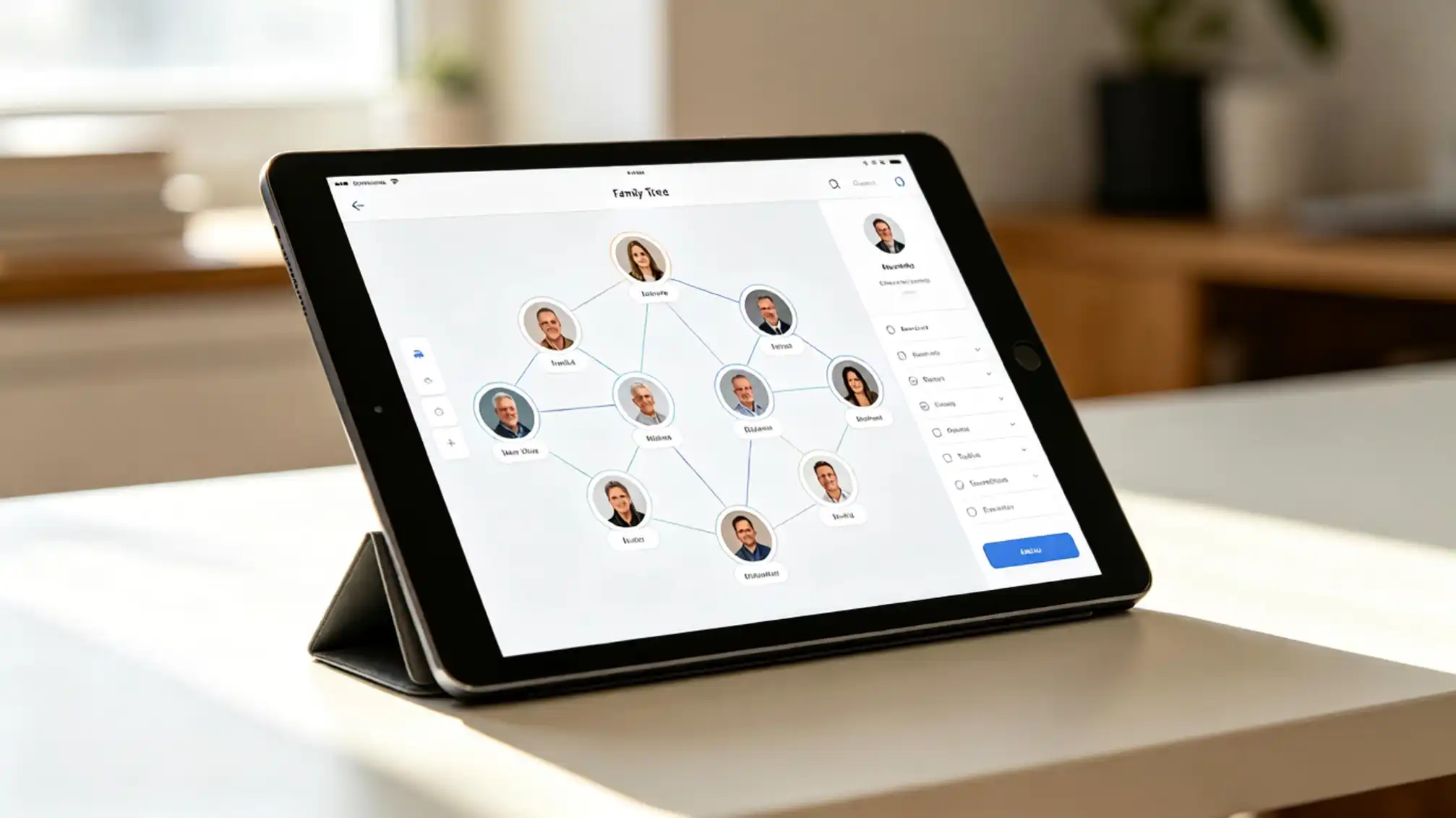
The wall handles warmth. The screen handles reach — cousins in other cities, grandparents who want to look at photos at 11 p.m., the branch of the family that moved away. Treat your digital space as a companion to the wall, not a replacement for it.
When you're ready to give those scattered family photos and stories a real home, you can start collecting your family's stories here — it's a natural next step once your corner has a few anchor pieces and you know which gaps you most want to fill.
Rotate on a Rhythm Everyone Can Predict
Change the corner four times a year — first day of spring, mid-summer, back-to-school, and the winter holidays. Tie each rotation to something real: a birthday, an anniversary, a season, a branch of the family tree.
Turn the swap into a fifteen-minute ritual with snacks. Everyone brings one photo or object to add. Everyone tells the story attached to it. The rotation stops being a chore and becomes the thing the kids actually ask about.
Include Everyone, Especially the Unlikely Contributors
Kids
Give children their own clip or frame to control. Their choices will look chaotic and that's exactly right — it teaches them that my family history is something they help write, not something they inherit finished.
Elders
Don't ask, "Tell me about your life." Ask, "Which of these three photos do you remember most, and what happened right before it was taken?" Specific prompts unlock specific memories. Write down the answers that same day, in their words.
The reluctant teenager
Put them in charge of the digital side, or of scanning. Give them a technical job with visible output and step back. Competence is a much easier sell than nostalgia.
Protect What You Build
A memory corner is only as durable as its weakest copy. Follow the simple 3-2-1 habit: three copies of your digital files, on two different types of storage, with one stored somewhere other than your house. Store prints and negatives away from heat, damp, and direct sun. Label the back of everything in pencil, not marker. And every couple of years, actually open the files to make sure they still load — a backup you've never tested is a hope, not a plan.
A Corner That Keeps Growing
You don't need a beautiful house or a finished archive to begin. You need one wall, one folder, one basket, and a standing invitation for everyone in the family to add something. Start this weekend with a single anchor photo and a single caption. By next year, that corner will be the place your family drifts toward when someone says, "Remember when—" — and this time, it will be written down.