Grandparents Family History: Gentle Questions That Unlock the Stories Behind the Names
There is a moment that happens in almost every family history conversation. You ask about a name on a chart, and your grandfather pauses — not because he doesn't know, but because the name pulls a whole afternoon out of him. A hot porch. A borrowed truck. A brother who never came home. That pause is the whole point. A family tree gives you dates; grandparents family history gives you the reason those dates mattered.
If your goal is to capture oral history before it quietly slips away, the answer isn't a longer list of questions. It's asking the kind of questions that lead somewhere — and knowing when to stop talking and let the story run. Here's how to do that warmly, practically, and without turning your grandmother into a witness on the stand.
Stop interviewing. Start visiting.
The word "interview" changes a room. Shoulders straighten, answers get shorter, and suddenly your grandmother is trying to be accurate instead of being honest. So drop the word entirely. You are not extracting data. You are sitting in a kitchen, drinking something too sweet, and letting someone wander through their own past out loud.
Pick a low-stakes moment — after a meal, during a long drive, while shelling peas. Start with one question and then stay quiet, even when the silence feels long. Most of the good material arrives about thirty seconds after you've decided the conversation is over. Take notes later, in the car, while the phrasing is still in your ears.
Open with the senses, not the census
Facts are stored in a different drawer of the mind than feelings. If you ask for a birth year, you'll get a birth year. If you ask what their street smelled like in summer, you'll get a whole neighbourhood. Sensory prompts work because they're easy to answer and impossible to answer briefly.
Prompts that bring a memory to the surface
- What did your street sound like on a summer evening when you were ten?
- What food did your mother make that you can still taste?
- Who was the first person outside your family you remember trusting?
- What was the worst weather you ever lived through, and what did the family do about it?
- What did you wear to something important, and who paid for it?
- Which song takes you straight back to being young?
- What was you ever came to leaving home for good?
Notice that none of these ask for a name or a date — yet almost every answer arrives with both attached. That's the trick. You collect the facts as a by-product of the story.
Save the deeper questions for later visits
The heavier family history questions need trust, and trust needs a second cup of tea. Once the easy ground is covered, you can gently move toward the parts of the family story that were never explained at the dinner table.
- What do you wish someone had told you about our family twenty years earlier?
- Who in the family was misunderstood, and what did people get wrong about them?
- Was there a time the family had to pull together? What did that look like day to day?
- What did your parents sacrifice that you only understood much later?
- Is there a story about our relatives that you've never told anyone?
- What did you want to be when you were sixteen — and what happened instead?
- Which traditions did we lose, and which ones do you wish we'd kept?
- What would you want your great-grandchildren to know about you that isn't on paper?
Ask one of these per visit, not eight. Then sit back and let it breathe.
Record it without making it awkward
A phone on the table records fine, but it also announces itself. A gentler approach: ask once, up front, whether you can record "so I get the details right." Most grandparents say yes, and many are quietly delighted. Then put the phone slightly off to the side, screen down, and forget it. If they get self-conscious, remind them you're not making a documentary — you're keeping their voice.
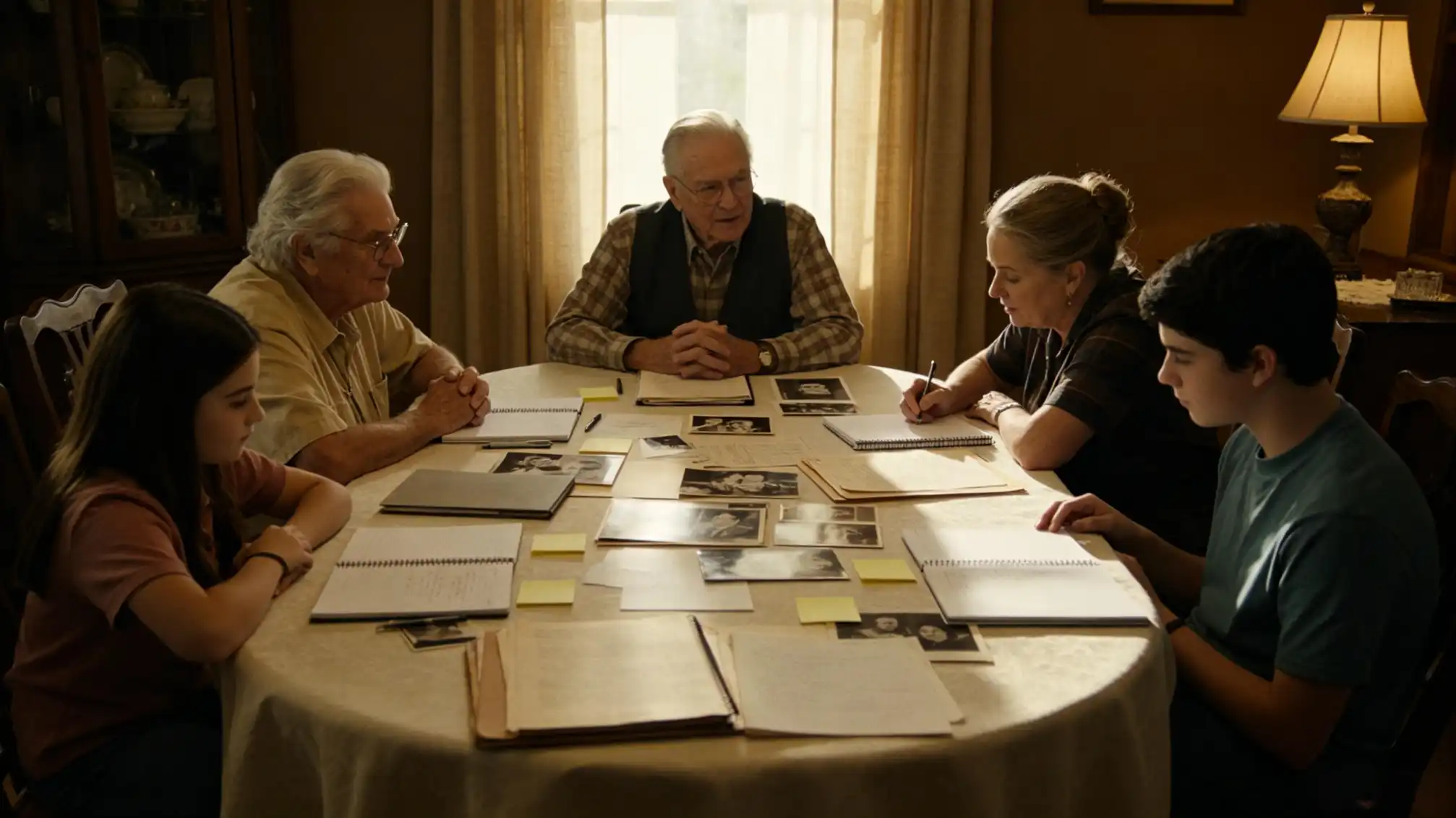
Voice matters more than you think. Years from now, the recording of your grandmother saying your name will be worth more than the transcript. So don't chase clean audio; chase a relaxed speaker.
Follow the thread across relatives
One person's memory is a doorway, not a record. The same event told by two siblings will come out differently — the year shifts, someone's role changes, a person gets left out entirely. That's not dishonesty, it's perspective, and comparing versions is often how you find the truth in the middle.
So when your aunt mentions the summer the family moved, ask your uncle about it next month. Ask a cousin what they were told. Over a few conversations you'll start to see which family stories are shared and which ones belong to one person alone. Both are worth writing down. When you're ready to put those pieces somewhere other people can find them, you can browse family stories for ideas on how other families have set theirs out.
Let imperfect memory be part of the story
At some point your grandmother will say, "I don't remember," or give two different answers in the same hour. Resist the urge to correct. Uncertainty is information. When someone isn't sure whether a relative died in the spring or the autumn, that gap tells you how sudden the loss was — how little time anyone had to hold on to the details.
Write down the hesitations too: "she thinks it was the year of the flood." Those small notes are often what later lets you line up an oral history with a document and finally pin a date down. And if your grandparent wants to change a story or take something back, honour that. A living person's comfort outranks a perfect archive.
What to do with what you collect
Within a day of each conversation, type up your notes, label the recording with the date and who was present, and file it somewhere more durable than your camera roll. Add the person's relationship to you, not just their name — "Dad's mother" saves your future self a headache. Keep a running list of names that came up, because that list is your next round of relatives to call.
Do one small thing after every conversation. A single paragraph transcribed beats an entire archive that lives only in your good intentions.