Grandparents Family History: Turning Everyday Chats Into Stories Worth Keeping
Most of us mean to ask. We sit across the kitchen table, pass the potatoes, and think: I should record this. Then the plates get cleared, the moment closes, and another year slips by. The good news is that grandparents family history doesn't require a research trip, a scanner, or a formal interview. It requires a chair, an hour, and a question a little more specific than "tell me about your childhood."
This guide is about turning ordinary visits into a collection of family stories you can actually keep — recordings, notes, photographs, and the small details that make relatives feel like people instead of names on a chart.
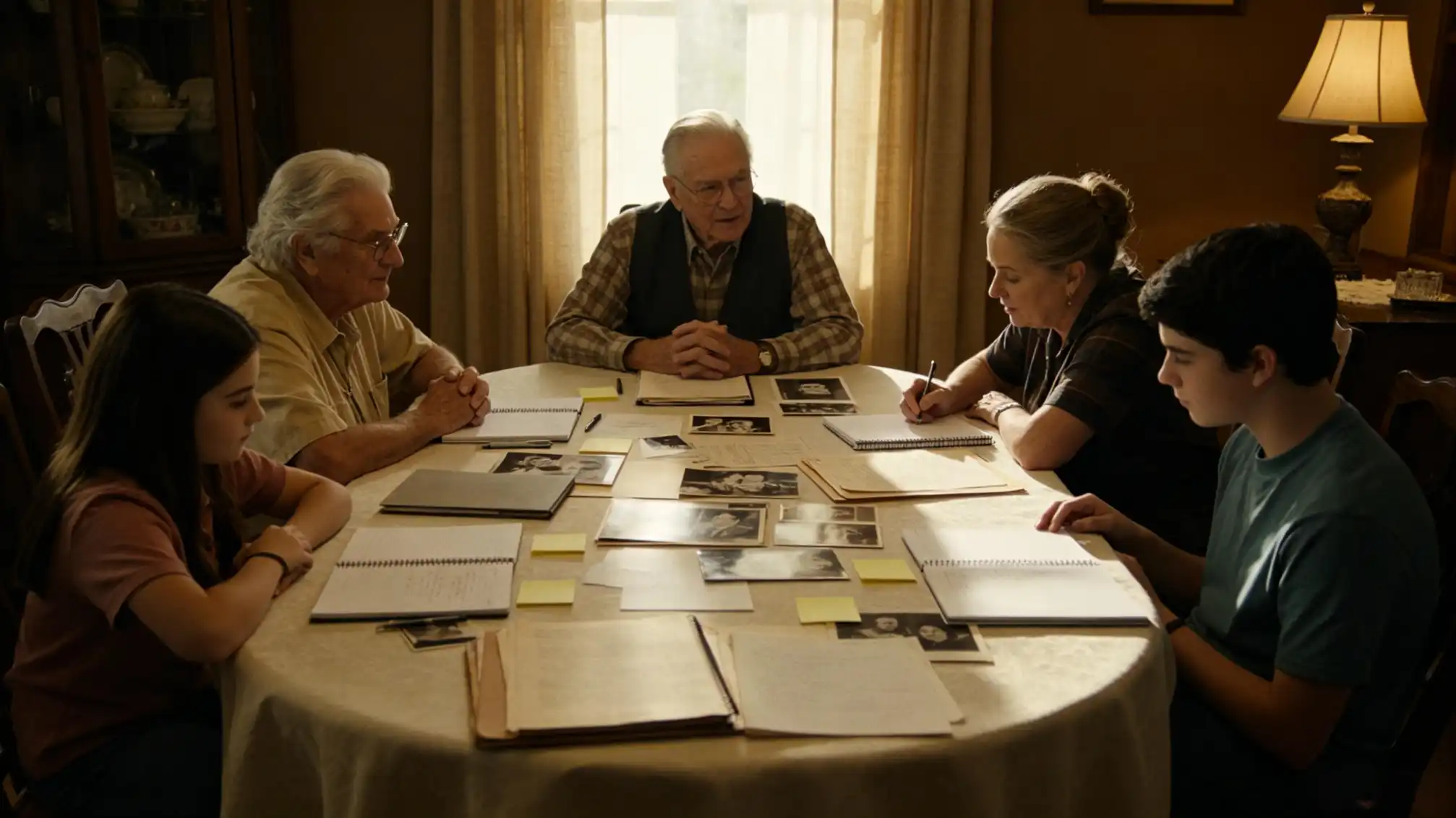
Why the Small Questions Beat the Big Ones
Ask someone to summarize their whole life and you'll usually get a polite shrug. Ask what the family ate on Sunday nights and you'll get a fifteen-minute answer full of voices, smells, and your grandmother's exact phrase for "stop dawdling." Specific prompts unlock memory; broad ones ask for a performance.
So trade "What was it like growing up?" for "Who taught you to ride a bike, and did you fall?" Instead of "Tell me about your parents," try "What did your mother do when she was worried about something?" The narrower the door, the more likely it opens.
Start With the Senses, Not the Dates
Dates and place names can often be found in documents, censuses, and old letters. What cannot be found anywhere else is what the house sounded like at night, what your great-grandfather's hands smelled like after work, or which song played when your grandparents first danced. Sensory questions reach memory through a side entrance, and once a person is back inside a moment, the facts tend to follow on their own.
Keep a notebook beside you during these conversations — not to write while they talk, but to jot the details you want to follow up on later: a town name, a nickname, a cousin you've never heard mentioned.
Family History Questions That Open Doors
Treat these as conversation starters rather than a checklist. Ask two or three, then let the answers lead. A hesitant response usually means the question is too large; a long one means you've found something worth staying with.
Childhood and Home
- What did your bedroom look like, and who did you share it with?
- Which chore did you dread most, and who usually got stuck with it?
- What did the neighborhood smell like in summer?
- Who was the strictest adult in the family, and were they right to be?
Work, Money, and Everyday Life
- What was your first job, and what did you do with the first money you earned?
- What did groceries cost when you were raising your kids?
- Was there a season when money was tight? How did the family get through it?
Love, Marriage, and Family Ties
- How did you meet your partner, and what did you notice first?
- What did your in-laws think of you in the beginning?
- Which relatives were you closest to, and what kept you close over the years?
Hard Times and Turning Points
- What is the hardest thing your family got through together?
- Was there a decision that changed the direction of your life?
- What do you wish you had asked your own parents while you still could?
That final one may be the most valuable family history question of all. It often produces a list of names and stories you'd never have known to ask about — and those become your next conversations with older relatives in other branches of the family.
What to Bring (It's Less Than You Think)
- A phone with a voice recorder. Ask permission before you press record, and say why you want it.
- Two or three printed photos. Old pictures are memory keys; hand them over and watch what surfaces.
- A notebook for names, spellings, and places you want to verify later.
- Unhurried time. Don't schedule this between errands or during a holiday rush.
Test the recorder once before the real conversation, then set the phone closer to your grandparent than to you — their voice is the point. If they dislike being recorded, take written notes instead and read a few back to them at the end. You'll often get corrections and extra detail, which is its own small gift.
Listening Well Means Following the Tangent
The best material usually hides in the detour. If your grandfather suddenly mentions a cousin nobody in the family talks about, don't steer back to your list. Say, "Tell me about him." A few phrases keep things moving without feeling like an interrogation: "What happened next?" "What did that feel like?" "Who else was there?" And silence is fine — some of the richest answers arrive after a pause.
Be ready for emotion, too. Memory doesn't file itself neatly, and a light question about school lunches can land next to a loss. If a story turns painful, let them decide how far to go. Say, "We can stop whenever you want," and mean it. Trust matters more than a complete archive.
Turn Recordings Into Family Stories While You Still Can
An audio file sitting on a phone is remarkably easy to lose. Within a few days, write down the date, who was speaking, and three sentences about what you covered. Then transcribe just the best five minutes — you don't need a full transcript to make a memory usable.
Once you have a handful of these, shape them into short written stories: the kind future relatives can read on a phone rather than listen to on a laptop that no longer exists. Keeping them in one place rather than scattered across group chats makes an enormous difference. You can post and organize them at familylove.love/stories, where the whole family can read, add photos, and fill in the gaps you missed.
While you're at it, capture the details researchers always wish they had: maiden names, correct spellings, towns that may have changed names or borders, and the nicknames that appear in old letters instead of legal names.
Bring the Next Generation In
Children ask better questions than adults do, because they haven't yet learned what's supposedly not polite to mention. Let a grandchild hold the recorder, or interview a great-grandparent for a school project. The result is usually a mix of comedy and unexpected honesty — and it teaches kids early that family stories are something you collect, not something you inherit passively.
Whatever your setup, start small. One relative, one hour, one open question. The archive builds itself from there.