{
"title": "Grandparents Family History: How to Capture the Stories While They Are Still Being Told",
"metaTitle": "Grandparents Family History: Capture Their Stories Now",
"metaDescription": "A warm, practical guide to collecting grandparents family history. Get the right family history questions, record the answers, and keep family stories safe for the next generation.",
"summary": "Collecting grandparents family history is less about research and more about listening well. This guide shows families how to set up a relaxed interview, which family history questions actually unlock memories, and how to preserve the answers so relatives can enjoy them for decades.",
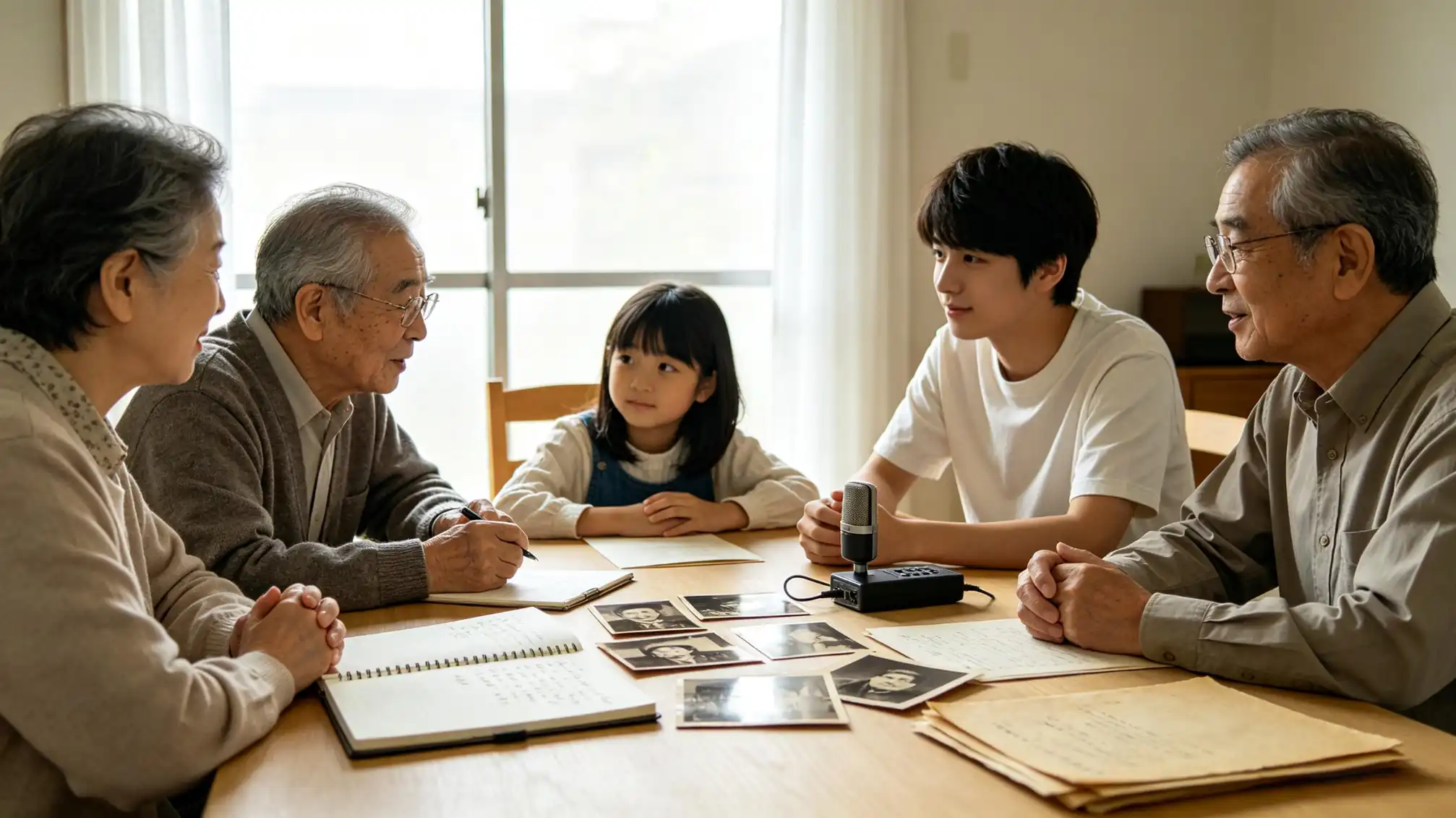
"contentHtml": "<h1>Grandparents Family History: How to Capture the Stories While They Are Still Being Told</h1>\n\n<p>There is a moment that catches almost every family off guard. You are sitting with your grandfather, half-listening, when he mentions a street you have never heard of, a sibling who died young, or a job he quit in 1962 to move across the country. You think, <em>I should write this down</em>. Then the kettle whistles, someone changes the subject, and the story slips away.</p>\n\n<p>Collecting <strong>grandparents family history</strong> does not require a genealogy subscription or a research plan. It requires a willing listener, a handful of good questions, and a simple way to keep what you hear. This guide is written for families who want the real thing — not just names and dates on a chart, but the texture of how their <strong>relatives</strong> actually lived.</p>\n\n<h2>Why the Window Closes Faster Than You Expect</h2>\n\n<p>Memory is generous in the telling and fragile in the keeping. The details that feel unforgettable today — the name of the neighbor who taught your grandmother to bake, the reason your grandfather left his hometown — often dissolve within a single generation if nobody records them. What survives is usually whatever was repeated out loud often enough to stick.</p>\n\n<p>You do not need to interview everyone at once. Start with one relative, one hour, one recording. That is genuinely enough to begin, and it is far better than waiting for the perfect family reunion that never quite gets scheduled.</p>\n\n<h2>Set the Stage So Stories Can Surface</h2>\n\n<h3>Choose familiar ground</h3>\n\n<p>Memory is place-dependent. A grandparent sitting in their own kitchen, with their own photos within arm's reach, will recall far more than they will in a noisy restaurant. Bring a photo album, a shoebox of letters, or an address book and let them leaf through it while you talk. Objects are excellent prompts.</p>\n\n<h3>Ask one question, then follow the thread</h3>\n\n<p>The biggest mistake families make is arriving with a printed list of forty questions and marching through it like a survey. A better rhythm: ask one open question, listen fully, and then ask about whatever detail caught your ear. Follow-up questions almost always produce better material than the original question did.</p>\n\n<figure><img src=\"https://r2.familylove.love/static/seo/interviewscene2.webp\" alt=\"Grandparent and grandchild talking together during a relaxed recorded family history interview at home\" /><figcaption>A relaxed one-on-one conversation at home teases out far more detail than a formal sit-down interview ever will.</figcaption></figure>\n\n<h2>Family History Questions That Open Real Doors</h2>\n\n<p>Use these as starting points, not a script. Skip anything that lands awkwardly and circle back later. If your grandparent grew up in difficult circumstances, let them decide how deep to go.</p>\n\n<h3>Beginnings: childhood and place</h3>\n\n<ul>\n<li>Where did you sleep as a child, and who else was in the room?</li>\<li>What did your street sound like on a summer evening?</li>\n>What was your favourite meal as a kid, and who made it?</li>\n<liWhat was school like for you — and how far did you have to travel?</li>\n</ul>\n\n<h3>Family ties and relatives</h>\n\n<ul>\n<li>Who in the family were you closest to, and why?</li>\n<li>What do you remember about your own grandparents?</li>\n<li>Were there relatives nobody talked about? What happened?</li>\n<liWhich family stories were told over and over at gatherings?</li>\n</ul>\n\n<h3>Love, work, and everyday life</3>\n\n<ul>\n<li>How did you meet your partner, and what was your first impression?</li>\n<li>What was your first job, and what did it pay?</li>\n<li>What did a normal Saturday look like when your children were small?</li>\n<li>What did you worry about most back then?</li>\n</ul>\n\n<h3>Turning points and hard chapters</h3>\n\n<ul>\n<li>What is the biggest you ever had to make?</li>\n<li>When did life change direction for you, and did you see it coming?</li>\n>What was the hardest year, and how did you get through?</li>\n<li>What do you you had known at twenty-five?</li>\</ul>\n\n<h3>Legacy and wishes</h3>\\n<ul>\n<li>What do you hope your grandchildren remember about you?</li>\n<li>What tradition should we keep, and which one should we let go of?</li>\n<li>What advice would you give the youngest person in the family?</>\n</ul>\n\n<h2>The Follow-Up Questions Do the Heavy Lifting</h2>\n\n<p>When an answer arrives, resist the urge to move on. Try these instead:</p>\n\n<ul>\n<li>What did that feel like at the time?</li>\n<li>Who else was there?</li>\n<li>What happened next?</li>\n<li>How did the family react?</li>\n<li>Can you tell me more about that day?</li>\n</>\n\n<p>Those five prompts will carry you through an hour without ever needing a new topic. They also signal you are genuinely listening, which is what makes a grandparent comfortable enough to share the parts they usually leave out.</p>\n\n2>Keep What You Hear Before Drifts</h2>\n\n<p>Recording is ideal, but only with permission — ask plainly and explain what you plan to do with it. If a grandparent is camera-shy, an audio recorder is far less intimidating than a phone pointed at their face. Older relatives are often more relaxed when you scribble notes on paper and read a few to confirm you got the spelling right.</p>\n\n<p>A few habits make the difference between a nice afternoon and a real archive:</p>\n\n<ul>\n<li>Write the full name, date, and location at the top of every note or file.</li>\n<li>Spell names out loud and ask for maiden names, nicknames, and village names.</li>\n>Photograph old photos, then note who is in each one while your grandparent is still there to say.</li>\n<li>Transcribe key passages within a week, while the voices are still in your ears.</li>\n</ul>\n\n<h2>Turn Fragments Into a Family Archive</h2>\n\n<p>Scattered recordings on three different phones will eventually disappear. Give the material a home. You can publish your grandparent's story, add photos, and invite <strong>relatives</strong> to contribute their own memories and corrections at <a href=\"://www.familylove.love/stories">FamilyLove Stories</a> — a simple way to keep <strong>family stories</strong> in one place where cousins, aunts, and uncles can read and add to them.</p>\n\n<p>Do not wait for a polished narrative. A messy, honest collection of first-person memories is far more valuable to the next generation than a tidy timeline with no voices in it.</p>\n\n<h1>Practical Steps</h1>\n\n<ul>\n<li><strong>Start your shared family story page:</strong> open <a href=\"https://www.familylove.l/stories\">https://www.family.love/stories</>, publish the first memory you have already collected, and invite relatives to add theirs.</li>\n<li><strong>For more help and guidance:</strong> visit <a href=\"https://www.familylove.love/docs\">https://www.familylove.love/docs</a> for-by-step support on recording, organising, and preserving your family history.</li>\n</ul>",
"images": [
"httpsr2.familylove.love/static/seoviewscene2.webp"
]
}