Relatives in Order: A Structured Guide to Family Tree Mapping
Mapping your relatives in a family tree is more than a hobby—it's a way to preserve family history and clarify family relationships for future generations. Yet without a system, the task quickly becomes chaotic. Duplicate entries, misconnected branches, and uncertain relationships can turn a rewarding project into a frustrating puzzle. This guide provides a clear, structured approach to organizing relatives so that your family tree remains accurate, navigable, and useful.
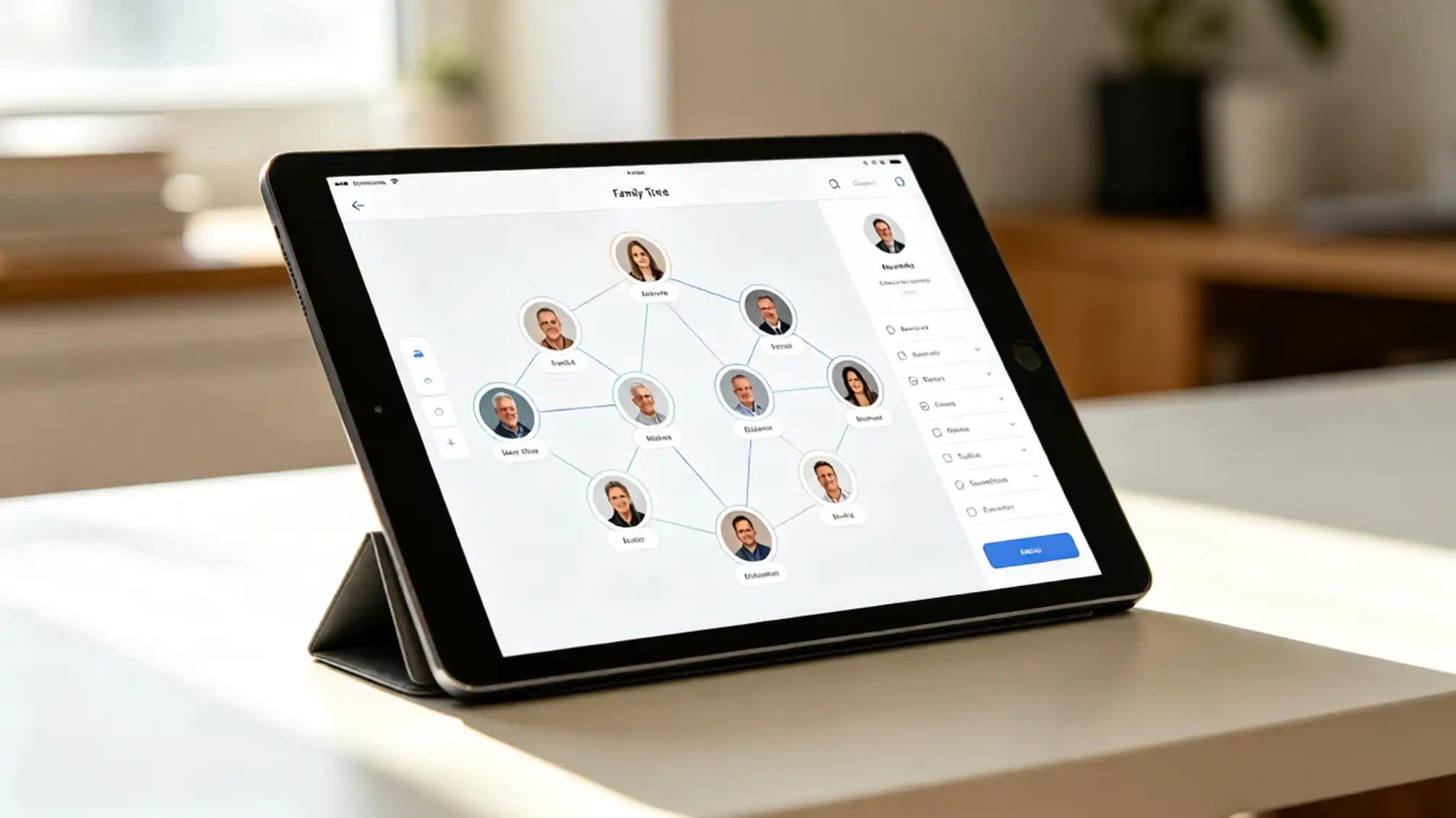
Why a Clear Structure Matters for Family Relationships
When you first start building a family tree, you might be tempted to add every name you find. But a tree without structure becomes a tangle of connections that's hard to verify or expand. A clear organization system helps you:
- See how relatives are connected across generations.
- Avoid duplicate profiles and conflicting information.
- Identify missing branches or gaps in your family history.
- Share your tree with relatives and collaborate effectively.
Think of your family tree as a map. Without a legend and a compass, it's just lines on paper. With a system, every relative has a place and a purpose.
Start with the Four Grandparent Lines
The simplest way to begin organizing relatives is to divide your tree into four main branches: your paternal grandfather's line, your paternal grandmother's line, your maternal grandfather's line, and your maternal grandmother's line. Each branch represents a distinct family history that can be researched separately.
Assign a unique identifier to each direct ancestor. For example, you could use:
- PGF – Paternal grandfather
- PGM – Paternal grandmother
- MGF – Maternal grandfather
- MGM – Maternal grandmother
From these four, you can work backward to great-grandparents and forward to aunts, uncles, and cousins. This skeletal structure prevents you from getting lost in collateral lines too early.
Mapping Relatives by Relationship Type
Once your core branches are in place, you can systematically add other relatives. Grouping them by relationship type keeps the tree logical.
Direct Ancestors
Your direct ancestors are your parents, grandparents, great-grandparents, and so on. For these, the Ahnentafel numbering system is widely used. You are number 1, your father is 2, your mother is 3, your paternal grandfather is 4, paternal grandmother 5, maternal grandfather 6, maternal grandmother 7, and so on. The formula is simple: for any person n, their father is 2n and their mother is 2n+1. This system instantly tells you the generation and line of any ancestor.
Siblings, Aunts, Uncles, and Cousins
Collateral relatives—siblings, aunts, uncles, cousins—are often where chaos creeps in. Assign them IDs linked to their parents. For instance, if your father is person 2, his siblings could be 2-S1, 2-S2, and so on. Their children (your cousins) could be 2-S1-C1, 2-S1-C2, etc. While this looks complex, it ensures every person is traceable to a common ancestor.
Alternatively, use a simpler naming convention: 'Aunt Mary (sister of Father)' and 'Cousin John (son of Aunt Mary)'. Consistency matters more than the specific format.
In-Laws, Step-Relatives, and Adoptive Relationships
Modern families include many relationship types that don't fit traditional bloodlines. Label them clearly to avoid confusion. Use tags like 'spouse of', 'step', 'adoptive', or 'foster'. For example, 'Jane Doe (spouse of Uncle Robert)' or 'Tom Smith (step-son of Aunt Mary)'. There's no universal standard, but being explicit helps anyone reading your tree understand the connection.
Distant Cousins and Collateral Lines
As you go beyond second cousins, the tree can explode in size. Instead of trying to map every descendant, focus on the connection point—the common ancestor. Create separate 'satellite' trees for distant branches and link them to the main tree through that ancestor. This keeps your core tree manageable while still documenting extended relatives.
A Practical Numbering and Naming System
Choosing a numbering system early saves hours of rework. For ancestors, Ahnentafel is the gold standard. For descendants, consider the Register system (also called the Modified Register), where you are 1, your children are 1.1, 1.2, your grandchildren 1.1.1, 1.1.2, and so on. This creates a clear hierarchy.
For collateral relatives, you can combine systems. For example, assign a prefix for the branch (P for paternal, M for maternal), then use a sequential number. Document your chosen system in a legend at the top of your tree so that anyone—including your future self—can understand it.
Documenting Sources and Uncertainties
Every relationship in your tree should be backed by a source. Whether it's a birth certificate, census record, or a family story, note where the information came from. This is crucial for family history accuracy. When a relationship is uncertain, mark it with a question mark or a confidence level (e.g., 'probable', 'unverified').
Use notes fields to explain discrepancies or conflicting information. For example, if a census lists a child you haven't identified, add a note rather than ignoring it. Future research may clarify the connection.
Keeping the Tree Manageable as It Grows
As you add more relatives, your tree can become visually cluttered. Most genealogy software offers different views: direct ancestors only, all descendants, or a fan chart. Use these views to focus on one branch at a time.
Regularly review your tree for duplicates and merge profiles when you find them. A quarterly 'clean-up' session can prevent small errors from compounding.
Collaborating with Relatives to Verify Information
Family trees are rarely built alone. Sharing your tree with relatives not only enriches the data but also helps verify relationships. When multiple family members contribute, you gain different perspectives and memories.
For a shared space to map these connections, you can use your family page to invite relatives and centralize updates. This makes it easy for everyone to see the same information and suggest corrections.
Be mindful of privacy for living individuals. Most platforms allow you to hide details for living people, which is important for security.
Common Pitfalls to Avoid
- Assuming relationships without evidence: Just because two people share a surname doesn't mean they're related.
- Ignoring half-siblings and non-traditional families: These relationships are just as important and should be clearly labeled.
- Inconsistent naming: Use full legal names as the primary name, with nicknames in parentheses.
- Forgetting sources: Without sources, your tree is just a list of names.
- Overcomplicating early: Build a solid core before adding distant cousins.
Tools and Templates for Organizing Relatives
Many online platforms and software programs offer family tree builders with built-in numbering systems and relationship calculators. Choose one that supports the systems you prefer. A simple spreadsheet can also work if you're comfortable managing the structure yourself. The key is to have a consistent data entry template: name, birth, death, marriage, parents, children, and notes.
Bringing It All Together
Organizing relatives in a family tree is a process of layering: start with the four grandparent lines, apply a numbering system, add collateral relatives methodically, document everything, and collaborate with family. Over time, your tree becomes a rich tapestry of family relationships that honors your family history and serves as a valuable resource for generations to come.