How to Build a Family Tree From the Relatives Sitting at Your Table
Most people imagine a family tree as a stiff chart filled with names they have never met. In practice, the best trees begin with the people who already pass you the potatoes at dinner: your parents, your grandparents, and the aunts and uncles who remember stories nobody ever wrote down. Learning how to build a family tree is less about dusty archives and more about asking good questions in a sensible order.
The method below moves one generation at a time, so your notes stay accurate and your relatives stay willing to help. It works whether you are building a tree for a reunion, a photo book, or a private record you plan to hand to your children.
Start With Living Memory, Not With Records
New researchers often jump straight into searchable databases and end up with dozens of unconnected names and no idea how they relate to each. A stronger approach is to begin with what only living relatives can tell you: nicknames, hometowns, approximate birth years, occupations, and the reasons families moved from one place to another. Those details are the bridges that later help you match a document to a real person instead of guessing.
Treat your first draft as a skeleton rather than a finished chart. Names and relationships first; documents and photographs later. This order matters because records are indexed by the names your ancestors actually used, which is rarely the name the family used at home.
Draw the Skeleton Before You Collect Details
Sketch a simple three-generation layout on paper or in a spreadsheet before you start collecting anything else:
- Generation 1: you, plus your siblings and your partner if relevant.
- Generation 2: your parents, their siblings, and their spouses.
- Generation 3: your four grandparents, their siblings, and any great-grandparents still remembered by name.
Leave generous space between entries. You will add columns for birth dates, marriage dates, places, and sources, and you will need far more room than you expect. If you prefer to work digitally, choose one tool and commit to it, because migrating a half-finished tree between formats is the fastest way to lose details.
Interview One Generation at a Time
Talking to parents and grandparents together often produces a version of events that pleases everybody and informs nobody. Separate conversations tend to be richer, and grandparents frequently recall their own grandparents in surprising detail, which is exactly the generation you cannot reach any other way.
Ask open questions and then stay quiet. A pause of five seconds often produces the most useful sentence of the afternoon. Record the conversation if your relative agrees, and write your notes up the same day while context is still fresh.
Questions that unlock real detail
- What were your parents' full names, including middle names?
- Where were they born, and where did they live as children?
- Did anyone in the family change a surname, and why?
- Which siblings were oldest and youngest, and who moved away first?
- What jobs, trades, or military service appear in the family?
- Who kept the photographs, letters, or the family Bible?
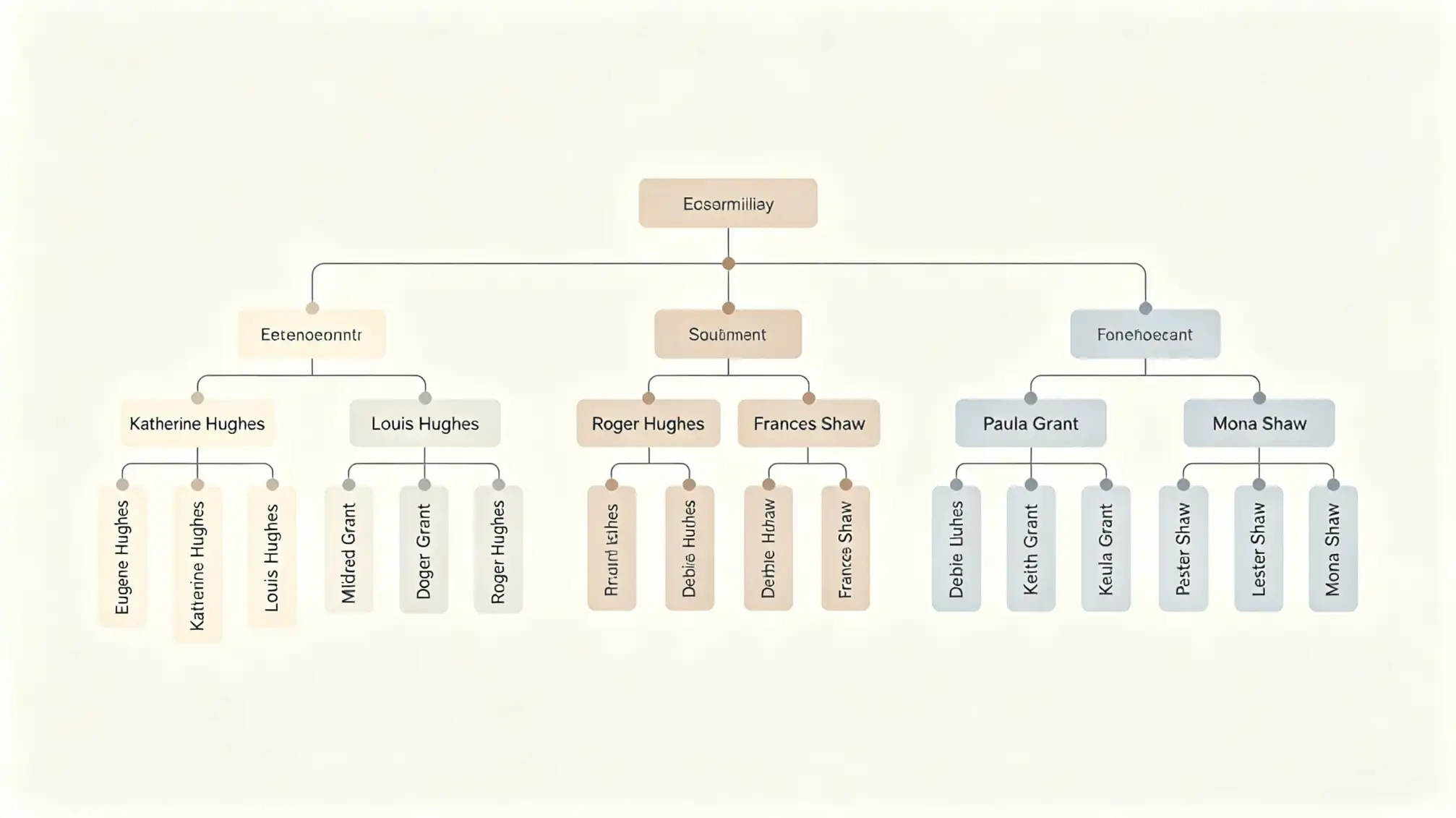
Organize Parents, Grandparents, and Siblings Without Confusion
Once names start multiplying, inconsistency becomes the biggest enemy of accuracy. Decide on a format on day one and never drift from it.
- Write maiden names in brackets: Margaret [Doyle] Reilly.
- Use full birth dates where known, and write "abt. 1932" when you only have a year.
- Record places from smallest to largest: town, county, country.
- Add a short source note for every fact you did not hear firsthand.
Half-siblings, step-parents, adoptions, and remarriages belong on the tree too. A family tree is a record of real relationships, not a tidy version of them. Note the relationship type beside each branch so that future readers understand how every person connects, and keep a short note about anyone whose details are uncertain.
Verify and Fill the Gaps
Once the interviews are exhausted, move to documents. Vital records, census returns, immigration lists, and newspaper announcements confirm dates and reveal names that oral history softened or skipped entirely. Crossing two independent sources is the standard for accepting a fact as settled.
When a record conflicts with a relative's memory, keep both versions and note the disagreement. Contradictions are not failures; they are clues pointing to a second marriage, a name change, or a family story that was carefully edited before it reached you.
Common Mistakes That Slow Beginners Down
A few habits cause most of the frustration people hit in their first year:
- Adding unverified people to fill blank branches. An empty space is honest; a wrong ancestor is a problem you will unpick for years.
- Chasing famous or royal connections. Focus on the direct line of parents and grandparents first, then widen.
- Skipping the source note. Two months later you will not remember whether a date came from a certificate or a cousin's guess.
- Doing it all alone. Relatives hold pieces you will never find in a database.
Keep the Tree Alive After the First Draft
A family tree that lives only in a notebook gets forgotten within a year. Sharing it is what turns a personal project into something relatives actually contribute to. Rather than emailing updated files back and forth, keep your connections in one place where family members can see how they fit into the wider picture — the family section at https://www.familylove.love/family is a straightforward way to do exactly that.
Set a small recurring habit: one hour a month to add a document, correct a date, or call an older relative. Trees grow fastest in short, steady sessions, and a tree that family members can see is one they will keep adding to.
Finally, write the stories down alongside the dates. A birth year tells you when someone lived; a note about why they left home tells you who they were. That combination is what makes a family tree worth passing on to the next generation.