Building Your First Family Tree: A Beginner's Roadmap to Getting It Right
Most family history projects begin with a single unanswered question: who came before me, and what were they like? That curiosity is a good starting point, but it can quickly turn overwhelming once you discover dozens of record collections, contradictory dates, and distant cousins with the same name. The beginners who succeed are rarely the ones who find the most dramatic ancestor. They are the ones who build slowly, document carefully, and keep their tree organized from the very first entry.
This roadmap is written for people opening a blank family tree for the first time. It focuses on method rather than luck, because a well-structured tree is what turns scattered names into a genuine family history.
Begin With the Family You Already Know
New researchers often rush straight to online databases and search for a great-grandparent whose name they barely remember. That approach produces guesswork. Instead, start with yourself and move outward through the people whose details you can confirm without research: your parents, siblings, grandparents, aunts, uncles, and first cousins.
The three-generation starting point
A practical first goal is three generations — you, your parents, and your grandparents. That is roughly a dozen people, and it gives you a stable foundation before you touch a single archive. Once those entries are complete, extending the tree backward becomes a matter of adding branches rather than repairing a shaky trunk.
Write down the basics before you search
For each person, capture full name (including maiden names), date and place of birth, date and place of marriage, date and place of death, and the names of their parents and spouse. Even incomplete entries are useful, because a missing field tells you exactly what to look for next. Keep a short research note beside any fact you are unsure about so you do not accidentally treat a guess as confirmed.
Decide How You Will Store and Grow Your Family Tree
Before entering dozens of names, choose the format that will hold your family tree for the next several years. Switching systems halfway through a project is one of the most common causes of duplicated work and lost notes.
Paper charts, spreadsheets, and dedicated software
A printed pedigree chart is excellent for visualising direct ancestry and works well for a first draft. A spreadsheet offers more flexibility, allowing you to add columns for sources, notes, and confidence levels. Dedicated genealogy software or a reputable online platform adds automatic relationship calculation, duplicate detection, and export options. Many beginners use a hybrid approach: a spreadsheet for raw research and software for the finished tree.
Consistency matters more than the tool
Whatever you choose, use it consistently. Every person should have one entry, not three variations scattered across notebooks and apps. If you keep physical notes, scan or photograph them regularly so a single lost folder does not erase months of work.
Work Backward, One Generation at a Time
Genealogy is researched backward, not forward. You identify a person, confirm their parents, then move to those parents in turn. Jumping three generations ahead because a name looks promising almost always creates a branch attached to the wrong family.
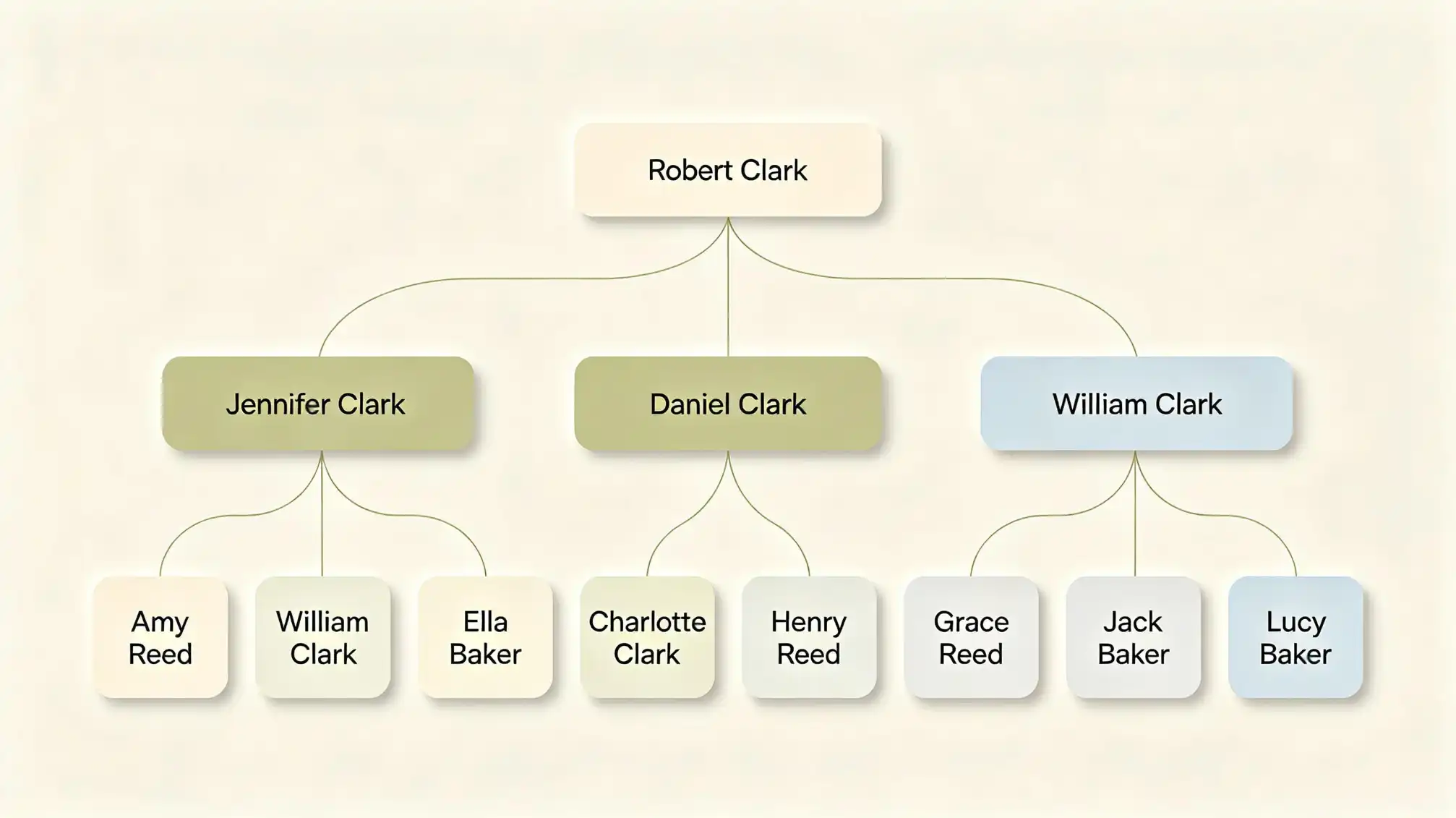
A useful habit is to finish one generation as completely as possible before starting the next. If you cannot confirm a parent, mark the gap and move sideways to a sibling or cousin of the same generation. Those collateral relatives often appear in records that the direct ancestor does not, which can eventually unlock the missing link.
Confirm Facts Before You Add Them
A family tree becomes valuable when its claims can be trusted. Treat every new fact as unverified until you have seen evidence, and record where that evidence came from — a certificate number, a census page, a parish register, or an interview date.
Primary sources versus secondary sources
A primary source was created at the time of the event by someone with direct knowledge, such as a birth certificate or a marriage register entry. A secondary source retells information later, such as a published family history or an obituary. Secondary sources are useful leads, but they should be confirmed against primary records whenever possible. Indexing errors and transcription mistakes are common, so view the original image rather than trusting a search result alone.
What to do when records conflict
Conflicts are normal. A census may record a slightly different birth year than a death certificate, and both may differ from a family story. Note all versions, weigh which source was closest to the event, and keep the discrepancy visible instead of silently choosing one. Future research often resolves the puzzle.
Interview Living Relatives While You Still Can
Your oldest relatives are irreplaceable sources. Their memories contain names, migrations, occupations, and family sayings that appear in no archive. A single recorded conversation can open an entire line of research.
- What were your parents' and grandparents' full names, including maiden names?
- Where were they born, and where did the family live before that?
- What occupations or trades ran in the family?
- Were there migrations, name changes, or estrangements you should know about?
- Do you have photographs, letters, certificates, or a family Bible?
- Who else in the family keeps records or remembers the older stories?
Record the conversation with permission, and label every photograph you scan with names, approximate dates, and the person who identified them. An unlabelled photograph becomes anonymous within a generation.
Keep Names, Dates, and Places in a Standard Format
Standard formatting prevents confusion later, especially when you are dealing with hundreds of entries. Write surnames in capitals, keep maiden names in parentheses, and choose one date format — for example, 14 March 1932 rather than 3/14/32, which is ambiguous across countries.
For places, record the full historical jurisdiction as it existed at the time of the event: village, district, county, and country. Boundaries and country names change, and a place recorded in its modern form can send you searching in the wrong archive. Adding a short note explaining a historical change is worth the extra minute.
Mistakes That Slow Beginners Down
- Copying entire trees from other users without checking the underlying sources.
- Assuming two people with the same name in the same town are the same person.
- Ignoring women's maiden names, which are essential for tracing maternal lines.
- Leaving photographs and documents unlabelled and undated.
- Working on five branches at once and finishing none.
Avoiding these five habits will keep your family history accurate and, just as importantly, enjoyable.
Where to Get Help and Stay Motivated
Family history is a long project, and progress comes in bursts. Joining a community of people doing the same work keeps you moving when a branch hits a dead end. If you want to connect with others building their trees and share what you have found, the family community at FamilyLove's family section is a practical place to start conversations and compare notes.
Set a small, specific goal each month — confirm one grandparent's birth record, scan one photo album, or interview one relative. Small confirmed additions build a tree that will still make sense to your grandchildren.