What a Family Tree Really Tells You: A Beginner's Guide to Starting Family History
Most people begin with one simple question: who were my grandparents, and where did they come from? A family tree is the tool that answers it — but it is also something more practical than a framed chart on a wall. It is a research framework, a way of organising what you know about your ancestors so that every new name can be checked, connected, and understood in context.
If you are just starting out in genealogy, this guide explains what a family tree actually represents, how to read one, and how to build your own without drowning in paperwork.
A Family Tree Is a Map of Relationships, Not a List of Names
At its simplest, a family tree is a diagram that places you at one point and traces the people connected to you — parents, grandparents, great-grandparents — backwards through time. Lines show descent, and boxes or branches hold names, dates and places.
But the diagram is only the surface. Underneath it sits a body of evidence: birth and marriage certificates, census returns, parish registers, photographs, letters, newspaper notices, and the memories of living relatives. The chart is the summary; the research is the substance.
That distinction shapes how you work. Someone who treats family history as a hunt for names will copy a stranger's online tree and quietly inherit that stranger's errors. Someone who treats it as a research project records where each fact came from and can still defend it years later.
The Building Blocks That Hold a Tree Together
Your direct line and the branches beside it
Beginners usually focus on direct ancestors — parents, grandparents, and so on. A complete tree also includes collateral relatives: siblings, aunts, uncles and cousins. These side branches frequently hold the clues. An uncle's marriage record may name the town where your grandmother was born; a cousin's obituary may list siblings you never knew existed.
Generations, not just dates
Genealogists think in generations. Each step back roughly doubles the number of people you are looking for: two parents, four grandparents, eight great-grandparents, sixteen great-great-grandparents. That doubling explains why records thin out so quickly beyond four or five generations, and why patience matters far more than speed.
Sources — the part beginners skip
Every fact in a well-built tree should point to a source. That might be an official certificate, a parish register, a census page, a newspaper announcement, or a family Bible. Recording sources as you go takes seconds; reconstructing them five years later can take weeks. This single habit separates a reliable tree from an entertaining story.
How to Read a Family Tree Diagram
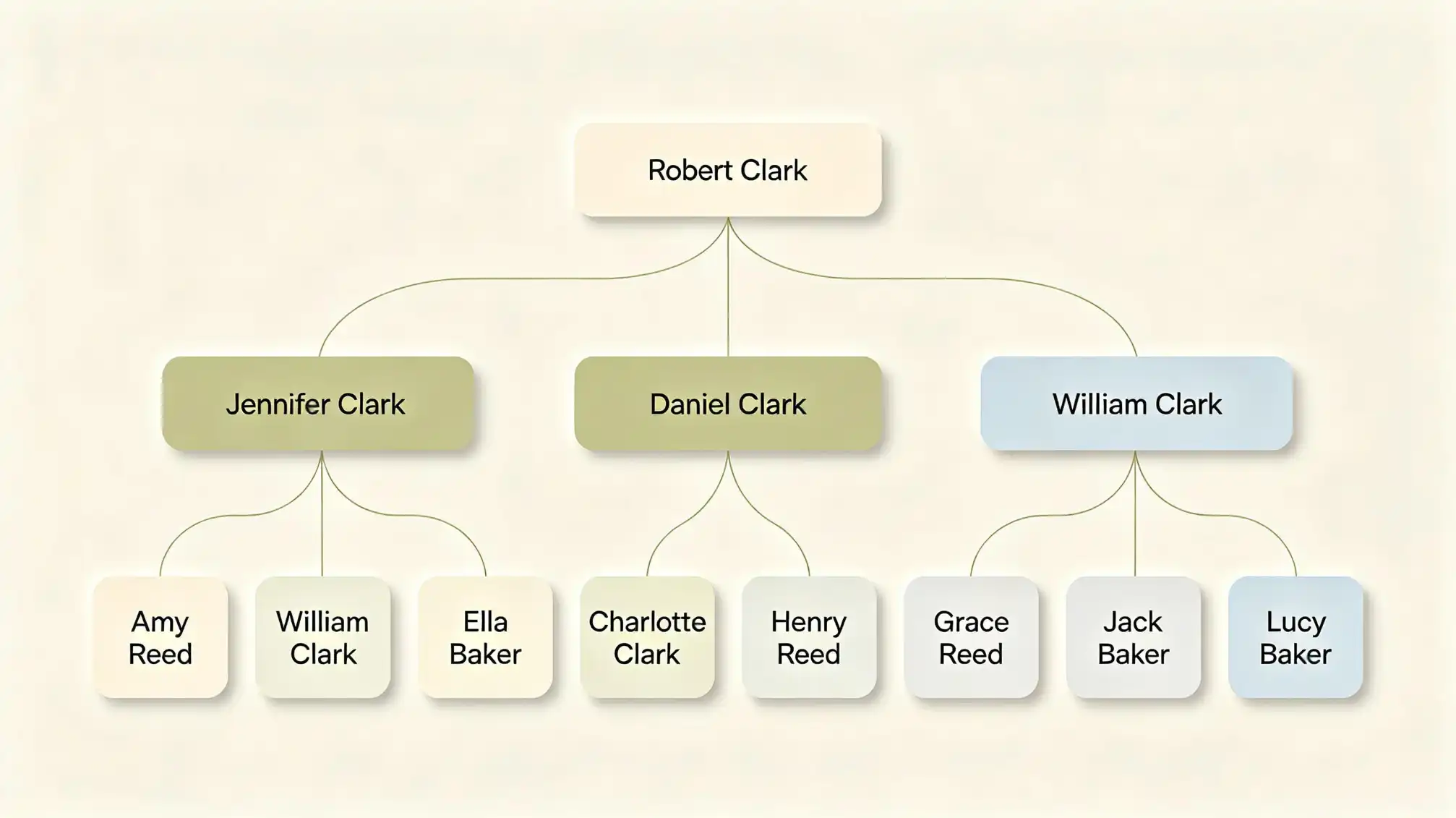
Charts vary in style, but most follow the same conventions. Generations are arranged in rows or radiating bands, with the earliest ancestor at the top or in the centre and the most recent at the bottom or the outer edge. Horizontal lines usually mean marriage or partnership; vertical lines mean descent. Women are often listed with a maiden name in brackets, and dates appear as birth–death, sometimes with a marriage year in between.
When you look at any diagram, ask three questions. Which direction does? Which line represents me? And where does the evidence for each entry come from? If the chart cannot answer the third question, treat it as a working sketch rather than a finished record.
Reading other people's trees is useful practice, but any diagram is only as strong as the research behind it. Building your own small tree teaches you the structure far faster than studying someone else's.
Starting Your Own Tree in an Afternoon
You do not need expensive software, a subscription, or a specialist archive to begin. You need a notebook, a pencil, and a few good conversations.
- Write down what you already know. Start with yourself, then work backwards through parents and grandparents. Include full names, approximate dates and places — even half-remembered details are worth capturing.
- Talk to the oldest relatives first. Ask open questions: where did the family live, what work did people do, who moved away and why. With their permission, record the conversation. Voices carry details that written records never will.
- Gather documents from home. Certificates, photographs with names written on the back, military papers, funeral cards, school reports and old address books are all primary material.
- Pick one system and stick to it. A paper notebook or a free online tree both work; the discipline matters more than the tool.
- Set a small, finishable goal. Identifying all eight of your great-grandparents is a realistic first milestone and gives your research a clear shape.
If you want a place to organise what you find and keep the family context alongside the dates, the family section at https://www.familylove.love/family is a natural starting point.
Where Beginners Usually Go Wrong
- Copying without checking. Online trees are research suggestions, not evidence. Always confirm a relationship with at least one original record.
- Chasing the famous ancestor. A link to a royal, a rebel or a celebrity is far rarer than an ordinary farming or labouring family. Expect the ordinary — it is usually more interesting anyway.
- Ignoring spelling variations. Before standardised spelling, clerks wrote names as they heard them. Search phonetic variants and abbreviations, not only the modern spelling.
- Trusting one record too much. Ages drift on census returns, and birth dates are often approximate. Compare several sources before settling on a fact.
- Leaving living memory for later. The relatives who remember the stories will not always be available. Ask now, record now.
What a Family Tree Gives You Beyond the Names
Once a tree has a few branches, patterns begin to appear. Families move along trade routes, follow industries, migrate between countries, or stay within a few miles for centuries. Occupations repeat across generations. Early deaths, large families and remarriages start to explain decisions that once looked arbitrary.
This is where family history quietly becomes something more than genealogy. You stop collecting names and start understanding people: what they faced, what they chose, and what they passed on. A family tree is never truly finished — but after a few months it stops being a chart and becomes a story you can hand to someone else.