Building Your First Family Tree: A Practical Roadmap From One Name to a Full Lineage
Most people begin with a single question: who were my grandparents, really? That question rarely stays small. Within a few weeks it turns into document folders, half-remembered stories, and a genuinely absorbing puzzle. The encouraging part is that you do not need expensive subscriptions or archive experience to get started. You need a method, and the patience to follow it in the right order.
This guide is written for the person opening a blank family tree for the very first time. Rather than chasing a famous or distant ancestor, you will build outward from yourself, one verified generation at a time, until the tree stands on its own.
Begin With Yourself, Not With a Distant Ancestor
The single most common beginner mistake is starting three centuries back. A passenger list from 1740 feels more exciting than your own birth record, so that is where new researchers dive in. The problem is that a tree built from the top down has no foundation. When you later discover that two people of the same name lived in the same county, you have no way to tell which one belongs to you.
Work in the opposite direction. Start with yourself, then your parents, then your grandparents. Each step stays anchored to a person you can confirm. You will move backwards through time, but you will always be building on solid ground.
Step One: Collect What Is Already in the House
Before you search a single database, search your own home. Most families are sitting on more evidence than they realise. Look for:
- Birth, marriage, and death certificates kept in drawers or safes
- Family photographs with names or dates written on the back
- Baptism cards, memorial programmes, and funeral notices
- Old address books, letters, and postmarked envelopes
- Military papers, passports, and immigration documents
- Family Bibles, recipe books, and handwritten notes in margins
Photograph or scan each item now, even if it seems minor. Names written on the back of a photograph are primary evidence in their own right, and paper degrades faster than you expect.
Step Two: Talk to Your Oldest Living Relatives
Your living relatives are a time-limited archive, and they are the resource beginners most often neglect. A ninety-year-old aunt may remember a great-grandparent's first name, the town the family left, or why a branch of the family stopped speaking to the others. That single conversation can save months of archive work.
Approach these conversations with structure rather than a formal interview. Ask open questions: where did the family live when you were a child, what did your father do for work, who came to the weddings, what was never discussed? Record the conversation if they agree, and write down your notes the same day, before memory blurs the details.
Be equally careful with what you do not ask. Some relatives carry painful family history, estrangements, adoptions, or losses. Let them set the pace, and treat what they share as a gift rather than an entitlement.
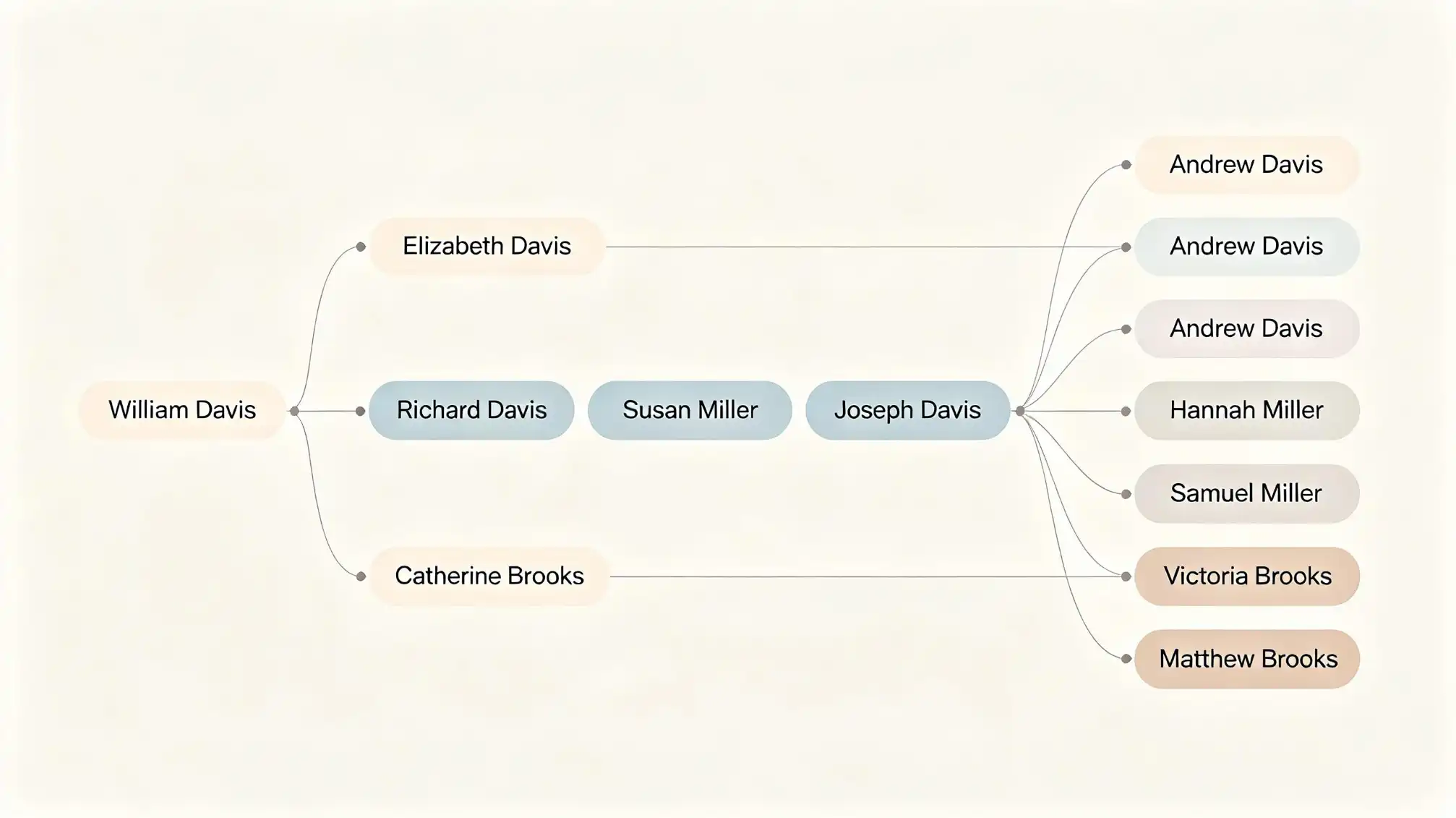
Step Three: Choose How You Will Record Everything
You need one home for your research, not five. Beginners typically scatter information across notebooks, phone notes, and a folder of screenshots, then lose track of which version is current.
Any of these systems works, provided you commit to it:
- Paper charts for people who think best with a pen in hand
- A spreadsheet with one row per person and columns for dates, places, and sources
- Genealogy software or an online tree for automatic relationship mapping and easy sharing
Whichever you choose, record four things for every person: full name, key dates, locations, and the source of each fact. That last column is what separates a reliable family tree from an entertaining work of fiction.
Step Four: Apply the Three-Generation Rule
Before you research a fourth generation, make sure the first three are fully documented. This rule feels slow, and it is the reason experienced researchers rarely have to unpick their early work.
For each person in those first three generations, aim to have at least two independent sources for a birth or death date and one for a marriage. When two records agree, you have a solid entry. When they disagree, you have a research task, not a crisis. Conflicting information usually points to a second person with the same name, a transcription error, or a date that was misremembered decades later.
Step Five: Build the Habit of Citing Sources
A source note does not need to be academic. It needs to answer one question: if I forgot everything tomorrow, how would I find this record again? Write the collection name, the record type, the date, and the reference or page number. For family stories, write who told you, when, and how they knew.
This habit pays off in two ways. It lets you verify your own conclusions later, and it lets relatives trust what you have assembled, because every claim can be traced back to something real.
Common Beginner Pitfalls to Avoid
- Copying whole trees from strangers. Someone else's research is a lead, never a source.
- Assuming name spellings were fixed. Immigrant names were often written phonetically by clerks.
- Trusting dates on the internet over dates on documents. Indexes contain errors; originals rarely lie outright.
- Ignoring the women. Search maiden names, and search them again under every spelling variant.
- Hoarding instead of sharing. Relatives who see your tree often donate documents you never knew existed.
Where Family History Gets Personal
At some point the research stops being a puzzle and becomes something closer to a conversation with the past. You may find a grandfather who emigrated alone at sixteen, a grandmother who raised six children through a war, or a branch that simply disappears from the records. These discoveries shape how you understand your own family, and they are worth recording with the same care you give to dates.
If you want a place to organise relatives, relationships, and the stories attached to them as your tree grows, you can build and explore your family space here. It works best once you have your first three generations written down, because you will be entering information you have already checked rather than guesses.
Keeping Momentum After the First Month
Enthusiasm fades when the easy answers run out. Protect your progress by setting a small, repeatable target: one record verified per week, or one relative contacted per month. Keep a running list of open questions, and revisit it whenever you have twenty free minutes. Over a year, that steady pace will produce a family tree most people never manage to start.