Family Tree Basics: A Beginner's Guide to Tracing Your Ancestors
Most people first meet the idea of a family tree in a school project or a television documentary: a tidy chart of names stretching back through the generations, each branch labelled with a birth year and a birthplace. The reality of building one is slower, messier and far more rewarding. This guide is written for beginners who want to understand what a family tree actually is, why it deserves more than a passing glance, and how to begin one without drowning in databases, archives and distant cousins.
What a Family Tree Really Represents
At its simplest, a family tree is a structured record of your ancestors and the relationships that connect them. But it is more than a diagram. Each name is a doorway into a life: a trade, a migration, a religion, a war, a courtship, a decision to leave one country and settle in another. Genealogy is the research method you use to find those people; the tree is how you hold what you find.
In practice, three shapes dominate the hobby, and knowing them early saves a lot of confusion:
- Pedigree chart — follows your direct line only: parents, grandparents, great-grandparents and so on. It answers the question, where do I come from?
- Descendant chart — starts with one ancestor and lists everyone descended from them, including aunts, uncles and cousins. It answers the question, who came from them?
- Fan chart — a circular version of the pedigree, useful when you want several generations visible at once.
Whichever shape you choose, the structure is only the frame. The substance is the evidence behind every entry.
Why Family History Matters, Especially at the Start
Beginners often assume the goal is simply to go as far back as possible. In truth, the value of a family tree appears much closer to home:
- Identity and context. Knowing where your ancestors lived, worked and worshipped explains habits, sayings and family customs that otherwise seem random.
- Health awareness. Patterns of illness across generations can be worth discussing with a doctor, even when the information is incomplete.
- Connection. Research gives you a legitimate reason to contact older relatives and ask questions you otherwise ask.
- Preservation. Photographs, letters and stories are lost when nobody writes them down. A tree is a place to keep them.
The Three Building Blocks: Names, Dates and Places
Almost every record you will ever consult is indexed by the same three details, so treat them as the foundation of your tree:
- Names. Record the full name as written, then note variations and nicknames. Many ancestors appear under abbreviated or anglicised forms.
- Dates. Birth, marriage and death dates anchor a person in time. Approximate dates are fine as long as you mark them as estimates.
- Places. A village or parish name often matters more than a surname. It is the detail that lets you find the right John Smith among hundreds.
Write down what you know, mark what you assume, and keep the two visibly separate. This single habit will prevent years of tangled research later.
Begin With the Living, Not the Dead
The most common beginner mistake is to jump straight into online archives. Start instead with the people who can still answer questions. Parents, grandparents, aunts, uncles and family friends hold memories, photographs and documents that no database contains.
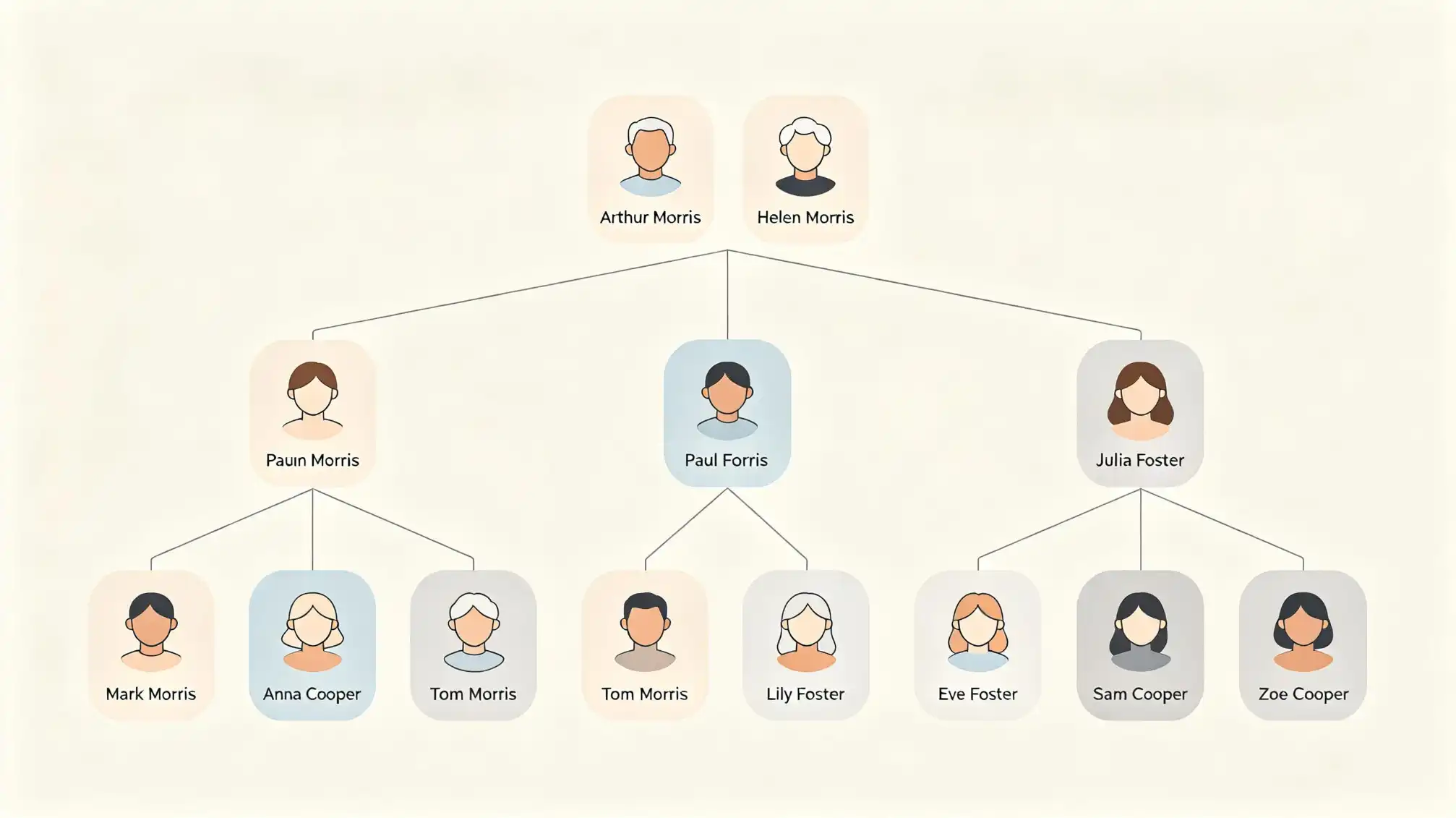
Ask open questions rather than yes-or-no ones: what was your childhood home like, who visited at Christmas, what did your mother do for work, where did the family move and why. Record the conversation if you can, and write up your notes the same day while details are fresh.
Once you have gathered what your relatives know, it helps to keep the people you have confirmed in one organised place before moving on to archives. The family space at https://www.familylove.love/family is a practical starting point for recording living relatives, relationships and the stories attached to them.
Common Beginner Mistakes to Avoid
- Accepting online trees as proof. Other people's research is a hint, not a source. Always trace a fact back to a record.
- Trusting a single record. Names were misspelled, ages were fudged and dates were invented. Look for two independent sources.
- Merging people who share a name. Two men with the same name in the same parish are not automatically the same man.
- Hoarding without organising. A folder of unlabelled scans is nearly useless. Label every file with a name, date and place.
- Chasing the famous ancestor. A connection to nobility is far rarer than a connection to farmers, labourers and servants, and that is exactly what makes the ordinary lives interesting.
Where to Look Once Family Memory Runs Out
When the interviews are done, the records take over. A sensible order of search moves from the recent and well documented to the older and patchier.
Civil registration and census records
Government birth, marriage and death records are usually the most reliable starting point, while census returns place an entire household at one address on one night, often revealing occupations, ages and birthplaces.
Church, military and immigration records
Baptisms, marriages and burials often predate civil registration. Military service files and passenger lists then explain how a family moved between countries and generations.
Online databases, archives and DNA
Large genealogy platforms are convenient indexes, but the original record is what counts. DNA testing can confirm relationships and point toward regions, though it never replaces documentary research.
Keeping Your Research Organised and Honest
Every fact in your tree should answer three questions: where did it come from, how reliable is it, and when did you add it? Note the source for each entry, flag uncertain conclusions, and resist the urge to fill gaps with guesses. A tree with fewer names and solid evidence is worth far more than a sprawling one built on assumptions.
It also helps to work in focused sessions. Choose one person, one question and one record type, then stop when you have an answer. Genealogy rewards patience more than enthusiasm.
A Tree Is a Story in Progress
Your family tree will never be finished, and that is part of its appeal. Each generation you uncover changes how you read the next one, and each document you find may quietly rewrite a family story you thought you knew. Begin small, document honestly, and let the branches grow at their own pace.