Family Tree Basics: How to Read, Build, and Grow Your Own
Almost everyone has seen a family tree — a framed diagram in a hallway, a template in a notebook, an online chart with empty boxes waiting to be filled. Far fewer people know what those boxes are actually for. For beginners, the term itself can feel slippery: is a family tree a picture, a database, or a research project? In practice it is all three, and understanding the difference is what turns a decorative chart into a genuine record of your family history.
This guide walks through what a family tree really records, how to read one, how genealogy differs from family history, and how to begin your own research without drowning in tabs, hints, and half-finished branches.
What a Family Tree Really Records
At its core, a family tree is a structured map of relationships across generations. It answers one question in detail: who is connected to whom, and how. Every entry represents a person; every line represents a relationship, most often a parent–child link, and sometimes a marriage or partnership.
Two categories of people appear on almost every tree:
- Direct-line ancestors. Parents, grandparents, great-grandparents and so on — the people you descend from in an unbroken line.
- Collateral relatives. Siblings, aunts, uncles, cousins and their families. They are not your direct ancestors, but they very often hold the photographs, documents, and stories that explain your ancestors' lives.
Just as important is what a tree does not record. A chart can tell you that your great-grandmother was born in 1912 in a particular town; it will not tell you why she left, what she did for a living, or how the family weathered the years that followed. Those things belong to family history, and they require sources — certificates, letters, oral accounts — not just tidy boxes.
The Building Blocks: Four Details That Make a Record Useful
Before you worry about formatting, software, or how far back you can reach, understand that a family tree is only as reliable as the details it holds. Four pieces of information do most of the work:
- Full names, including maiden names. A woman recorded only under her married surname can become almost impossible to trace through older records.
- Dates — with ranges where necessary. "About 1885" is more honest and often more useful than a guessed exact year.
- Places. Village, town, county, and country matter because historical records are usually kept locally. A birthplace is often the single most valuable clueyou have.
- Sources. A short note about where each detail came from — a census entry, a birth certificate, a relative's memory — is what separates genealogy from guesswork.
How to Read a Family Tree Diagram
Diagrams come in several shapes, but they share a common grammar. Once you recognize it, any chart becomes readable in seconds.
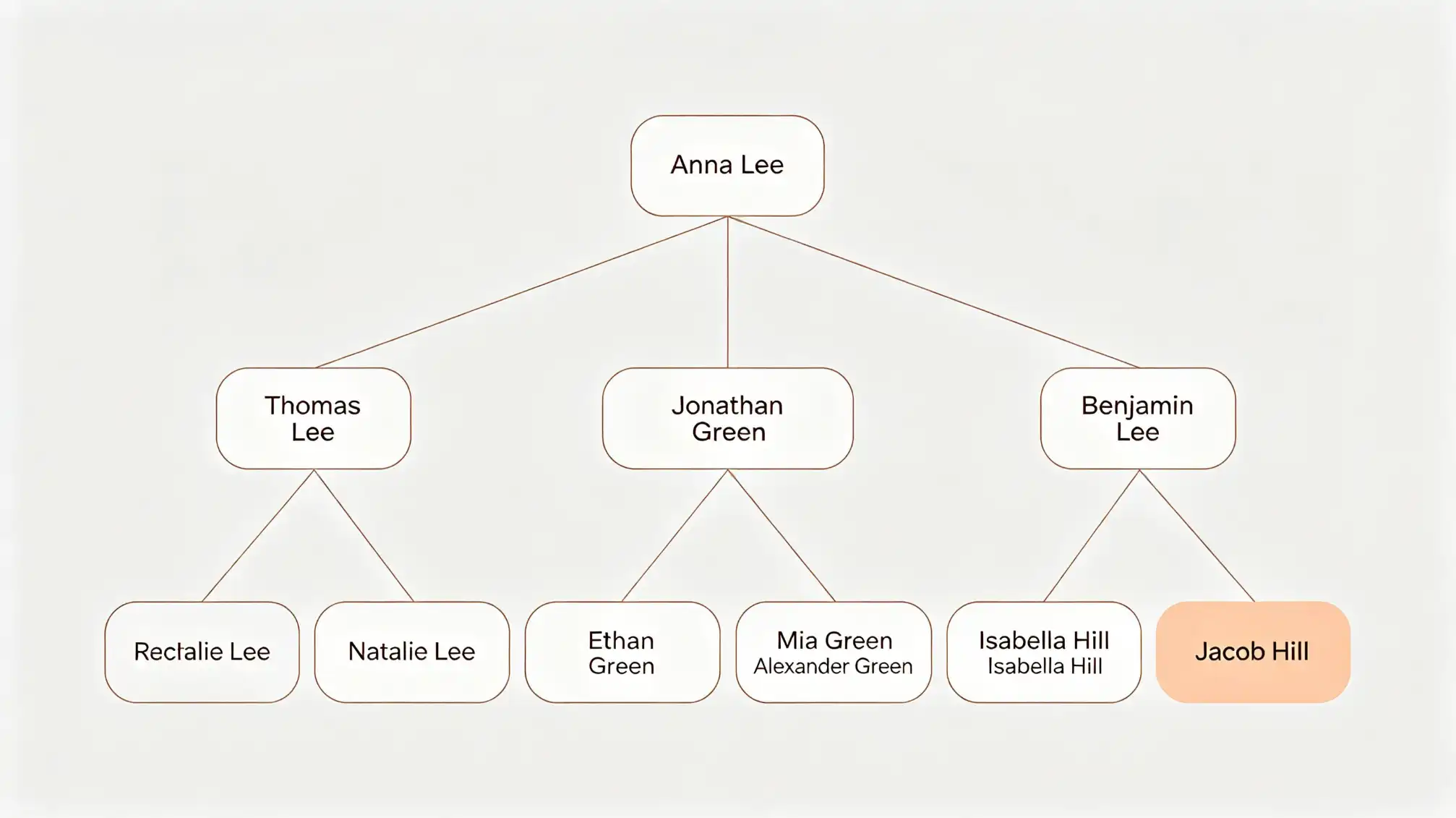
The two most common layouts are the pedigree chart and the descendant chart. A pedigree chart starts with one person — usually you — and fans outward through parents, grandparents, and earlier ancestors. A descendant chart works in the opposite direction, beginning with a couple or an ancestor and spreading downward through their children, grandchildren, and beyond.
Direction is a convention, not a rule. In most diagrams, vertical lines indicate descent, horizontal lines indicate a couple, and each row or column represents a single generation. Numbering systems (such as the Ahnentafel system) may appear beside names to keep large trees manageable. If a chart you inherit looks unfamiliar, trace one line from a name you recognize until you reach a name you do not — the pattern will quickly become clear.
Genealogy and Family History Are Not Quite the Same Thing
The two terms are often used interchangeably, but they describe different activities. Genealogy is the research discipline: identifying people, verifying dates and places, and documenting relationships with evidence. Family history is the narrative built on top of that research: occupations, migrations, military service, religious life, family traditions.
A useful way to think about it is that genealogy supplies the skeleton and family history supplies the flesh. Skipping the first step produces trees full of unsupported names. Skipping the second produces a chart that is accurate and completely lifeless.
Genealogy Vocabulary for Beginners
A handful of terms appear constantly in family history work. Knowing them early saves a great deal of confusion.
- Ancestor: a person from whom you are directly descended.
- Descendant: a person directly descended from a given ancestor.
- Maiden name: a woman's surname before marriage; essential for tracing maternal lines.
- Collateral line: relatives outside your direct ancestry — siblings, aunts, uncles, cousins.
- Primary source: a record created at or near the time of an event, such as a birth certificate. Secondary source: information recorded later, such as a published family history.
Mistakes That Slow Beginners Down
Most early frustration in family history comes from a small number of avoidable habits.
- Copying other people's trees without checking sources. Errors multiply quickly once they are repeated across databases.
- Skipping the living. Older relatives are the most time-sensitive source you will ever have.
- Ignoring spelling variants. Names were often written phonetically; searching only one spelling hides records.
- Leaping centuries back too quickly. A solid four-generation tree is worth far more than a shaky twelve-generation one.
How to Start Building Your Own Family Tree
Begin with yourself and work backwards one generation at a time. Write down what you already know, then talk to older relatives and record their answers — names, approximate dates, places, and the stories attached to them. Only after that should you move to written records such as civil registration, census returns, and church registers, working from the most recent evidence toward the oldest.
It also helps to organize the people around you before you go hunting in archives. Capturing living relatives and their relationships is a practical first step, and the family profiles section at www.familylove.love/family is a straightforward place to do exactly that — start with the names you can confirm today, and your tree will grow more accurately from there.