{
"title": "How an Online Family Tree Makes Family History Easier to Compare, Verify, and Share",
"metaTitle": "Online Family Tree: How to Compare, Verify & Share Family History",
"metaDescription": "Comparing digital family tree tools? Learn how an online family tree improves source verification, collaboration, privacy, and portability of your family history research.",
"summary": "A practical guide for people comparing digital genealogy tools, explaining how an online family tree changes the way you verify sources, collaborate with relatives, protect living family members, and keep your family history portable across platforms.",
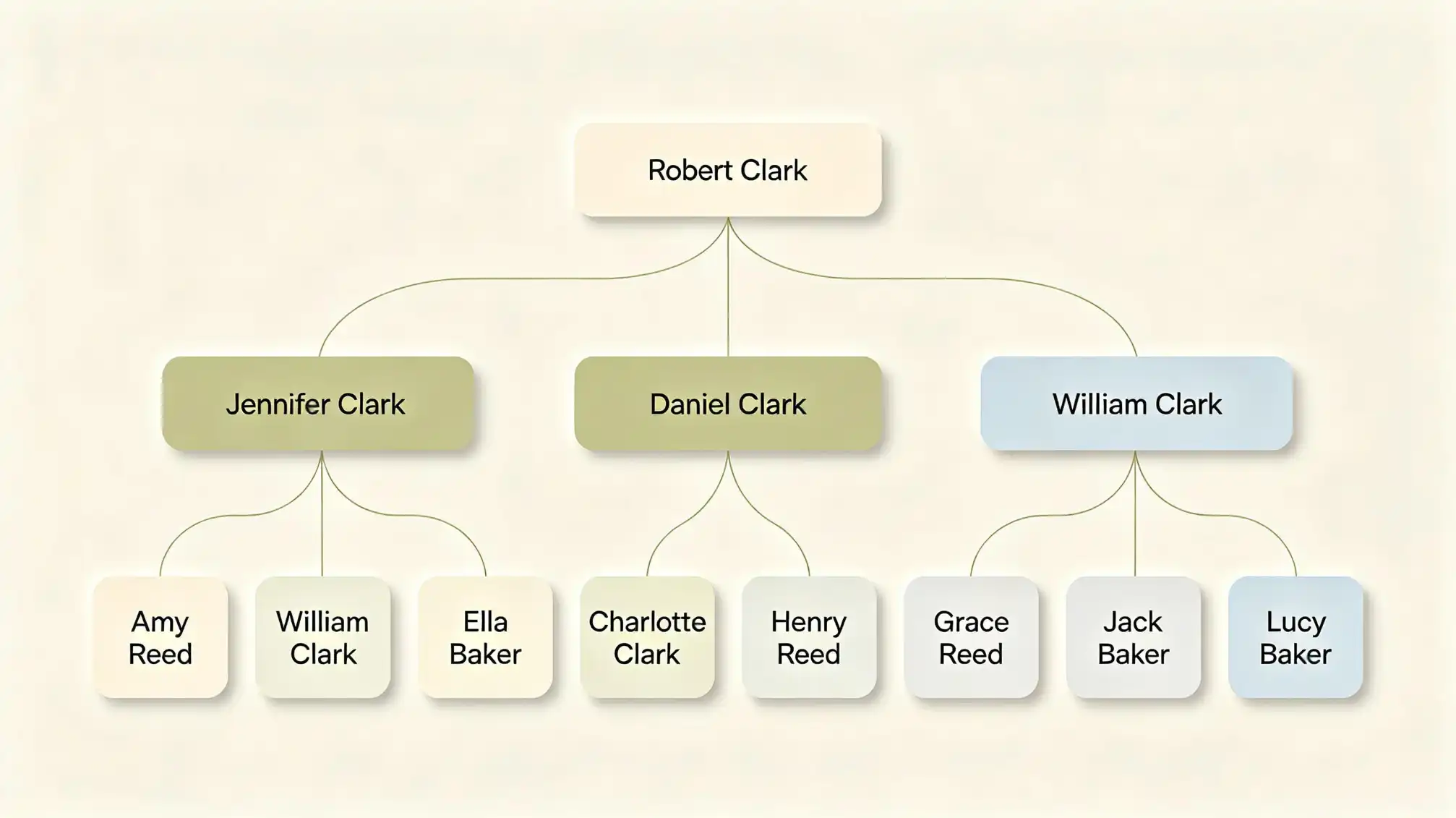
"contentHtml": "<h1>How an Online Family Tree Makes Family History Easier to Compare, Verify, and Share</h1>\n\n<p> people who start researching their family history do not begin by choosing software. They begin with a question: who was my grandmother's father, where did the family move from, and why. The tool only becomes important once the research grows past a few dozen names — and that is usually the moment when a paper chart, a spreadsheet, or a folder of scanned documents stops working.</p>\n<p>That is also the moment when comparing digital tools becomes genuinely difficult. Every platform promises a large database, smart matching, and beautiful charts. The differences that matter in daily use are quieter: how evidence is recorded, how easily relatives can contribute without breaking your work, how safely you can move your data if you change your mind later. This article focuses on those practical differences so you can judge an online family tree on what it will actually do for your research.</p>\n\n<h2>Why the Move Online Changes the Research Experience</h2>\n\n<p>A family tree kept on paper records conclusions. A family tree kept online records conclusions, evidence, and the path you took to reach them. That distinction sounds academic, but it shapes everything. When a record is attached to a with a date, a repository, and a note about what it does or does not prove, you can revisit the reasoning months later — or hand it to a cousin — without redoing the work from scratch.</p>\n\n<p>The second shift is speed of correction. Genealogy is full of early mistakes: a wrong maiden name, two men with the same name in the same parish, a entry attached to the wrong household. In a digital environment these errors are fixable in one place and reflected everywhere. On paper, the same correction means erasing, rewriting, or leaving a permanent note that contradicts the chart.</p>\n\n<figuren <img src=\"https://r2.familylove.love/static/seo/modernFamilyTreeDiagram2.webp\" alt=\"Diagram of a modern online family tree showing connected generations and linked records\" />\n figcaption>A well-structured online family tree keeps generations, sources, and notes connected in one place, which makes corrections and verification far easier than on a static chart.</figcaption>\n</figure>\n\n<h2>Comparing Digital Family Tree Tools: The Criteria That Actually Matter</h2>\n\n<p>When you put two or three platforms side by side, resist the pull of database size as the primary measure. Millions records are useful only if the tool lets you evaluate what it finds. Instead, score each option against the following four criteria.</p>\n\n<h3>1. Evidence handling and source citation</h3>\n\n<p>Look for a structure that separates a fact from the source supporting it. You want to attach a citation to a specific event — a birth, a marriage, a burial — rather than to a person in general. You also want a place for your own analysis, such as a note explaining why you accepted one record and rejected another. If a tool only offers a free-text biography field, you will eventually lose track of which conclusions are proven and which are still working theories.</p>\n\n<h3>2. Collaboration without chaos</h3>\n\n<pFamily research is rarely a solo activity, and shared trees are where tools differ most sharply. Some platforms let anyone edit anyone's profile, which is efficient but can undo careful work. Others require invitations, permissions, or a review step before changes go live. Neither approach wrong, but you should know which one you are choosing before a well-meaning relative merges your great-grandfather with a stranger.</p>\n\n<h3>3. Export and portability</h3>\n\n<p>This is the most factor in any comparison. Ask directly: can I download my complete tree, including sources and media, in a standard genealogy format? A tool that locks your research inside its own walls is a risk, not a home. Even if you never leave, the ability to export means you can keep a private backup and open your data in desktop software when the internet is unavailable.</p>\n\n<h3>4. Privacy controls for living people</3>\n\n<p>Birth dates, addresses, and photographs of living relatives deserve more protection than nineteenth-century parish records. Check whether the platform hides living individuals by default, whether you can mark specific people as private and who can see your tree at all. If the settings are hard to find, that is a signal about how seriously the platform the issue.</pn\n<h2>Where an Online Family Tree Saves the Most Time</h2>\n\n>Once your tree passes a few hundred people, the practical benefits become concrete rather than theoretical:</p>\n\n<ul>\n <li><strong>Duplicate detection:</strong> matching tools flag people who may already exist in your tree, so you decide instead of accidentally creating a second John Williams born in the same year.</li>\n <li><strong>Consistent place names:</strong> structured location fields reduce the confusion caused by parishes, districts, and borders that changed over time.</li>\n <li><strong>Instant sharing:</strong> sending a link to a cousin is faster and more accurate than emailing a scanned chart that becomes outdated the next day.</li>\n <li><strong>Backup by default:</strong> your work is stored away from single hard drive, which matters more than most researchers admit until a laptop fails.</li>\n <li><strong>Visual review:</strong> charts and timeline views make gaps obvious, so you can see at a glance which branches still need evidence.</li>\</ul>\n\n<pIf you are starting from nothing, it helps to build the first few branches deliberately rather than importing a large file and sorting it out later. Setting up your own profile and immediate family first, then expanding outward one generation at a time, keeps the structure clean. You can begin that process on <a href=\"https://www.familylove.love/family\the family page</a> and treat it as your working base before you invite anyone else in.</p>\n\n<h2>Mistakes People Make When They Compare Tools</h2>\n\n<p>The most common error is judging a platform by its database size. A huge index of records is not the same as a usable research environment; what matters is whether you can record what you found and why it counts. The second error is importing an existing tree and accepting every match without review, which quietly spreads other people's unverified conclusions into your own work. The third is ignoring export until it is too late — by then, merging years of notes into a new format becomes a project of its own.</p>\n\n<p>A fourth, subtler mistake is choosing a tool that does not match how your family actually behaves. A private researcher who wants complete control will be frustrated by an open, wiki-style platform, while a large extended family will be frustrated by software designed for one user. Decide which of those two you are before you sign up.</p>\n\n<h2>A Quick Evaluation Checklist</h2>\n\n<ul>\n <li>Can I attach a source to a specific event, with a note explaining my reasoning?</li>\n <li>Can I control who edits and who only views?</li>\n <li>Can I export the full tree, citations and images?</li>\n li>Are living relatives hidden or restricted by default?</li>\n <li>Does the interface stay readable as the tree grows past a thousand people?</li>\n <li>Is there a clear path to ask for help when something breaks?</li>\n</ul>\n\n<p>Answer those six questions honestly and the comparison becomes much simpler. A tool that scores well on of them will support your genealogy for years; one that scores well on only the first will probably be replaced within twelve months.</>\n\n<h1>Practical Steps</h1>\n\n<ul>\n <li>Create your starting tree and add your immediate family first, then expand one generation at a time — begin at <a href=\"https://wwwamilylove.loveamily\">https://www.familylove.love/family</a>.</li>\n <li>For help with record structure, sources, and getting the most out of your research, see the guidance at <a href=\"https://www.flove.love/docs\">https://www.familylove.love/docs</a>.</li>\n</ul>",
"images": [
"https://r2.familylove.love/static/seo/modernFamilyTreeDiagram2.webp"
]
}