How to Build a Family Tree That Connects Parents, Grandparents, and Every Ancestor in Between
Starting a family tree can feel like standing at the bottom of a very tall staircase. The good news is that you do not have to climb it all at once. The most reliable approach is to begin with the people closest to you — your parents and grandparents — and let each conversation open the door to the next generation. This guide walks you through a practical sequence for how to build a family tree that stays accurate, readable, and easy to maintain, whether you are working on paper, in a spreadsheet, or inside a dedicated genealogy app.
Start With the Living, Not the Distant Past
New researchers often jump straight to a famous ancestor or a mysterious great-great-grandparent. That is usually a mistake. Living relatives are your best sources: they can confirm names, correct spellings, explain nicknames, and tell you which stories are family legend versus documented fact.
Begin with your parents, then move to grandparents on both sides. Capture full names (including maiden names), birth dates and places, marriage dates, and the towns where they lived. Even small details — a street name, a church, a trade — become search terms later when you look for ancestors in official records.
If a relative is elderly or unwell, prioritise that interview first. A single hour with a grandparent can be worth months of archive searching.
Choose the Shape of Your Family Tree First
Before you collect another name, decide how your chart will be laid out. A clear structure prevents the tangled lines and duplicated entries that frustrate beginners three months in.
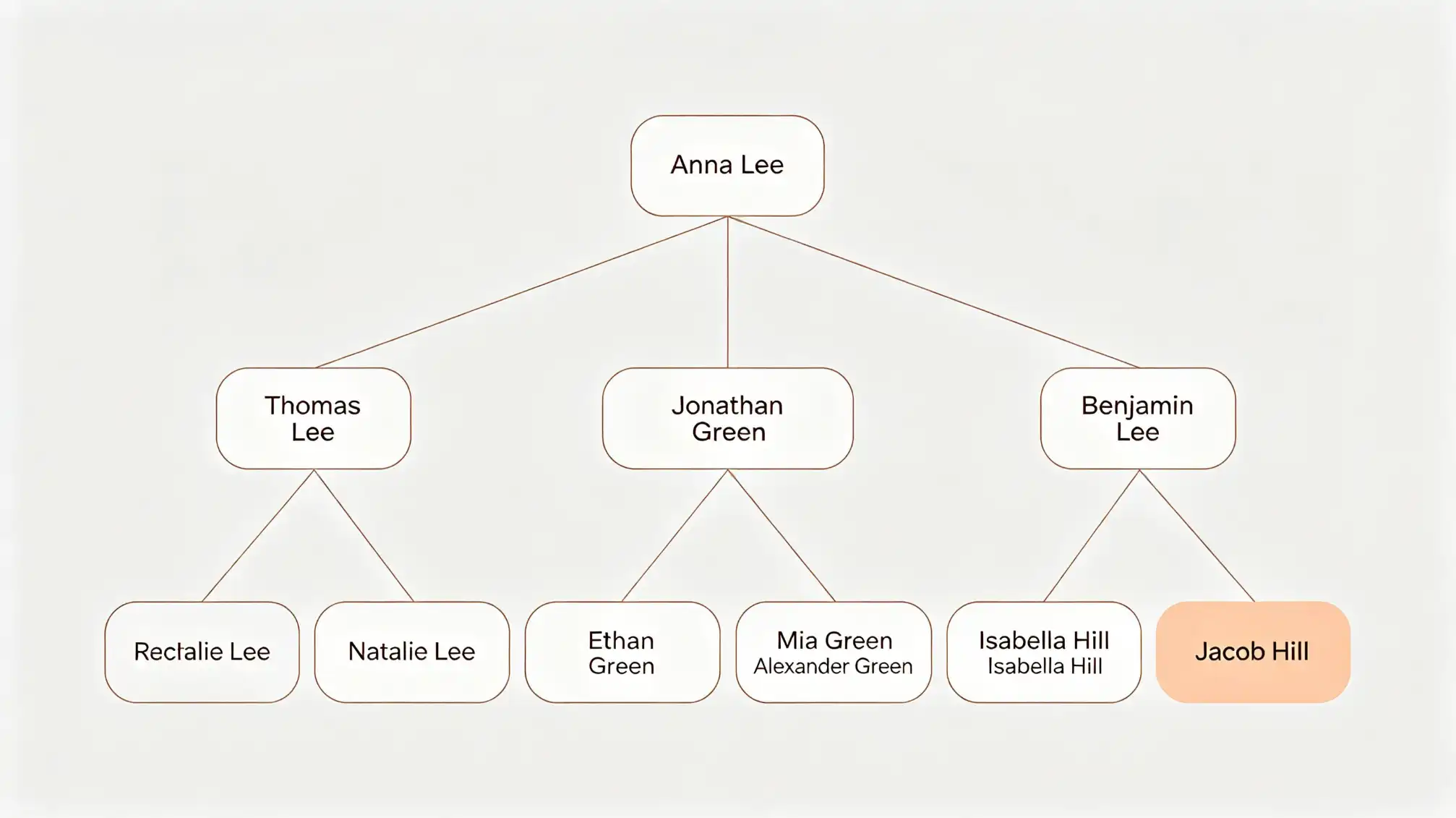
Most people choose one of three formats:
- Pedigree chart — follows direct ancestors only (you, parents, grandparents, great-grandparents). Best for lineage research.
- Descendant chart — starts with one ancestor and lists everyone who came after. Best for cousin connections.
- Family group sheet — one couple plus their children, with dates and places. Best as your working data record.
Pick one primary format and treat the others as supporting views. Consistency matters far more than which style you choose.
Collect Facts in a Consistent Format
Family trees fall apart when the same person appears as "Grandma Rose," "Rosie Miller," and "R. M. Kowalski." Standardising your entries early saves hours of cleanup later.
A simple rule set that works
- Write names as First Middle Last (Maiden).
- Use one date format throughout — day, month, year.
- Record place as town, county, state or province, country.
- Never overwrite a fact; add a note if relatives disagree.
Questions worth asking parents and grandparents
An open-ended "tell me about the family" often produces vague answers. Specific prompts work better:
- What were your parents' full names, and where were they born?
- How many brothers and sisters did you have, and what happened to each of them?
- Where did the family live before moving here?
- Who in the family kept photographs, letters, or a Bible with records?
- Which relatives have you lost touch with, and when did that happen?
Record the conversation if your relative agrees. Voice notes often contain details you would never think to write down.
Write down where each fact came from
For every date and place, note the source: "told by Aunt Marie, 2024," "marriage certificate," "census record." This habit turns a hobby into real research and makes it easy to verify or correct later.
Expand One Generation at a Time
The temptation to leap backwards is strong. Resist it. Finish a generation before starting the next, or you will end up with disconnected branches and uncertain links.
Step one: siblings, aunts, uncles, cousins
Add the brothers and sisters of your parents and grandparents. These relatives frequently hold the photographs and stories that direct ancestors never left behind, and they are often easier to contact than you expect.
Step two: documented ancestors
Once the modern generations are solid, move to records: birth, marriage, and death certificates; census returns; immigration lists; military files; cemetery indexes. Each document should connect a person to a parent — that connection is what makes a tree rather than a list of names.
Step three: fill the gaps
Work on the smallest missing detail each session. "I need my grandfather's birth year" is a task you can finish. "I need to research the whole family" is not.
Handle Complicated Family Structures Honestly
Real families include second marriages, step-parents, adoptions, single parents, and estranged branches. A good tree reflects that reality instead of hiding it.
- Label relationships clearly: biological, adoptive, step, foster.
- Use separate lines or a note for marriages that ended.
- Ask living relatives how they prefer a sensitive relationship to be described.
- Add a private note rather than deleting a person who is difficult to place.
Clarity here protects the tree's accuracy and keeps future generations from repeating the same confusion.
Choose a Tool You Will Actually Keep Updated
Paper charts are wonderful for a wall; they are poor for revisions. A spreadsheet handles data but shows no relationships. Genealogy software and online trees do both, and they let you attach images and documents to each person.
Whichever option you choose one master copy and back it up. If you are organising relationships for a wider circle — in-laws, cousins, blended households — it helps to keep an overview of who belongs where. Setting up a dedicated family page makes those connections easy to review and share with the people who helped you build them.
Plan Your First Three Sessions
Family tree building stalls when it becomes an endless project. Breaking it into short, defined sessions keeps momentum.
- Session one: call or visit your parents and record names, dates, and places for their generation and their parents.
- Session two: contact one grandparent or an aunt or uncle to fill gaps and identify old photographs.
- Session three: enter everything into your chosen tool, then list your three biggest gaps and order the records you need.
Repeat that cycle monthly. A tree grows steadily this way, and each session ends with a visible result rather than a growing pile of notes.
Mistakes That Slow Beginners Down
- Copying whole branches from other people's trees. Treat them as leads, never as proof.
- Skipping sources. A date without a source is only a guess.
- Chasing the famous name. Your own grandparents usually hold better stories.
- Waiting for perfect information. Record what you have and improve it over time.