Building Your First Family Tree: A Practical Guide for Beginners
Every family tree begins the same way — not with an archive, a subscription, or a DNA kit, but with a single name you already know. The real challenge for most beginners is not a shortage of information; it is deciding what to do first. This guide walks through a clear, repeatable process for turning scattered memories, half-remembered stories, and a drawer full of photographs into a structured family history you can keep building for years.
Start With Yourself, Then Work Backward
The most common beginner mistake is jumping straight to a famous ancestor or a distant country. Instead, begin with the person you know best: you. Record your own full name, birth date, and birthplace. Then add your parents, then your grandparents. This pedigree approach — moving back one generation at a time — keeps your work anchored to facts you can actually verify.
A useful rule to adopt from day one: only add a person to your tree when you can name at least one source. That source might be a birth certificate, a marriage record, a census entry, or simply a living relative who was present at the event. If you cannot point to a source, mark the detail as unconfirmed rather than treating it as settled.
Write down what you already know before you research anything
Spend one evening creating a simple list. For each direct ancestor, note the full name (including maiden names), approximate birth year, birthplace, spouse, and children. Most people can fill in three generations without leaving the chair. That list becomes your starting map — and it tells you exactly where the gaps are.
Choose a Format That Fits How You Think
You do not need software to begin. A large sheet of paper, a spreadsheet, or an online platform all work. What matters is that the format separates three things: people, relationships, and sources. Trees that blur these together become difficult to correct later.
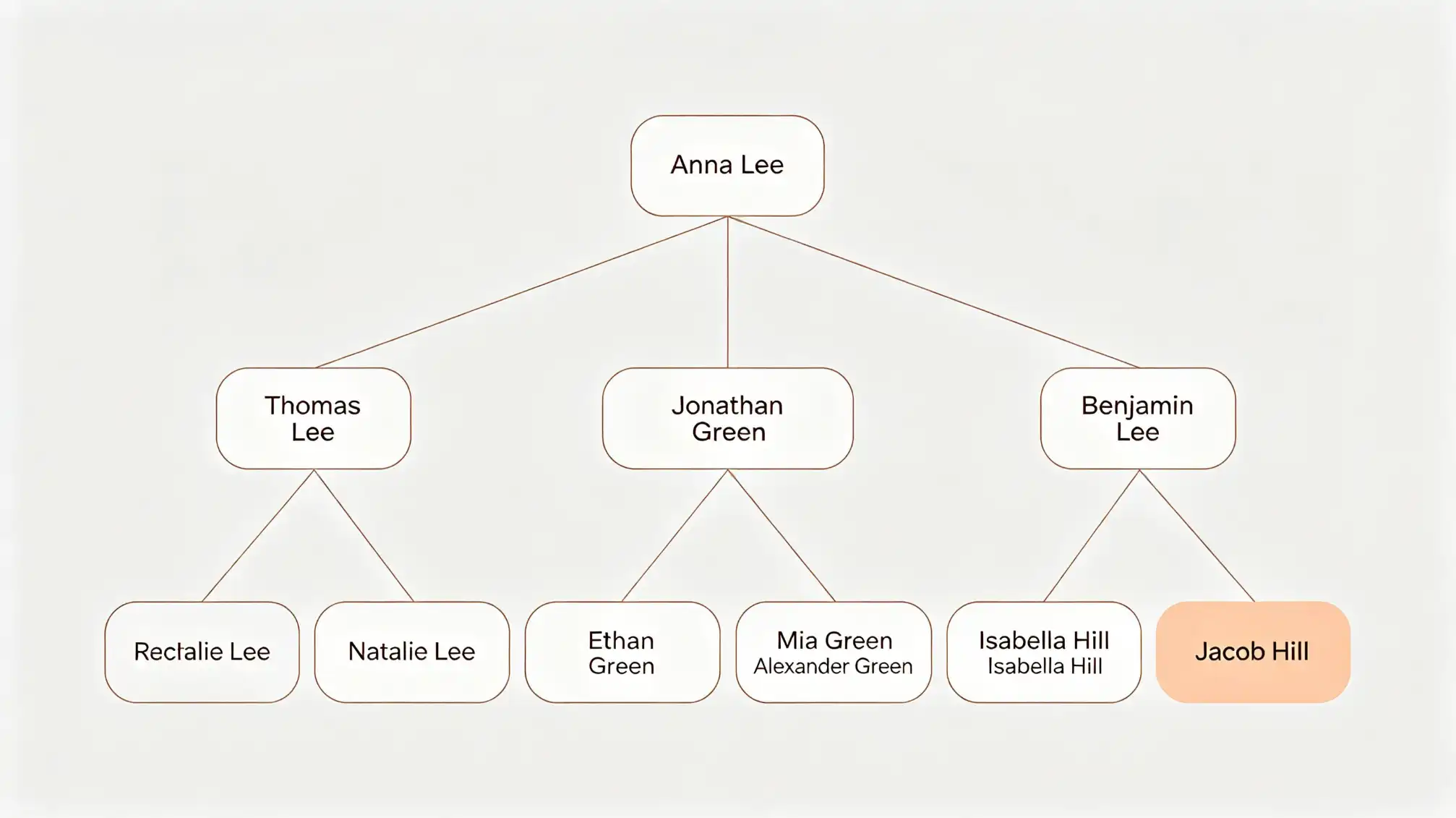
If you prefer a visual overview, a pedigree chart showing direct ancestors is easiest to read at the start. If you are more interested in siblings, cousins, and the wider network, a descendant chart or family group sheet will serve you better. Many beginners keep both: a chart for orientation and a written record for detail.
Talk to Living Relatives Before You Search Online
Online databases are excellent at confirming facts and terrible at explaining them. Living relatives are the opposite. An hour with an older family member often produces more leads than a month of searching indexes, because they can tell you which county, which church, and which spelling variant to look for.
Prepare a short list of open questions before the conversation, and record it if you have permission. Ask about full names, nicknames, migration, occupations, and family stories that seem too odd to be true — often contain a real detail worth chasing.
As your network of names grows, it helps to see how other families organise and share their histories. You can browse real examples and start connecting your own branches on the family pages at FamilyLove, which are a practical reference for structuring a growing tree.
Apply the Two-Record Rule Before You Attach Anyone
Names repeat. Dates get recorded incorrectly. A person with the same name born in the same decade in the same county is not necessarily your ancestor. A simple safeguard is the two-record rule: find at least two independent sources that agree on the key facts before you attach a person to your tree.
Independent means genuinely separate — two census returns are independent, but a family tree copied from another researcher is not a source at all. Indexes, transcriptions, and other people's trees are clues, not evidence. Always try to view the original record or a clear image of it.
Keep a Research Log and Cite Every Source
Six months from now, you will not remember which website gave you a birth year or why you ruled out a particular candidate. A research log solves this. For each search, note the date, the database you used, the search terms, and what you found or failed to find.
- What you looked for: the person and the specific fact.
- Where you looked: collection, archive, or website.
- What you found: a transcript, an image, or nothing.
- What it means: confirmed, contradicted, or still open.
Negative results matter as much as positive ones. Knowing that you already checked a parish register saves you from repeating the same search twice.
Common Beginner Mistakes to Avoid
Most early setbacks come from a small number of habits that are easy to correct:
- Copying whole branches from other people's trees without checking the underlying records.
- Accepting an index transcription as proof of a fact.
- Recording only direct ancestors and losing the collateral relatives who often hold the clues.
- Skipping source citations because the fact feels obvious.
- Chasing a distant ancestor before the nearest generations are fully documented.
Each of these is reversible. The earlier you fix them, the less rework you will face later.
Expect Slow Progress and Treat It as Normal
Family history is a long project, not a weekend task. Some lines will open up quickly; others will stall for months because a record was lost, never created, or is held in an archive that has not digitised it. Treat a stalled line as a prompt to switch branches rather than a dead end. There is always another relative to document, another record set to search, and another generation to push back.