How to Trace Ancestors Without Guesswork: An Evidence-Led Method
Most family history projects stall for the same reason: names get collected faster than proof. A tree with four hundred entries and no sources is not a family history — it is a set of assumptions. When you are working on older generations, the aim is not to fill blanks quickly but to build a chain of evidence strong enough that every person you add holds up under scrutiny.
What follows is a sequence. Working through it in order costs a little patience at the start and saves a great deal of rework later.
Begin with a written inventory of what you actually know
Before opening a single database, write down everything you can state about your oldest known relatives: full names as recorded, including middle names and maiden names; dates and places of birth, marriage and death; occupations, religious affiliation and migration routes. Then mark each item in one of three ways — documented, remembered, or assumed. The items you cannot mark at all are your research plan.
This inventory does two things. It stops you re-searching facts you already hold, and it reveals which generation is the weakest link: usually the one where a name was passed down orally with no paper behind it.
Anchor your starting point in documents, not memory
Family memory is excellent at identifying people and unreliable about dates. A recollection that "we came over in the twenties" may be accurate while the year supplied is off by five. Find the earliest document you can for the person you are most confident about — a birth certificate, a marriage record, a census entry — and build outward from there.
Treat every story as a lead, not a conclusion. "The family changed its name at Ellis Island" and "we are descended from a Cherokee princess" are both common and both usually wrong, but each points you toward records worth checking.
Keep facts and theories visibly separate
Your family tree should tell you how much you trust each entry. Without that signal, one plausible guess quietly becomes a foundation for ten more.
Three levels of confidence
- Confirmed — supported by at least one original record, ideally two independent ones.
- Probable — consistent with records but resting on inference, such as a name in the right place at the right time.
- Unverified — inherited from another researcher, an unsourced online tree, or family tradition alone.
Anyone browsing your tree, including you six months from now, should see the difference at a glance. An unsourced ancestor is a question, not a fact.
Let photographs and objects carry their own evidence
Older generations left more than paperwork. Photographs, letters, bibles, medals and inscribed jewellery often hold details no database contains — a regiment number on a uniform, a street sign behind a group, a photographer's mark on the back of a cabinet card that places a family in a specific town in a specific decade.
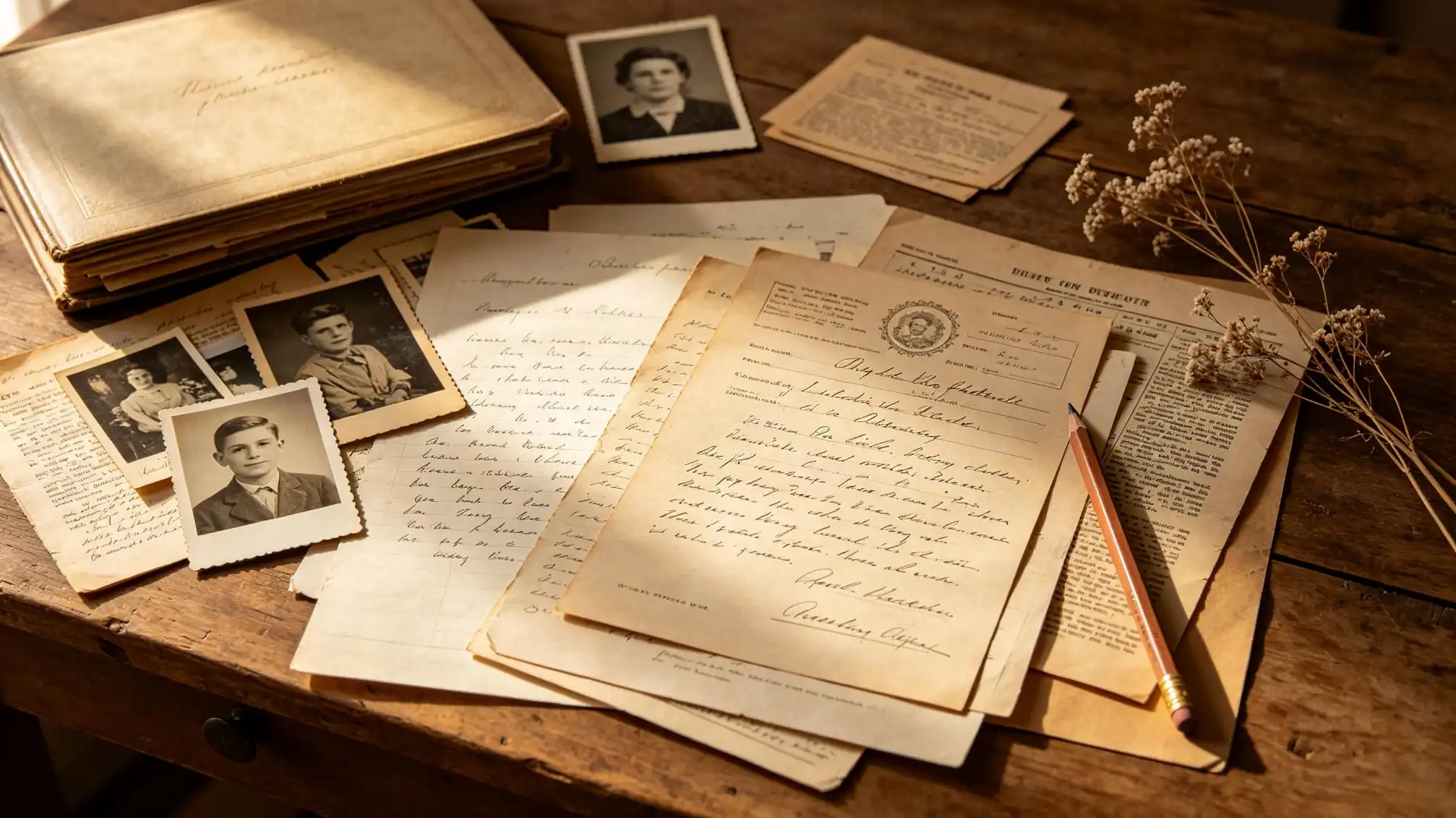
Scan everything at high resolution before it degrades further, and record identifications while memories are fresh: who is in the picture, who said so, and when they said it. If you want a place to keep those stories alongside the images, gathering them on a story page keeps the narrative attached to the evidence instead of scattered across notebooks.
Move backwards one generation at a time
The most common cause of a corrupted tree is skipping. Researchers jump straight to an ancestor in the 1600s because a name matches, and in doing so they bolt an unrelated branch onto their family.
Instead, resolve one generation completely before opening the previous one. For a great-grandparent, that means a birth or baptism record, a marriage record, a death record, and at least two appearances in records showing them in the same place over time. Only when those are in hand do you move to their parents — and the parents' names should emerge from the records you already hold, not from a search engine suggestion.
Match the record type to the era and the place
Records are not random. They exist because a government, church or employer needed them, so knowing when a record type began in your ancestor's jurisdiction tells you what is realistically available.
- Civil registration — birth, marriage and death certificates. Start dates vary widely by country and state, so check the local start date before assuming a certificate exists.
- Censuses — usually the richest sourcefor household structure, occupation and neighbourhood, but only from the year they began.
- Parish registers — baptisms, marriages and burials, often predating civil records by centuries.
- Military, immigration and land records — valuable for placing a person when they vanish from local records.
- Newspapers — birth, marriage and death notices, court reports, and the accidents no official record bothered with.
When you hit a wall, widen the search instead of deepening it
A brick wall usually means you are looking at the wrong person or the wrong place, not that the record is missing. Move sideways: research the siblings, the in-laws, the neighbours listed on the same census page, and the witnesses who signed a marriage register. Families migrated in groups and settled near people they already knew. That wider network — sometimes called the cluster approach — is often what reveals where a family came from when the direct line gives nothing.
Record your sources as you go
Cite every fact to the specific record it came from: repository, collection, reference number, page, and the date you accessed it. Record negative results too. Knowing that you searched a ten-year run of parish registers for a burial and found nothing prevents you repeating the work. A source citation written at the moment of discovery takes thirty seconds; reconstructing one three years later can take hours.
Use DNA to confirm, not to answer
DNA testing is most useful after you have built a documentary framework. A match only becomes meaningful when you can ask a specific question: does this person fit the branch I have already traced? Testing without a tree produces a list of names and no way to place them. Test the oldest living generation first — their matches are the most informative, and that opportunity is not permanent.